

Tackling Triple Nickel: General Industry Coverage
When it comes to milling aerospace parts made from Ti5553, difficulty is in the eye of the beholder.
When it comes to milling aerospace parts from Ti5553, difficulty is in the eye of the beholder.
CTEplus video illustrations
Click on the following links to view related video demos from:
Milling or otherwise machining the titanium alloy Ti5Al5V5Mo3Cr, or Ti5553, is something like having a bad first date, but a better second one. You get an unpleasant first impression of someone who later exhibits the opposite characteristics after you get to know them better. That’s a good thing, because the alloy has become an important workpiece material for critical aerospace structural components, such as landing gear.
As a result, new cutting tools and machining strategies are being developed for Ti5553. For example, John Palmer, U.K.-based global aerospace manager for ATI Stellram, LaVergne, Tenn., said the toolmaker developed its 5230VS chevron-style milling cutter when “looking at different ways to machine this challenging material.” However, by applying the correctly designed cutting tool with the proper milling strategy, toolpath and coolant supply in a rigid machine tool, “it becomes very easy to machine Ti5553,” he added. “You just have to think a bit more before you start to machine.”
Others interviewed for this article concurred. “Today, triple 5-3 has demonstrated to be very predictable with machining consistency similar Ti6Al4V,” said Michael Standridge, aerospace industry specialist for Sandvik Coromant Co., Fair Lawn, N.J. “The variances in the two materials create the need for different cutting data to be used to obtain similar tool life. Once you have your parameters set properly, triple 5-3 is relatively easy to machine.”
Courtesy of ATI Stellram
ATI Stellram offers a variety of milling cutters for machining titanium and other difficult-to-cut materials.
The main problem part manufacturers have when initially milling titanium is trying to transfer the knowledge gained from machining other metals, according to Gary Churchill, technical director for metal distributor Titanium Metal Supply Inc., Poway, Calif. “Then they sort of short circuit,” he said.
He recalled one shop that complained about hard and soft areas in large titanium forgings, which Churchill suspected was not the case. He asked if the customer had previously machined titanium. The response? “No, but we machine aluminum all the time.” After providing recommended speeds and feeds for titanium, the perceived problem of poor-quality material disappeared.
This article focuses on the properties of the workpiece material, design of the cutting tool system—including substrate, geometries and coatings—and appropriate coolant application to effect-ively mill Ti5553 to produce aerospace structural components. [Editor’s note: machine tool design for cutting titanium was covered in the September 2010 article “Ti Machines.”]
Made to be Difficult
Nicknamed “triple nickel,” Ti5553 is considered more difficult to machine than the more common Ti6Al4V because of its higher alloying elements of molybdenum, vanadium and chromium. “These higher content percentages make Ti5553 more challenging to machine, so your tool substrate, geometry and coating need to be right,” said Nick Trott, a technical sales manager for M.A. Ford Europe Ltd., Derby, U.K., a division of Davenport, Iowa-based M.A. Ford Manufacturing Co. Inc., which manufactures the tools. “Cutting parameters and milling strategy also play a big part in machining this alloy.”
Trott added that the alloying elements that make Ti5553 challenging to machine enhance the properties desired for high-load aerospace structural components, such as landing gear.
Palmer explained that heat treatments penetrate further into a Ti5553 part than one made of Ti64, increasing the linear load section strength in Ti5553 up to about 6 ” compared with about 2 ” for Ti64.
Aerospace part designers welcome the material’s ability to reduce part weight while not sacrificing strength, but chromium and molybdenum make the material “more aggressive [to machine],” Palmer said. “You must have a tool material capable of withstanding that type of cutting aggression.”
Balanced Cutting
Tools designed to cut other titanium alloys are also suitable for machining Ti5553, but not at the same speed. Some machinists reduce the cutting speed for Ti5553 to half of what is appropriate for Ti64, noted T.J. Long, engineering manager for indexable milling systems at Kennametal Inc., Latrobe, Pa.
Not all applications require cutting speeds that conservative, but triple nickel isn’t going to be cut faster. For example, when taking a 0.050 ” axial DOC with a high-feed mill, 140 to 160 sfm is appropriate for milling Ti64 but 100 to 120 sfm is the range for Ti5553, according to Terry Carrington, aerospace industry product manager for Iscar Metals Inc., Arlington, Texas.
Standridge concurred. “You must run slower to achieve a balance of tool life and tool security,” he said.
Balance is also the operative word when developing a substrate for tools designed to cut titanium. Such a substrate must have a balanced mixture of hard particles to resist heat and tough particles to absorb shock, Standridge emphasized.
That’s typically achieved, in part, by sintering submicron-grain carbide for hardness with 10 to 12 percent cobalt binder content for toughness, Trott noted.
For its chevron-style mill, Stellram selected its X500 carbide grade because it withstands crack propagation caused by heat or vibration through the workpiece and stays intact in the worst machining conditions, according to Palmer. He noted that the grade can rough Ti5553 at a “relatively high” surface speed of 80 to 150 sfm.
For finishing, Palmer added that ultrafine micrograin substrates offer the opportunity to produce sharp cutting edge profiles, precision ground or honed to provide a polished profile, rather than a standard ground surface found on tools for general milling. “If you have coarse-grain carbide and produce a sharp cutting edge, the edge is going to look sawtooth rather than razorlike,” he said.
Carbide isn’t the only tool material suitable for milling Ti5553. Cobalt and P/M HSS tools are often applied to cut titanium, particularly on older, less rigid machines. Still, Palmer feels the productivity gains carbide tools provide make HSS tools part of history. That’s because HSS traditionally run at 20 to 30 sfm and carbide tools can finish Ti5553 at up to 300 sfm, he noted.
Geometries at Work
Effectively milling titanium requires positive geometry to shear the material, reducing cutting forces, pressure and generated heat. “The positive cutting action is not just found in the edge line, but in the axial and radial rakes in the tool body tip seat,” Standridge said.
As previously noted, tools for milling titanium require sharp cutting edges. That’s because titanium exhibits a low modulus of elasticity, which leads to a “springiness” characteristic whereby titanium parts may move under the force of the cutting edge and then spring back, according to Iscar Metals.
Creating that sharp edge without negatively impacting the tool material and edge strength can be a challenge. Although an as-pressed insert has a stronger cutting edge than an insert with a ground edge, titanium typically needs to be cut with an edge that’s ground sharp, according to Carrington.
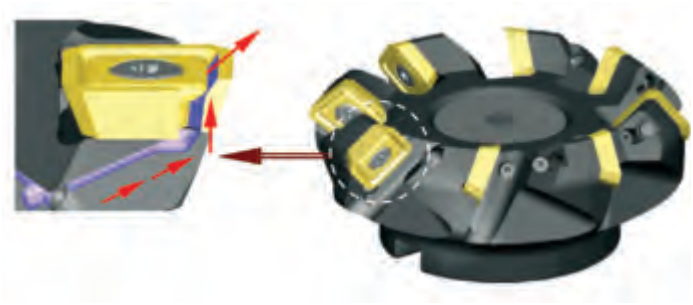
Courtesy of Kennametal
Kennametal Beyond Blast inserts channel coolant through the insert to the tool/workpiece interface to provide efficient coolant delivery, lubricity and heat transfer (see below).
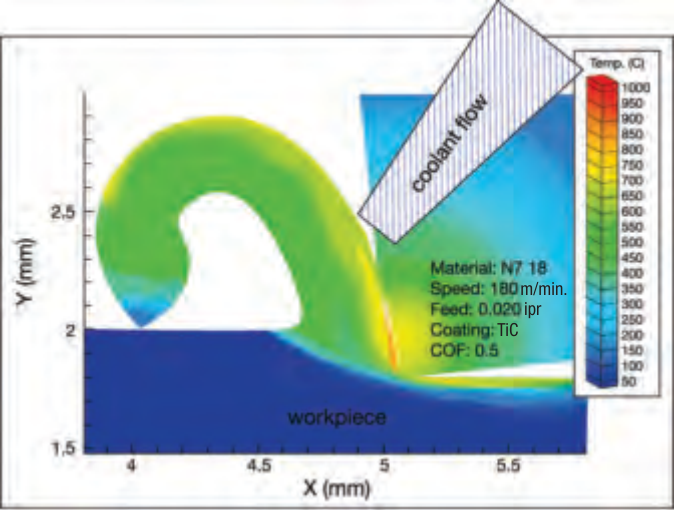
Courtesy of Kennametal
An example of how Beyond Blast through-insert cooling works on a specific workpiece.
“Anytime you put a grinding wheel on a piece of carbide, you have reduced the integrity of that cutting edge—period,” he said. “You can’t put heat on a piece of carbide without changing its physical structure a little. It pulls binder out of that carbide.”
An edge that’s too sharp, however, can be easily damaged. “Typically, the primary failure mode in titanium machining is microchipping,” Long said, “which tends to progress to macrochipping.” To combat that, a light hone on the edge is suitable for stable machining environments and a T-land edge preparation may be required for less-stable conditions, he noted.
Sharpness is also a concern at the end of a tool. To protect that corner, or end edge, M.A. Ford offers a range of corner radii, Trott noted. “If you gash a tool with a sharp corner, it would not have the strength to tackle Ti5553 or any other titanium alloy for that matter,” he said.
Chip Shape
One common tool geometry isn’t always required when milling titanium. “Our titanium endmills don’t have chipformers or chipbreakers,” Trott said. “We don’t find them necessary.”
Because titanium “doesn’t particularly like to be machined, you have to make the cutting edges as sweet cutting as possible, but you also have to make them resilient to withstand wear and loading, which we believe we’ve achieved with our titanium endmills,” Trott said. “Once you have an endmill designed for the job, with the correct parameters and milling strategy, Ti5553 becomes pretty easy to machine.”
Once a chip is formed, it must be evacuated to avoid recutting it. To effectively export the chip from the cutting zone, ATI Stellram designed its titanium milling tools with a round flute to match the shape of the chip instead of the traditional V-type flute for standard cutters.
Palmer noted that the critical geometric feature is sufficient clearance on a tool’s cutting edge. Without it, built-up edge appears on the flank rake, which creates friction with the workpiece surface and additional heat. Eventually, a piece of the built-up metal deposits itself on the workpiece via friction welding, damaging the cutting edge and galling the workpiece.
“When machining steel, you talk about BUE on the front primary rake,” Palmer explained. “With titanium, yes, it does build up a slight deposit on the cutting edge, but the big danger is the buildup of material on the flank surface on the relief of the cutting edge.”
As with other materials, vibration must be minimized when milling titanium alloys. One way to achieve that is with variable, or differential, pitch, noted Long. Changing flute spacing can break up vibration-generating harmonics.
Long added that increasing the number of teeth on a cutter boosts productivity because the chip load and cutting speed are limited when milling titanium. But increasing the number of teeth reduces the ability to provide differential pitch and may cause chip packing. “You have to weigh the benefit of a higher number of teeth against having a coarser pitch tool with a differential pitch and/or a more open chip gash,” he said.
Review the print ads from this magazine to continue
This quick advertiser review unlocks the rest of the article and keeps the full-screen reader focused on the ads instead of the page chrome.
Advertisers included in this article experience
Print placements connected to this article
Mscmetalworking
THE BEST VALUE
IN METALWORKING For over 60 years, Hertel has been providing the metalworking industry with unsurpassed value. Hertel taps are ideal for general machining applications and come in a wide variety of styles and sizes. Available exclusively at MSC Industrial Supply Co.® IS #41.
THE BEST VALUE IN METALWORKING For over 60 years, Hertel has been providing the metalworking industry with unsurpassed value. Hertel taps are ideal for general machining applications and come in a wide variety of styles and sizes. Available exclusively at MSC Industrial Supply Co.® IS #41
Visit Mscmetalworking View this placement in the issue recordPrint ads from this magazine
IN METALWORKING For over 60 years, Hertel has been providing the metalworking industry with unsurpassed value. Hertel taps are ideal for general machining applications and come in a wide variety of styles and sizes. Available exclusively at MSC Industrial Supply Co.® IS #41.
THE BEST VALUE IN METALWORKING For over 60 years, Hertel has been providing the metalworking industry with unsurpassed value. Hertel taps are ideal for general machining applications and come in a wide variety of styles and sizes. Available exclusively at MSC Industrial Supply Co.® IS #41
Continue reading
February 2011
Although a rigid machine is extremely important when machining titanium, Long noted that plunge milling and high-feed cutters can boost productivity on less-rigid conventional machines.
A variable-helix tool also helps reduce vibration by altering the repetitive cutting cycle that induces harmonics. Standridge explained different helix angles induce different cutting forces in the material, with a high helix tending to grab or pull the workpiece into the cutting tool and a smaller helix tending to have the opposite effect, pushing more on the material. Toolmakers design various helix angles in combination with sharp, microscale edge lines to create an effective balance between shear effect and edge stability. It’s advantageous, for example, when finishing thin walls. “You need to balance the cutting forces with a sharp cutting action to minimize heat generation in the material for the best overall stability in the component feature,” he said.
Keep It Cool
Titanium is a poor heat conductor, so only about 25 percent of the heat in the cutting zone—which can be 1,000° C or hotter—is transferred to the chip. Compared to steel, only one third of the heat is transferred. Therefore, coatings such as aluminum titanium nitride, titanium carbonitride and titanium silicon nitride—generally in a multilayer configuration—create a heat barrier to extend tool life without altering edge sharpness by being too thick.
According to Ravi Iyer, senior engineer in Kennametal’s Product Engineering Group, a physical vapor deposition coating is desirable for milling titanium. He noted that a PVD coating is more effective than a CVD one in a wet environment, which is highly recommended because of titanium’s low thermal conductivity and to minimize the risk of igniting titanium chips—a fire that’s difficult to extinguish.
In addition, a PVD coating exhibits a compressive residual stress state, which is well suited to the thermo-mechanical load cycling caused as the milling inserts enter and exit the cut, Iyer explained.
Titanium can be milled with uncoated tools, but modern coating processes have overcome any issues end users had with coatings, according to Iscar’s Carrington. “If you’re running an uncoated product today, by and large you’re leaving money on the table,” he said.
In addition to providing a heat barrier, a coating provides lubricity. “Titanium is starving for lubrication, and anything a little slicker is going to perform better,” Carrington said, noting that he feels TiCN provides more slickness than TiAlN.
Coolant also provides the lubricity titanium craves, but only if the coolant concentration is high enough. According to Carrington, machining titanium is significantly more effective when a 14 percent coolant concentration is applied, which compares with a 5 to 7 percent concentration when machining multiple materials and 9 to 11 percent for high-temperature alloys.
Carrington recalled how he helped achieve acceptable cutting speed and tool life for one customer’s titanium milling application, but on the next product run received complaints about the endmills. After examining the tools to make sure they weren’t ground incorrectly and reducing cutting speed by 30 percent, tool life was still about half of what it was initially. Convinced the tools were the problem, the customer switched suppliers only to find that the original endmill outperformed the others he tried even at the reduced parameters for the original. On the third product run, the customer revealed the problem was eliminated. “I said, ‘OK, I give. What’s the deal?’ He said, ‘We changed the coolant and percentage.’ Same part, same machine, same cutting tool, same cutting parameters—dramatically different results,” Carrington said.
Under Pressure
How coolant is directed to the tool/workpiece interface is also critical. External coolant systems still might be the primary method, but high-pressure/increased flow-rate, through-the-tool coolant systems are becoming more popular. “More than any other material, the use of high-pressure coolant is very beneficial when cutting heat-resistant superalloys like titanium,” Standridge said. “High-pressure coolant directed properly into the cutting zone creates a separation point, so there’s less contact time between the titanium chips, the workpiece material and the cutting edge.” That reduces edge line wear.
Courtesy of Sandvik Coromant
The challenge in milling is to deliver the proper flow rate to achieve high-pressure levels because a multiple-flute mill has numerous coolant holes, which creates more area for the coolant to fill. To address that, Sandvik Coromant developed a jet nozzle system in which threaded nozzles are positioned in coolant holes to restrict flow at the cutting edge and increase pressure, similar to placing your thumb over a garden hose.
The challenge in milling is to deliver the proper flow rate to achieve high-pressure levels because a multiple-flute mill has numerous coolant holes, which creates more area for the coolant to fill, Standridge noted. To address that, Sandvik Coromant developed a jet nozzle system in which threaded nozzles are positioned in coolant holes to restrict flow at the cutting edge and increase pressure, similar to placing your thumb over a garden hose, he explained. (See video illustration above.)
The goal is to achieve a coolant pressure of about 1,000 psi, or 70 bar, but an adequate flow rate is also important, Standridge noted. “We typically like to see pumps with a minimum flow rate of 15 gpm.”
Although high-pressure coolant’s quenching action helps cool the cutting zone, it also assists in mechanically forming and evacuating chips. To enhance those coolant functions, Kennametal introduced Beyond Blast tools with through-coolant inserts to channel fluid directly to the milling cutter/ workpiece interface. (See illustrations above.)
“Coolant forces are getting under the chip and directing it away from the cut, whereas the coolant is coming from outside the cutting zone and pushing the chip back into the cut in a traditional coolant system,” said George Coulston, Kennametal’s vice president of Innovation Ventures. “Beyond Blast pushes chips out of the cutting zone.”
Extending tool life is one of the main benefits of reducing cutting zone temperature. “By having more efficient coolant delivery, we can lower the temperature at the tool/workpiece interface,” Coulston said. “Carbide’s strength deteriorates as the temperature increases.”
Effectively milling Ti5553 and other titanium alloys requires a systematic approach in which using a rigid machine, programming toolpaths to reduce the cutting force and securely holding workpieces—among other elements—must be considered collectively. Having the proper cutting tool alone won’t guarantee success. Nonetheless, the tool is what meets the metal and strips the chip from its parent. And having the right tool goes a long way in preventing an application from being truly challenging. CTE
 About the Author: Alan Richter is editor of CTE. He joined the publication in 2000. Contact him at (847) 714-0175 or alanr@jwr.com.
Vacuum heat treating titanium for airframe applications
Aeronautical engineers continually search for new and optimal materials to achieve specific design requirements throughout an airframe. Many considerations impact the structural design of an aircraft, such as the complexity of the load distribution through a redundant structure, the large number of intricate systems required and the operating environment of the airframe. All are primarily governed by weight savings. Thus, the optimal materials are composites, such as carbon fiber-reinforced plastic, and titanium alloys.
Composites, which excel at handling tension, greatly reduce maintenance due to fatigue compared to aluminum. When engineers analyzed loading and environmental factors, aluminum was determined to be a poor choice. Titanium is also a low-maintenance, high-strength material. In the new Boeing 787 Dreamliner, about 15 percent of the total airframe is titanium.
Within the 787 structure, most of the heat-treatable titanium is used in landing gear, structural fittings, floor structures, extrusions and nacelles.
While Ti64 has been the workhorse titanium alloy in aerospace applications, several flight-critical parts in the 787 aircraft are made of the Ti5Al5V5Mo3Cr beta alloy. Compared to Ti64, Ti5553 exhibits an enhanced hardening ability, and higher strength, fracture toughness and cycle-fatigue behavior. As a result, parts made of Ti5553 forgings are used in highly loaded locations, such as flap tracks, pylons, sides of body chords and landing gear.
Without the proper heat treatment of this exotic material, specific critical metallurgical properties could not be attained. Heat treatment of Ti64 typically involves a solution treatment above the beta transus temperature (the lowest temperature at which a 100 percent beta phase can exist), followed by fast cooling (water quenching). The part is then age hardened at a prescribed temperature for a period of time. This treatment works well for most wrought products. However, aeronautical engineers must design for improved “buy-to-fly” ratios—the mass of material required to machine a part compared to the mass of the original part.
Because Ti64 distorts excessively during water quenching, an alloy is needed that can be “control cooled” to manage distortion. That alloy is Ti5553. The BASCA (beta anneal slow cool age) heat treatment of Ti5553 produces superior ultimate properties and better buy-to-fly ratios than Ti64 by enabling engineers to design near-net-shape parts.
Engineers design parts according to a variety of heat treat specifications. Because there is no universal specification, contradiction and nebulous statements exist within specification documents. The following are summaries of the top five heat treating problems.
1. Heat treat specifications do not describe critical cooling rates for quenching per units of measure (degrees F or C). The exact cooling rate of “water,” “oil” or “air” is unclear because cooling rates of liquid quenchants vary based on the media’s immersion temperature, agitation and heat-exchange rate.
2. Titanium heat treat specifications assume subsequent thermal processing will produce an oxygen-rich layer of alpha case. This is not necessarily true with today’s vacuum technology. There are many methods to help minimize formation of an alpha case in vacuum.
3. Severe problems can arise when titanium alloys contact hydrogen-rich environments. Typically, hydrogen pickup occurs during metal manufacturing and processing, especially at noninert, elevated temperatures. Deep-vacuum processing along with elevated temperature depletes this hydrogen down to single-digit-part-per-million levels. Specifications must state a maximum allowable hydrogen ppm level to help eliminate the risk of hydrogen embrittlement and material failure.
4. Specifications do not acknowledge the use of graphite for fixturing in vacuum. Graphite fixturing enables an engineer to design more precise near-net-shaped components. Graphite’s attributes include excellent heat transfer characteristics and coefficient of thermal expansion, which mimics titanium’s CTE and remains dimensionally stable and strong at a high temperature. Also, graphite can be machined to hold tight tolerances during thermal cycling.
5. Specifications do not clearly define and differentiate between work and control thermocouples. All values must be recorded and reported on only the workpiece thermocouples.
Boeing and Airbus project the global airplane fleet will double by 2029, and the use of composites and titanium in airframes will continue to grow. Currently, Boeing’s and Airbus’ combined titanium consumption is 60 million lbs. per year.
To thermally process titanium, metallurgists must interact with Boeing, AMEC and SAE committees to discover and remedy specification shortfalls. These actions will improve thermal processing and enhance safety in military and commercial aircraft.
—Robert Hill Jr., president of Solar Atmospheres, Hermitage, Pa. Contact him at (866) 982-0660.
Contributors
ATI Stellram
(615) 641-4200
www.atistellram.com
Iscar Metals Inc.
(817) 258-3200
www.iscarmetals.com
Kennametal Inc.
(800) 446-7738
www.kennametal.com
M.A. Ford Manufacturing Co. Inc.
(800) 553-8024
www.maford.com
Sandvik Coromant Co.
(800) SANDVIK
www.sandvik.coromant.com/us
Solar Atmospheres
(866) 982-0660
www.solaratm.com
Titanium Metal Supply Inc.
(888) 748-8510
www.titaniummetalsupply.com
Glossary terms in this article
Related



Subscribers can use MFGAxis notes, saves and discussion tools with their innoNET account.


