

Talking cure: Medical Manufacturing
The use of conversational programming is growing and may influence tomorrow's conventional machine controls.
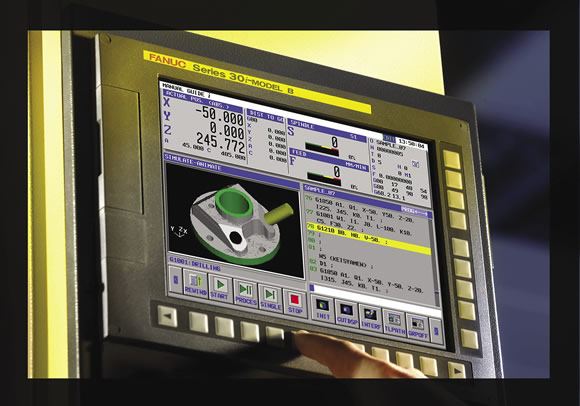
Courtesy of FANUC
A conversational programming unit.
Developed some 30 years ago as a means of facilitating easier operator programming on the shop floor, conversational programming (CP) allows the machine operator to use “canned” cycles for specific machining functions. Through a series of prompts from a graphical user interface, CP combines simplified keyed-in commands and icons to facilitate inputs. The requests from the control to the operator are what make the control “conversational.” The operator enters the required numerical values, and the resultant screen display graphically defines the part and, like conventional controls, allows on-screen simulation.
Conversation Evolution
When conversational programming was first introduced, controls tended to be more heavily differentiated, and the conversational programs that evolved parallel to them reflected the differences. Jody Michaels, aftermarket support manager for control manufacturer FANUC America Corp., Rochester Hills, Mich., said, “The software has evolved over time, and CP has improved and become more user-friendly with each version.”
According to Randy Pearson, dealer support specialist at control manufacturer Siemens Industry Inc., Elk Grove Village, Ill., “The first generation of conversational programming was developed after the primary control was completed. The canned cycles were literally extracted and modified. Today, both conventional and conversational modes are developed at the same time.”
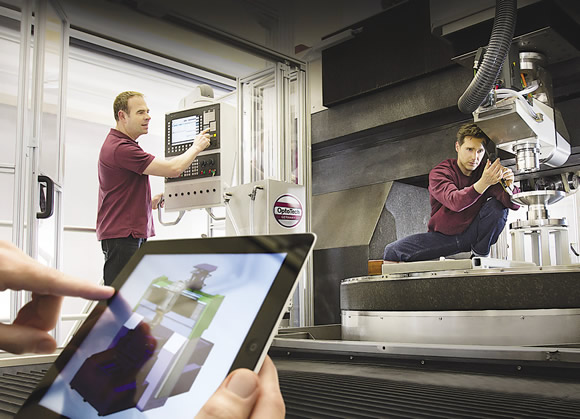
Courtesy of Siemens
Siemens engineers, such as those shown here, refine control capabilities, including elements such as speed, functions and graphics for both conventional and conversational programming.
Kurt Zierhut, vice president of electrical engineering at machine tool builder Haas Automation Inc., Oxnard, Calif., described the evolution of CP at Haas: “In the mid-1990s, we introduced ‘Quick Code.’ Supported by G-code protocols, it was preformatted using code fragments but without numerical values. The second version asked for numerical values, and, by the third iteration, we had moved to a visual approach that only required the operator to fill in the boxes based on requests from the control.”
CP’s evolution has allowed newer and less-experienced operators to engage with machine tools, according to Douglas Rizzo, training coordinator/application engineering at machine tool builder Doosan Infracore Machine Tools, Pine Brook, N.J. “We originally introduced conversational programming as an option in the mid-1980s. Our first package, FAPT, was a FANUC-based system for turning,” Rizzo said. “Our current ‘EZ Guide i’ is only 4 years old but has been updated even in that time frame. The ease of use, flexibility and shortened learning curve all contribute to conversational programming’s popularity—especially in job shops. At a time when many American manufacturers are having trouble filling shop floor positions, conversational programming is helping to provide a solution.”
CP is typically used to make relatively simple parts produced in lots of 100 or less.
Michael Minton, national application engineering manager for Methods Machine Tools Inc., Sudbury, Mass., got started in CP 30 years ago. “Then, as now, CP is easier to learn than conventional G-code programming because it’s less technical,” he said. “Over the years, there have been many changes, especially in the way different control manufacturers do it. For instance, some builders develop it [to use more] as a sales tool, stressing its generic abilities to expedite training and programming. At Methods, however, we work with our associates at FANUC to customize a conversational programming control package uniquely suited to the features and capabilities of the machine lines we sell. Because it’s more specific, we found our approach to be a more practical means of both instructing new operators and generating programs in less time.”
FANUC’s Michaels agreed that a short learning curve is a key CP advantage. He claimed he can take a person who has a basic understanding of manufacturing, often just a high school shop course, and train him or her in CP in 2 days. “In fact, our company is involved in training programs for students, and CP is an excellent introduction,” he said. “It’s one thing to talk about manufacturing, but when a young person can program a part, watch it run and then hold it when it comes off the machine, there’s a realization that this field can be truly exciting. Of course, some machines are easier to program than others. A turning center is a better place to start than a machining center.”
Likewise, because turning is the first exposure most operators have to CP, as it is one of the simplest machining operations, Siemens offers two CP software packages: ShopTurn, a simple introduction to CNC turning, and ShopMill, which covers advanced machining. Both have an identical user interface.
However, the simplicity of CP has a downside. Depending on who writes the part program, operators using CP are liable to find a number of idiosyncrasies that they have to live with because they cannot change the cycle. “As a result, [operators] lose some control over elements like speeds, feeds and optimization,” Michaels said.
Haas’ Zierhut agreed that using CP exclusively can limit a shop. “Many job shops like CP because they don’t want to go to the expense of hiring and maintaining a programming department. But they may well be limiting themselves in terms of the number and kind of parts they produce. Most important, if the machine is being used as a programming station, it’s not making parts. And, with the cost of machines today, that can be a very expensive choice.”
Complex Parts Exclusion
Perhaps the biggest disadvantage of CP, however, is its inability to define and program complex parts.
Major manufacturers, such as OEMs, that typically make more complex parts have avoided CP for several reasons, according to Pearson. “In the first place, they typically have programming departments using CAD/CAM that can generate optimized programs in code. This results in faster production for high-volume products, as well as the ability to tackle complex parts. You’re not going to see aerospace or medical parts programmed through CP. To be fair, you can approach certain complex parts through the use of CP, but the time involved makes it inefficient and impractical.”
While agreeing that complex parts remain a challenge for conversational programming, Methods’ Minton argued that “there are major applications where it works well. Conversational programming can also serve as a ‘gateway’ into conventional programming.
“One of conversational programming’s greatest benefits is in job shops doing small runs of less complex parts or in industries where primary applications are straightforward,” Minton continued. He cited the example of field operations in the oil industry, which make many simplified rotational components. CP is an ideal solution for them.
“The greatest disadvantage is the fact that, by using conversational programming exclusively, you’re limited in reducing cycle times because the routines are already set,” he said. “On the other hand, once an operator learns CP, the transition to conventional G-code programming is extremely natural. And, once they’ve learned conventional programming, operators tend to prefer it because of its intrinsic flexibility.”
A Hybrid Approach
One of the ways to overcome the disadvantages of CP outlined above is to use a hybrid approach that combines conventional and conversational programming. For example, Siemens offers a compromise control that permits a “mix-and-match” approach in solving both G-code and conversational programming issues.
Review the print ads from this magazine to continue
This quick advertiser review unlocks the rest of the article and keeps the full-screen reader focused on the ads instead of the page chrome.
Advertisers included in this article experience
Print placements connected to this article
We Asked The Mastercam Community...
Why do you use Mastercam?
Mastercam is the most widely used CAD/CAM software in the world with an unmatched global community to back it up. Join us to find out how the #MastercamFamily can benefit you
We Asked The Mastercam Community... Why do you use Mastercam? Mastercam is the most widely used CAD/CAM software in the world with an unmatched global community to back it up. Join us to find out how the #MastercamFamily can benefit you. 671 Old Post Rd.Tolland, CT USA • 800 228 2877 www.mastercam.com
Visit We Asked The Mastercam Community... View this placement in the issue recordPrint ads from this magazine
Mastercam is the most widely used CAD/CAM software in the world with an unmatched global community to back it up. Join us to find out how the #MastercamFamily can benefit you
We Asked The Mastercam Community... Why do you use Mastercam? Mastercam is the most widely used CAD/CAM software in the world with an unmatched global community to back it up. Join us to find out how the #MastercamFamily can benefit you. 671 Old Post Rd.Tolland, CT USA • 800 228 2877 www.mastercam.com
Continue reading
September 2013
For example, if a part requires multiple holes of the same diameter, the conversational programming cycle typically returns the drill to the same fixed position as it completes each hole. Depending on the dimensions of the workpiece, the operator could switch to conventional programming to minimize the distance traveled and thereby shorten the cycle.
Even with this capability, CP is not typically used on complex parts possessing unique profiles and/or geometries. These are much better defined through conventional programming. This is also true of high-volume parts in which specific toolpath optimization can greatly improve cycle times over the run.
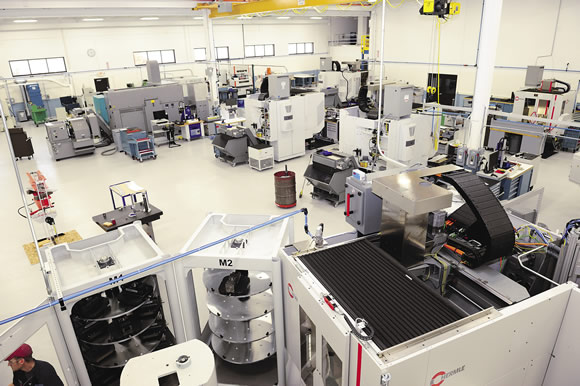
Courtesy of Marten Machining
Marten Machining uses conversational programming in concert with conventional G-code programs.
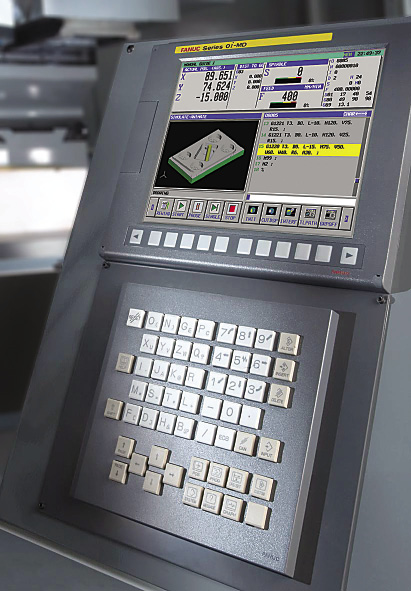
Courtesy of FANUC
A FANUC control with conversational programming screen.
Like the Siemens mix-and-match control, the Doosan EZ Guide i package also takes a hybrid approach. EZ Guide uses both canned and macro cycles for functions such as pocketing, facing and thread milling. The system constructs its own four-digit G codes and equations to accomplish more challenging tasks. It also features an NC conversation function that can convert the entire program to G code for backup.
“Once an operator has a feel for the system—and the machine tool—it is possible to abridge certain routines to reduce cycle times. This offers more flexibility than traditional CP where you can’t change the routine,” Doosan’s Rizzo said. “For really complex parts and CAD-derived applications, traditional programming remains the best solution. But once an operator is fluent in CP and has become familiar with the way the machine operates, it’s much easier to learn conventional programming.”
Marten Machining Inc. has found that another variation of the hybrid approach works well for its operations. Much of the work done by the Stevens Point, Wis.-based job shop involves prototyping advanced parts. It has grown thanks to its early adoption of 5-axis machining and its innovative manufacturing techniques, including a “team” approach that permits operators greater involvement in the manufacturing process, according to owner Dave Marten.
“Despite the advanced nature of many of our parts, we use CP on our Heidenhain controls fairly often as an adjunct to our offline (conventional) programming capability, which is done by programmers using Mastercam CAM software,” Marten said. “For instance, if there’s a hole pattern to drill and tap, the offline program will define the position. But we let the operator decide, using CP, what the sequencing will be based on the tooling being used. We also use CP for certain touch-probe cycles. We like CP because it keeps our operators involved in the process and lends greater versatility to our programming.”
Differences Narrow
Many of the disadvantages of CP, other than its inability to program complex parts, have been resolved, according to CP developers. As with conventional programming, the wide differences that existed between control manufacturers have eased considerably. FANUC’s Michaels said: “If you can operate one type of control system, it’s not going to take you very long to learn another. But the differences between them are in the details. For example, there are aspects to cycles related to tolerances and part quality that are much better in certain CP software.”
Also, the improvement in graphics and ease-of-use in conversational programs has helped increase CP’s utilization. Graphics technologies originally spearheaded by movie producers and video game makers have found their way into the manufacturing industry, and every generation of controls has reflected the changes.
This helps younger people, particularly those in their early 20s, catch on to CP. Their generation grew up with video games, and they are quick to catch on to the prompts and the graphics in CP.
According to Doosan’s Rizzo, this connection is an important advantage. “The present generation of young people grew up on video games that became increasingly complex and followed logical sequences. This has found its way into CP as the graphics, prompts and menus all have to be presented in a logical sequence to achieve the maximum effect.”
Revolution Needed
While the development of CP has been a boon for parts manufacturers, a more radical approach for all controls may be needed. “G codes have been around for a long time,” Haas’ Zierhut said. “As machine tools and parts become more complex and work materials change, G codes may be approaching the limit of their usefulness. [We need to] totally reevaluate the way in which we approach parts manufacturing. Young people entering manufacturing through the portal of conversational programming will demand protocols that both visually and in practice bring programming to a whole new level.” CTE
About the Author: Frank Burke has more than 35 years of experience in the machine tool and allied industries. He has worked for Cincinnati Milacron and subsequently for White-Sundstrand Machine Tool Corp. He has written extensively on technology and communications topics and holds an MBA from The Wharton School of the University of Pennsylvania. Telephone: (414) 225-9200. E-mail: frank.b@burkeandtowner.com.
Contributors
Doosan Infracore Machine Tools
(973) 618-2500
www.doosan.com
FANUC America Corp.
(888) FANUC-US
www.fanucamerica.com
Haas Automation Inc.
(800) 331-6746
www.haascnc.com
Marten Machining Inc.
(715) 592-5092
www.martenmach.com
Methods Machine Tools Inc.
(877) MMT-4CNC
www.methodsmachine.com
Siemens Industry Inc.
(800) SIEMENS
www.usa.siemens.com/industry
Glossary terms in this article
Related




Subscribers can use MFGAxis notes, saves and discussion tools with their innoNET account.


