

Technology Targets Crashes: 5-Axis Machining
As CNC machining gets more complicated, the chance of programmer and operator errors increases. These errors can cause collisions involving machine components and workpieces during the cutting process, resulting in downtime and part, tool and machine damage. Costly crashes aren't inevitable, however, thanks to technologies aimed at preventing collisions and minimizing their impact.
As CNC machining gets more complicated, the chance of programmer and operator errors increases. These errors can cause collisions involving machine components and workpieces during the cutting process, resulting in downtime and part, tool and machine damage.
Costly crashes aren’t inevitable, however, thanks to technologies aimed at preventing collisions and minimizing their impact.
Okuma claims to be the first machine tool builder to deploy online collision-prevention technology. Developed for CNC machines running in either automatic or manual mode, Okuma’s Collision Avoidance System (CAS) integrates a 3D model of the machine, blanks and tooling with the control unit to create a virtual machine. By running this virtual machine seconds ahead of the actual one, Okuma claims CAS can spot potential problems and stop the machine before a costly collision.

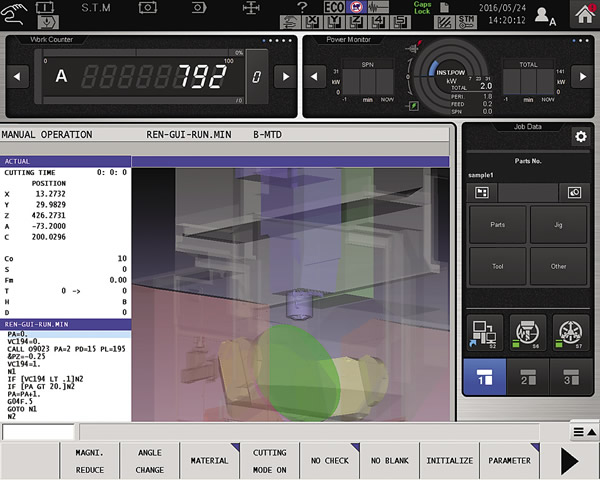
Shown on the control screen of a 5-axis machining center, Okuma’s Collision Avoidance System monitors the entire machining envelope to prevent collisions. Image courtesy Okuma America.
How reliable is CAS? “As long as you’ve modeled everything correctly, CAS will operate correctly,” said Brad Klippstein, controls product specialist at Okuma America Corp., Charlotte, N.C.
In addition to a model of the machine itself, which Okuma provides, CAS requires models of the raw workpiece material, workholders, cutting tools and machine accessories. In some cases, Klippstein said, downloadable 3D drawings of the additional machining components are available online for free and CAS users simply import them into their systems.
According to Klippstein, CAS is most suitable for long and unchanging production runs “because you just have to set it up one time for thousands of parts. But in an environment where you’re always setting up different jobs and changing tooling and fixtures, some people don’t use it because it requires a bit of a time commitment to set it up every time.”
Review the print ads from this magazine to continue
This quick advertiser review unlocks the rest of the article and keeps the full-screen reader focused on the ads instead of the page chrome.
Advertisers included in this article experience
Print placements connected to this article
Fax +1 817 258 3221, [email protected]
ISCAR's Winning Edge
Grooving Innovations Jet Coolant Directed to the Cutting Edge for Better Chip Control with Superior Productivity Turning Grooving Parting ISCAR METALS INC
ISCAR's Winning Edge Grooving Innovations Jet Coolant Directed to the Cutting Edge for Better Chip Control with Superior Productivity Turning Grooving Parting ISCAR METALS INC. Tel +1 817 258 3200, Tech Tel 1-877-BY-ISCAR Fax +1 817 258 3221, [email protected] www.iscarmetals.com
Visit Fax +1 817 258 3221, [email protected] View this placement in the issue recordPrint ads from this magazine
Grooving Innovations Jet Coolant Directed to the Cutting Edge for Better Chip Control with Superior Productivity Turning Grooving Parting ISCAR METALS INC
ISCAR's Winning Edge Grooving Innovations Jet Coolant Directed to the Cutting Edge for Better Chip Control with Superior Productivity Turning Grooving Parting ISCAR METALS INC. Tel +1 817 258 3200, Tech Tel 1-877-BY-ISCAR Fax +1 817 258 3221, [email protected] www.iscarmetals.com
Continue reading
July 2016
CAS can coordinate data with Okuma’s 3D Virtual Monitor (3DVM) software, which lets users check their machining setup for possible collisions before production begins. While offline software tools like 3DVM can spot potential problems in automatic machining, they’re not enough when humans are involved in the machining process. In these cases, an online tool is needed to check what the machine operator is doing, said Marco Schumann, who researches machine tool and forming technology at Chemnitz University of Technology, in Germany.
In addition to preventing problems, however, online collision-avoidance systems can “crash” production speed and quality. For example, Schumann pointed out that collision-avoidance setups based on faulty assumptions can adversely impact product quality and unnecessarily stop production. He reported hearing from users of one online collision-prevention system that it stops their machines too often, so they disabled it to prevent process disruptions.
“We need a system that prevents collisions without changing production time or quality,” said Marco Witt, a chemical engineer at Chemnitz University of Technology.
Witt and Schumann are co-developers of a collision-prevention system that uses a virtual model based on “hulls” surrounding every moving machine part. The size of each hull depends on the corresponding component’s maximum speed and deceleration. Collisions between hulls surrounding different components can reduce the speed of the components or stop them completely.
Though not for sale at present, this system is deployed in 5-axis machines manufacturing aerospace parts in the U.K. and Canada.
Another option for machine users concerned about collisions is trying to reduce their impact. That’s the objective of the motor-spindle safety system from the German firm Jakob Antriebstechnik. To protect the motor spindle from collision-induced overload at the tool, this system cuts off the “flux” at the connection of the machine tool and spindle when an allowable force value is exceeded, according to the company.
Then there’s the “airbag” from the Japanese firm Nakamura-Tome (supplied in the U.S. by Methods Machine Tools Inc., Sudbury, Mass.). A standard feature on all of the company’s machines, the airbag is actually a collision-mitigation system that reverses the servomotor-feeding direction and stops the machine within 8 milliseconds of a crash.
So whether prevention or mitigation is your preference, there are options designed to help you avoid the expensive consequences of crashes.
Glossary terms in this article
Related



Subscribers can use MFGAxis notes, saves and discussion tools with their innoNET account.


