

Thanks a Bunch: General Industry Coverage
A bandsaw is a common sight in a machine shop. To get blanks on the floor faster, shops use bandsaws to cut several square, rectangular or round solid bars or tubes at a time. Knowing about the proper bandsaw, workholders and saw blades can make the bundle cutting process go much more smoothly.
A bandsaw is a common sight in a machine shop. To get blanks on the floor faster, shops use bandsaws to cut several square, rectangular or round solid bars or tubes at a time. Knowing about the proper bandsaw, workholders and saw blades can make the bundle cutting process go much more smoothly.
Bandsaws have a fairly large work envelope that allows materials to be stacked and cut. But if a shop is going to be cutting a high volume of bundles for a specific job, it will need a dedicated bandsaw.
Courtesy of Simonds International
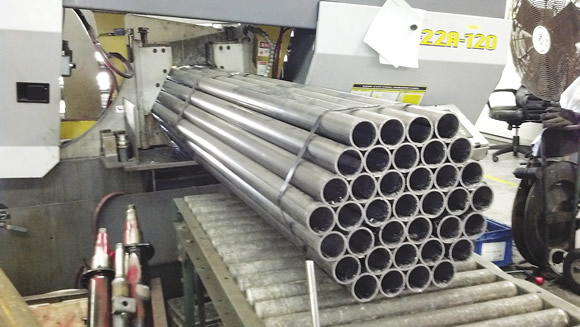
Cutting bundled tubing requires a bandsaw blade designed for interrupted cutting, such as the IC Enduro, which has a wide tooth set to help prevent blade pinching.
“It’s about efficiency and generating a high volume of parts in a short period of time,” said Michael Finklea, director of sales and marketing for bandsaw manufacturer Cosen Saws USA, Charlotte, N.C. “For example, we have a customer that makes keyways for holding gears in place. He cuts bundles of 1⁄16 ” square stainless steel, and every time he makes a cut he creates 900 parts. The only way he can do that [in a reasonable amount of time] is to have a dedicated bandsaw that can bundle cut. “
Bundle cutting is generally done with an automatic or semiautomatic vertical, horizontal or scissor-type bandsaw.
To cut tubing on single- or dual-column horizontal bandsaws—and some vertical ones—the machine needs a canted head, meaning it is mounted at a slight angle, producing the same effect as angling the workpiece. The bandsaw blade passes through the tube at an angle, improving the consistency of the cut and increasing blade life.
Courtesy of Cosen Saws USA
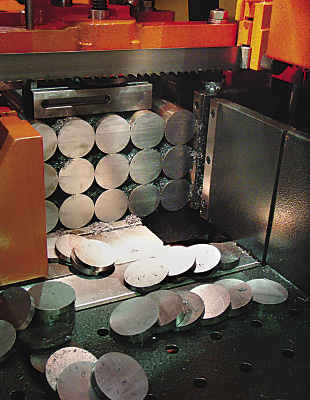
Cosen’s structural-steel horizontal bandsaw uses a bundle-cutting attachment, in addition to side vises, to hold tubes in place.
“With horizontal machines, the blade is offset anywhere from 3 to 5 percent,” said Ron Saxon, national accounts manager for bandsaw blade manufacturer Simonds International, Fitchburg, Mass. “The blade does not come in perfectly parallel with the material, and this helps eliminate tooth strippage. This is done more for tubing, where you have interrupted cuts.”
Scissor-type bandsaws do not encounter this problem with tubing because the blade comes into the workpiece at an angle.
Bundle Wrap
Vibration from poorly nested workpieces limits bundle cutting performance. Generally, workpieces are not perfectly straight and do not have perfectly identical dimensions, and therefore are prone to move within the stack. “If you have a bundle of 1 “-round workpieces five wide and five high, the chance that all 25 of those are the exact same size is pretty small,” Finklea said.
To minimize movement and vibration, workpieces must be tightly secured. In addition to the side vises already on the bandsaw, the most effective method to hold material in place is to use a top clamp, commonly referred to as a bundle cutting attachment, an option on most production bandsaws. The side vises maintain the position of the material and the top clamp applies down pressure, keeping an individual piece from popping up and out from the bundle.
Even with a top clamp, there is a chance for round workpieces to start spinning. “With round materials, if you have one in the middle that is on the smaller side, and the others around it are bigger, the middle piece is floating. Even though you have clamping on all sides, there is nothing holding that smaller piece and as soon as the blade hits it, the piece starts to spin,” Finklea said. “We tell customers the only way to guarantee that a piece won’t spin is to tack weld the ends of the pieces—put a dot of weld where the pieces are touching, just enough to keep them together so the one in the middle will not spin.”
Save the Blade
If vibration and spinning are not kept under control, they cause the blade teeth to chip or strip or even the blade to break.
For bundle cutting, the most effective cuts are those made in solid bars using bi-metal blades. When blades continuously cut solid material, stresses on the teeth after initial impact tend to be consistent. Bundle cutting solid materials is like cutting one big workpiece, noted Saxon.
Courtesy of L.S. Starrett
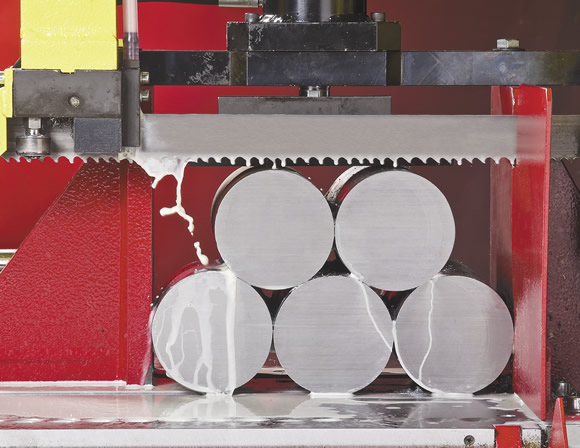
L.S. Starrett’s Intenss Pro bimetal blades are suited for tightly bundled solids, including tool steel, stainless steel and nickel-based and nonferrous alloys.
Conversely, cutting tubing typically abuses the blade because the teeth must enter and exit two walls. These sudden changes increase vibration and workpiece movement, stripping the teeth from the blade. When multiplied by the number of tubes in a bundle, it is easy to see how blade life would be reduced. According to Finklea, this reduction could be as much as 25 percent.
“That constant impact of leaving and entering a cut in interrupted sections does have an effect on the cutting edge of the tooth and you are going to see a little lower blade life no matter the material,” said Gene Ramsdell, manager of North America saw R&D for bandsaw blade manufacturer The L.S. Starrett Co., Athol, Mass.
Having an application-specific tooth design to address the problems inherent in interrupted cutting helps extend blade life.
Variable pitch is typically the norm for any bimetal blade. A variable-pitch blade has various tooth sizes to reduce vibration whether used for bundles or a single piece. Tooth pitch generally is based on workpiece size. It is recommended that the tooth pitch enable at least three teeth to be in contact with the workpiece at all times; having six to 12 teeth in the cut is optimal.
Review the print ads from this magazine to continue
This quick advertiser review unlocks the rest of the article and keeps the full-screen reader focused on the ads instead of the page chrome.
Advertisers included in this article experience
Print placements connected to this article
Knightcarbide
Knight Carbide is a one-stop supplier of high-quality, cost-efficient
solutions for greater productivity, accuracy and repeatability. 48665 Structural Dr. • Chesterfield Twp., MI 48051-2666.
Knight Carbide is a one-stop supplier of high-quality, cost-efficient solutions for greater productivity, accuracy and repeatability. 48665 Structural Dr. • Chesterfield Twp., MI 48051-2666 P: 586.598.4888 • F: 586.598.1998 www.knightcarbide.com • email: [email protected]
Visit Knightcarbide View this placement in the issue recordPrint ads from this magazine
solutions for greater productivity, accuracy and repeatability. 48665 Structural Dr. • Chesterfield Twp., MI 48051-2666.
Knight Carbide is a one-stop supplier of high-quality, cost-efficient solutions for greater productivity, accuracy and repeatability. 48665 Structural Dr. • Chesterfield Twp., MI 48051-2666 P: 586.598.4888 • F: 586.598.1998 www.knightcarbide.com • email: [email protected]
Continue reading
January 2014
Achieving proper tooth engagement with tubing, however, is difficult because as the blade passes through the material, the amount of material in the teeth changes. Teeth are engaged in the wall material, while simultaneously disengaged in the open spaces. “If you have 100 pieces of 1⁄8 ” tubing, it is almost impossible to have that engagement,” Saxon said. “One solution is to try a finer-pitch blade.”
Tooth geometry is optimized for bundle cutting applications. A highly positive rake angle is best-suited for solid bars and heavy-walled tubing. Thin-walled tubing is best cut with straight or less positive rake angles.
“Most blade manufacturers have their own take on geometries for cutting bundles,” Ramsdell said. “And for interrupted cuts, it may involve a strong, reinforced tooth form that may not be as aggressive a tooth style as far as rake and relief angle. This will help with the impact of going in and out of the wall sections and also with pulling and recutting chips throughout the cut.”
Another issue with bundle cutting tubing is pinching the blade. “Pinching is basically the result of the workpiece moving in the bundle and compressing against the side of the blade while it is being cut,” Ramsdell said. “In many cases, it will physically stop the blade in its tracks, strip teeth off or cause the blade to break.”
The most common way to prevent pinching is to apply a blade with a heavier, wider tooth set. “This creates a wider kerf so if the material does move, it may not be enough to cause the blade to pinch like a conventional set blade,” Ramsdell added.
Challenging Chip Control
Chip removal is another challenge with bundle cutting. “As the blade takes a chip out, a lot of times the gullets just load up because there is no place for the chips to go when you are inside of a bundle,” Saxon said. “If the gullets are full of chips and the blade is still trying to cut, it can cause chip welding and the blade teeth can strip.”
Also with tubing, chips collect in the hollow of each tube in the bundle and cutting through those workhardened chips decreases blade life. Therefore, flood coolant is essential to flush chips but bundle cutting tubing with flood coolant is usually messy. “As you cut through the bundle, as soon as the coolant hits the tube, it starts filling the tube instead of continuing on the blade or continuing through the cut,” Finklea said. “Coolant tends to travel up those tubes or even into the spaces between round solid bars to a certain extent and out the ends.”
Courtesy of L.S. Starrett
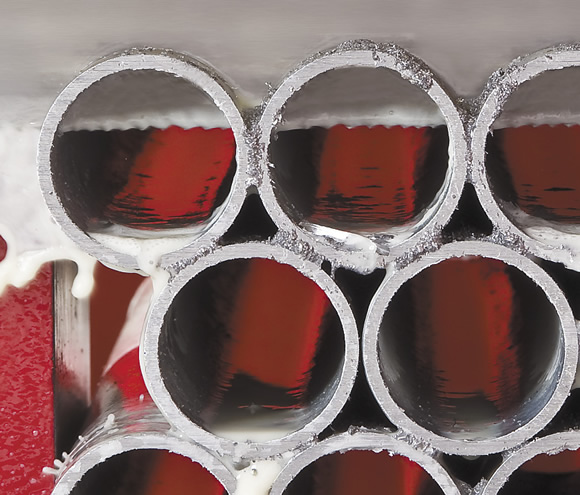
L.S. Starrett’s Versatix bimetal blades are for bundle cutting tubes, small solids and structural workpieces. They have a tooth form that dissipates stress during cutting, which leads to less tooth breakage and longer blade life, according to the company. When bundle cutting tubing, chips collect in the hollow of each tube and flood coolant runs through the tubes, which flushes chips but is also messy.
Collecting coolant runoff is not easy. Containers or trays are sometimes placed at the end of the tubing, but the process remains messy. Finklea mentioned a customer cutting 4 “-round tubes for a bearing application that put rubber plugs in the tail end of the tubes so the coolant only exited from the front.
An alternative to flood coolant for bundle cutting tubing is a lubricating mist. But while these misting systems provide a cleaner operation, they do not remove chips.
“It is a no-win situation either way,” Ramsdell said. “If you use flood coolant, you have chips and coolant flowing out the back and front of your bandsaw. If you use mist, your blade has to recut chips, which [reduces] blade life.”
Burr formation is another problem. “You do tend to raise more burrs in bundle cutting, but it is up to the end user as to what is tolerable,” Ramsdell noted. “Some cust-omers just want the bundles cut, so burrs are not a problem. But to control it, you can change the tooth pitch, tooth form, blade speed or downfeed [feed rate] to try and minimize the burrs.”
Handling is the Hardest
With bundles, cutting tends to be the easiest part. “The biggest issue with bundle cutting is material handling,” Finklea said. “On the inbound side, that bundle may be in a big stack. You have to break it apart, reshape it and put it into your bandsaw. And on the outbound side, the customer has to deal with those cut parts.”
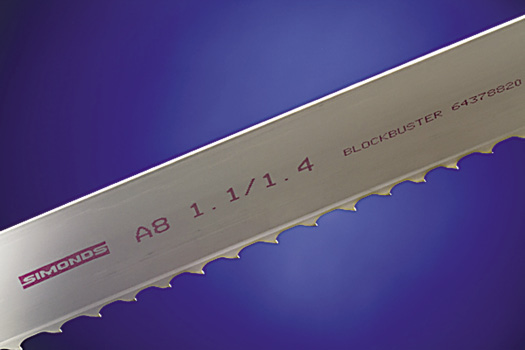
Courtesy of Simonds International
Simonds Blockbuster bimetal blade can be used for large bundle cutting of solid bars.
Machinists have to think of all those aspects in the process, he continued. Questions to answer include:
- How big of a bundle to make?
- How much time it takes to get the bundle together and into the machine?
- how much time it takes to get the parts off the machine?
And a bigger bundle is not always better. “We run into that a lot,” Finklea said. “The operator just thinks he’ll cram as much material as he can in there, but that does not necessarily increase productivity because he has to look at the entire process. Sometimes going to a little smaller bundle is better because you can handle the material better.”
He summed it up this way: “The bandsaw tends to be the red-headed step child of the shop. Typically, the newest, least-qualified person runs the bandsaw. But the bandsaw is the first step in the process, and if you can use it the best way, it makes everything else downstream easier for processing the material to make it into a part. You don’t have to overcome the problems from the start.” CTE
Contributors
Cosen Saws USA
(877) SAWING1
www.cosen.com
The L.S. Starrett Co.
(978) 249-3551
www.starrett.com
Simonds International
(800) 343-1616
www.simondsinternational.com
Glossary terms in this article
Related




Subscribers can use MFGAxis notes, saves and discussion tools with their innoNET account.


