


The thinking factory: General Industry Coverage
CTE Editor Alan Richter covers a cognitive factory that "thinks" for itself in his April 2011 Look Ahead column.
With the integration of cognition sensor networks and computer algorithms, machine tools are entering the virtual world. Within that world, Munich Technical University’s Institute for Machine Tools and Industrial Management is conducting research within the framework of CoTeSys (Cognition for Technical Systems), which is funded by the German Research Foundation. “We aim to use the tripartite requirement of ‘detect, deduce, deliver’ to make machines more proactively autonomous than they used to be,” said professor Gunther Reinhart, director of the institute.
He noted that Cognitive Technical Systems differ from other technical systems in that they perform cognitive control, which includes reflexive and habitual behavior in accordance with long-term intentions. “Cognitive capabilities such as perception, reasoning, learning and planning turn technical systems into ones that ‘know what they are doing,’ ” Reinhart said.
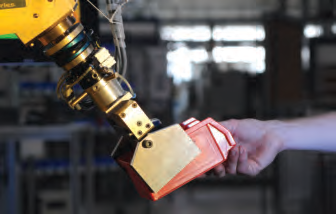
Courtesy of CoTeSys/Kurt Fuchs
Within the CoTeSys framework, virtual cooperation enables a robot and human to simultaneously work on the same workpiece.
To move the research from the “ivory tower” down to earth, the university developed the Cognitive Factory demonstration platform—a factory that thinks for itself. Researchers from multiple disciplines, including mechanical and electrical engineering, informatics and psychology, are working on the project, located at the university.
“The related project CogMaSh (Cognitive Machine Shop) aims at using cognitive capabilities to achieve a balance between flexibility, performance and cost-effectiveness by transforming machines and processes into cognitive ones,” Reinhart said. “As a basis for validation, a flexible manufacturing system is used as a demonstration platform.”
The FMS includes machine tools, assembly robots, a quality assurance area, a storage facility, a pallet transportation system, depth and infrared cameras and sensor networks with radio frequency identification systems. The RFID technology collects real-time data from machines and other shop equipment. The information, such as quality-related data, is measured by external devices, such as a laser scanner, or integrated sensor elements on an RFID transponder, such as a strain gage or temperature sensor, Reinhart explained. “Therefore, RFID provides the basis for a precise image of the real world,” he said. “By combining workpieces with RFID transponders, they become smart products that are enabled to share information with the planning level and other resources on the shop floor through a respective communication infrastructure. Smart products are therefore able to actively influence their way throughout the shop floor.”
For example, a workpiece “asks” machine tool No. 2, “Can you drill a 50mm-dia. hole in the required amount of time or shall I take myself to another machine?” If the machine says “yes,” then the workpiece uses the information on the transponder to book a “factory taxi” and says to the transport system, “Please take me to machine No. 2.”
For more information, contact the Institute for Machine Tools and Industrial Management, Munich, Germany, at +49-89-289-15500 or www.iwb.tum.de.
Related


Subscribers can use MFGAxis notes, saves and discussion tools with their innoNET account.