A time for Swiss precision
When trying to have the most advanced manufacturing possible and buying new machines that are extremely complex, forward thinking is better.
When trying to have the most advanced manufacturing possible and buying new machines that are extremely complex, forward thinking is better.
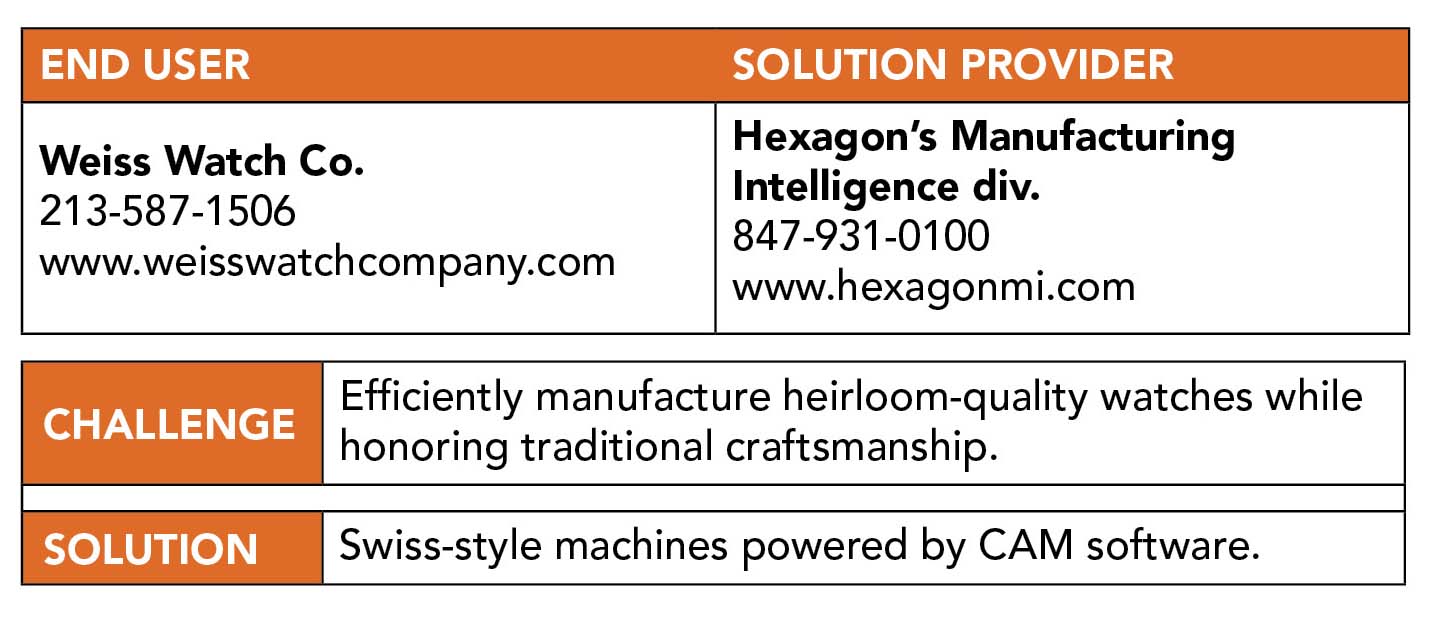
Weiss Watch Co. combines traditional Swiss watchmaking techniques with advanced manufacturing technologies to produce heirloom-quality timepieces that are built to last. Using Swiss-style machine tools powered by Hexagon’s Esprit CAM software from North Kingstown, Rhode Island-headquartered Hexagon’s Manufacturing Intelligence div. enables the company to manufacture components more efficiently while honoring traditional craftmanship.
Long before he helmed the business that bears his name in Nashville, Tennessee, Cameron Weiss of Weiss Watch was a born engineer.
“I built a lot of different things as a kid but gravitated toward watches because I liked the technical aspect and their mechanical nature,” Weiss said.
His enduring interest in timepieces led to his enrollment in a school operated by Swatch Group, which offers a Swiss-style curriculum dedicated to the repair and restoration of watches sold in the U.S. He then worked in Europe for watchmakers Vacheron Constantin and Audemars Piguet.While his goal was to establish his own watchmaking business, Weiss believed that he’d have to relocate to Switzerland to make his dream come true. Upon returning to the U.S., however, he found that there was interest in domestically produced watches made by small companies that provide opportunities for customers to interact with brand founders and designers.”I learned that people are willing to spend more knowing that a watchmaker designed and made the product in the U.S.,” Weiss said. “I realized we could use advanced manufacturing technology to keep costs attainable while producing watches of the same quality as Swiss watch brands.”To learn more about manufacturing, and specifically how to operate CNC machinery and CAM software, he joined a company in Los Angeles that produces housings for underwater cameras.Weiss designed and produced components for his first 10 watches in 2013 with the help of local prototype manufacturers and assembled the watches in his apartment. Those first 10 pieces sold within a month and the rest, as they say, is history. Weiss eventually established the small shop where he designs, manufactures and assembles purely mechanical timepieces.”I’m producing wristwatches that are more attainable and trying to bring the mechanical side of watches to more people,” he said.As a production team of one, Weiss was challenged with figuring out how to efficiently perform what amounts to three different jobs without hiring anyone. For several years, he outsourced the production of some components and produced what he could using a Swiss-style lathe and a two-axis mill with 2+1-axis positional machining capabilities.While he doesn’t produce components in volume or require high throughput, Weiss does require adherence to tight tolerances and fine surface finishes. Lights-out machining is his objective.”I don’t want to fill the shop up with people who just move parts to different machines,” he said. “Manufacturing a watch case is typically done by stamping out a blank, then taking that blank and putting it on a CNC lathe to cut the internal diameters before switching it over to a mill to cut the exterior shape. This requires three different processes performed by three different types of manufacturing professionals.”To increase his production capabilities, Weiss acquired a Chiron mill-turn machine tool with a bar feeder that offers five-axis milling and Swiss-style turning capabilities. To program the new machine tool, he implemented Esprit CAM software because of its ability to accurately program complicated multiple-axis and multitasking machine tools, specifically Swiss-style lathes.Cameron Weiss examines one of the heirloom-quality watches his company produces. Image courtesy of Hexagon’s Manufacturing Intelligence
“It seems like Esprit is more focused on improving Swiss programming than other CAM developers,” Weiss said. “I also didn’t want to have to use multiple solutions to program our machine tools, and it’s able to program all of the machinery in my shop.”
Swiss-style lathes make it much easier to machine especially small, thin parts, as well as components that are significantly longer than they are wide. The stock material on Swiss-style lathes emerges from a guide bushing to be machined by tools at the face of the bushing. The material moves in and out of the bushing throughout the machining operation, which enhances part stability.
“The benefit of a Swiss lathe is that very thin parts won’t deflect when the cutting tool touches them because you’re cutting right where it’s being held rather than from 10 mm away on a part that’s only one tenth of a millimeter in diameter,” Weiss explained. “Our thickest watch case is still under 11 mm. The majority of the watch is made with turning and you have a lot of small parts like screws, pinions and wheels that are all cut on Swiss machines.”
Weiss’s Chiron machine tool is equipped with a B-axis head that offers “swivel capability” for flexible machining of the top side and full front face of the bar. It’s also equipped with a vice that grabs and holds the part while the spindle is used as a saw for parting off. The vice then flips back around so that the back of the bar can be machined.
Review the print ads from this magazine to continue
This quick advertiser review unlocks the rest of the article and keeps the full-screen reader focused on the ads instead of the page chrome.
Advertisers included in this article experience
Print placements connected to this article
Platinumtooling
THE NAME TO KNOW FOR...
LIVE TOOLS / ANGLE HEADS / SPEED MULTIPLIERS / SWISS COMPONENTS MARKING TOOLS / KNURLING TOOLS / BROACHING TOOLS / SHRINK FIT TOOLS Platinum Tooling is proud to be the importer of Heimatec Live Tools and Angle Heads, Tecnicrafts Swiss Collets and Guide Bushings, Henninger Spindle Speeders, Quick Knurling and Marking Tools, Rineck Shrink Fit Tool Holders and REV Broaching Tools
THE NAME TO KNOW FOR... LIVE TOOLS / ANGLE HEADS / SPEED MULTIPLIERS / SWISS COMPONENTS MARKING TOOLS / KNURLING TOOLS / BROACHING TOOLS / SHRINK FIT TOOLS Platinum Tooling is proud to be the importer of Heimatec Live Tools and Angle Heads, Tecnicrafts Swiss Collets and Guide Bushings, Henninger Spindle Speeders, Quick Knurling and Marking Tools, Rineck Shrink Fit Tool Holders and REV Broaching Tools. Platinum Tooling offers a wide selection of machine tool accessories for most machine brands, including standard and custom tools to help with the most challenging applications. If you need live tooling, we’re here to help. 16 E. Piper Lane, Ste.128 | Prospect Heights, IL | 847-749-0633
Visit Platinumtooling View this placement in the issue recordPrint ads from this magazine
LIVE TOOLS / ANGLE HEADS / SPEED MULTIPLIERS / SWISS COMPONENTS MARKING TOOLS / KNURLING TOOLS / BROACHING TOOLS / SHRINK FIT TOOLS Platinum Tooling is proud to be the importer of Heimatec Live Tools and Angle Heads, Tecnicrafts Swiss Collets and Guide Bushings, Henninger Spindle Speeders, Quick Knurling and Marking Tools, Rineck Shrink Fit Tool Holders and REV Broaching Tools
THE NAME TO KNOW FOR... LIVE TOOLS / ANGLE HEADS / SPEED MULTIPLIERS / SWISS COMPONENTS MARKING TOOLS / KNURLING TOOLS / BROACHING TOOLS / SHRINK FIT TOOLS Platinum Tooling is proud to be the importer of Heimatec Live Tools and Angle Heads, Tecnicrafts Swiss Collets and Guide Bushings, Henninger Spindle Speeders, Quick Knurling and Marking Tools, Rineck Shrink Fit Tool Holders and REV Broaching Tools. Platinum Tooling offers a wide selection of machine tool accessories for most machine brands, including standard and custom tools to help with the most challenging applications. If you need live tooling, we’re here to help. 16 E. Piper Lane, Ste.128 | Prospect Heights, IL | 847-749-0633
Continue reading
March 2024
“We do a lot of hobbing and broaching, as well as some tooth profiles and castle-type face gears. This involves machining on many faces of the part in a tiny area with weird profiles and oddball tooling that make the programming nearly impossible.”
Prior to using Esprit to program the new Chiron machine tool, tests were performed to ensure that the toolpath generated by the software would work flawlessly with the machine-specific post processor.
“Both companies were great,” Weiss said. “Esprit sent an engineer to Chiron to run some test programs on the machine and to make sure that everything was operating as expected.”
Weiss relies on the Esprit digital twin to paint an accurate picture of how each machining operation will play out. The twin details the machine tool, stock and vendor-specific data for cutting tools, toolholders and workholders. The software’s simulation capabilities are based upon the accuracy of this digital twin and are enhanced by machine-aware artificial intelligence. Its patent-pending AI engine represents a change in the way that CNC machines are driven, as it uses AI to simplify programming, increase tool life and improve machine performance.
“The Chiron machine is all modeled up in Esprit and the simulation is very helpful because we’re dealing with such tiny areas and tight tolerances that visualization helps tremendously in making sure that nothing’s going to crash,” Weiss said. “With Swiss machines, the movements are so tiny that it doesn’t look like they’re even running. You just see oil spraying and it looks like nothing’s moving and then, all of a sudden, a little screw or a pinion comes out.”
Weiss can cut 60 watch cases from a single piece of stainless steel or titanium bar stock and perform a significant amount of work on one machine tool with limited monitoring. With five-axis capabilities, he can develop more complex case geometry that couldn’t be machined on his existing equipment or outsourced due to prohibitive costs. The addition of the Chiron enables Weiss to be more competitive, produce nearly all components in-house and offer case-making services for watch companies with limited equipment.
Use of the Chiron mill-turn has also eliminated the laborious setups required for performing multiple operations on different machines. Pairing the complex machinery with Esprit ensures that Weiss can machine with confidence.
“Esprit seems more forward thinking on the technology side and when you’re trying to have the most advanced manufacturing possible and buying brand new machines that are extremely complex, forward thinking is better.”