Titanium Cutting Simplified
Titanium Cutting Simplified
Look Ahead features simulation tools for automating titanium cutting.
The University of Sheffield (U.K.) Advanced Manufacturing Research Centre (AMRC) and Boeing are developing simulation tools that can create new automated manufacturing processes, with the aim of automating the selection of cutting parameters for producing titanium components.
"The problem manufacturers have when machining material such as titanium is that the material properties can vary from one batch to the next and require new cutting parameters," said Jeremy Oakley, University of Sheffield professor of statistics. "However, you wouldn't necessarily know [these material properties] have changed until identified in the quality checks of finished components."

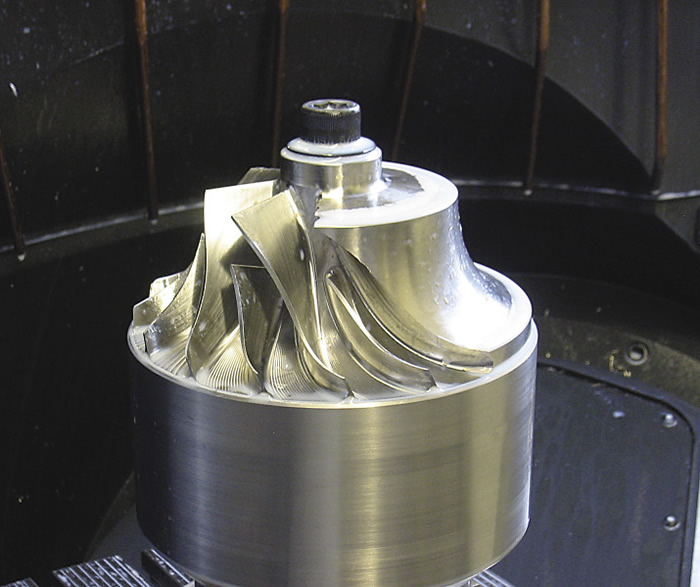
File image of a titanium impeller test part. AMRC conducted physical cutting trials on batches of titanium alloys with different properties. Image courtesy Wikipedia Commons.
The variation in material batches affects dimensional accuracy, surface finish and tool life, the researchers reported. Observing the cutting process and manually stopping the machine to check on the cutting tool can be costly and often relies on the experience of the machine operator.
The AMRC conducted cutting trials on batches of titanium alloys with different properties and performed orthogonal, peripheral climb milling to collect data, such as temperature, cutting forces and vibration. A finite element (FE) model that replicated the machining process was also used to extract the same data through simulations of the process.
University statisticians used the output data from the cutting trials and FE model to identify optimal parameters to use during machining, which allow for the uncertainty of the material properties changing from batch to batch.
Following the identification of optimal cutting parameters, the second stage of the project involved tool wear tests, which were successfully completed. Sensor data from these experiments was used to develop a statistical process control strategy to automate the decision of when to replace the cutting tool.
A feedback adjustment method is being developed for taking corrective action to prolong tool life. "This will allow the tool and machine to react to the properties of the material and automate the decision to adjust the cutting parameters independently, without the operator having to stop the process," Oakley added.
A fully automated system could be potentially applied to manufacturing processes other than titanium milling, and would ensure consistent part quality in spite of variations in material properties.
For more information about the University of Sheffield AMRC, Sheffield, U.K., visit www.amrc.co.uk/news or call +44 114-222-1747.
File image of a titanium impeller test part. AMRC conducted physical cutting trials on batches of titanium alloys with different properties. Image courtesy Wikipedia Commons.