Training on demand
Online training offers an alternative, as well as complementary, way to learn machining and programming.
Even before the COVID-19 pandemic, online, or virtual, machinist training was well established. But demand grew as in-person instruction was restricted, and interest will continue to flourish after herd immunity is achieved.
For the past decade, Mazak Corp. has offered online, on-demand training in addition to instructor-led courses at its training center and more customized training at customer facilities. When the coronavirus reared its ugly, spiked head in March 2020, all instructor-led courses went online until October, said Roy Gentry, national training manager for the Florence, Kentucky-based machine tool builder. The percentage shifted to about 50% earlier this year, and he expects about 30% of students to remain online for the instructor-led courses by summer.
“People who still don’t want to travel can take the online instructor-led classes,” he said, “but some people want that hands-on, face-to-face interaction, and we have that too.”
Gentry predicts that in the near future, Mazak will offer hybrid classes in which some students receive instruction at the training center and some students study remotely. Regardless of where students are, class sizes have a hard limit of eight people.
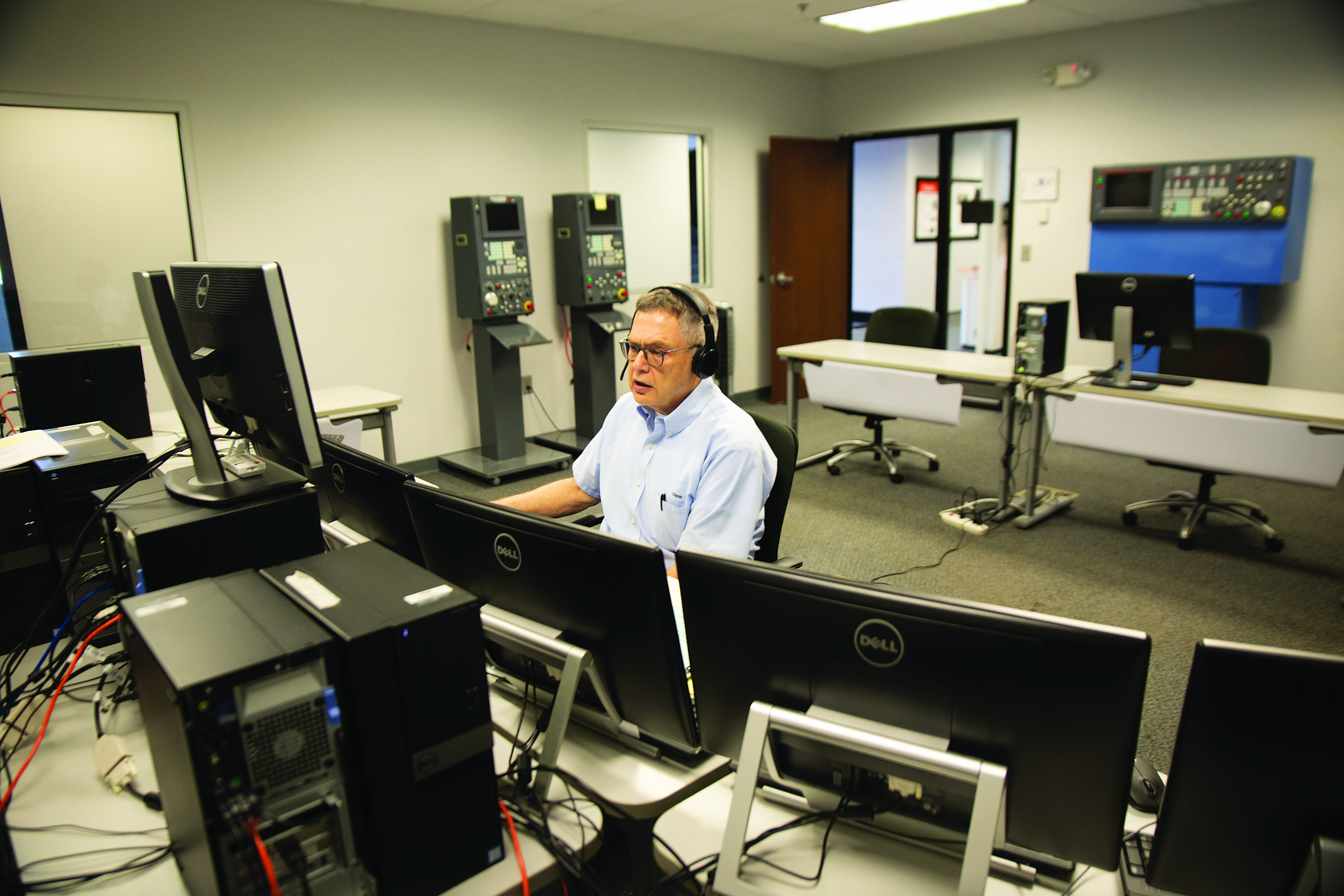
Programming instructor Patrick Reynold conducts a remote training course at Mazak’s training center in Florence, Kentucky. Image courtesy of Mazak
“We like to keep it around six,” he said. “We limit class size because the more people you get in, people become less likely to participate, and you usually have one person who steps up and does everything. But then the rest kind of suffer as a result.”
Gentry said virtual programming classes had no problem reaching the limit because there is no difference in taking them remotely or in person. In addition to having a PC, he recommends that remote students have two monitors: one to show the control simulator and one to watch the instructor.
On the flip side, end users are more reluctant to have their maintenance personnel participate online because they feel that in-person, hands-on training is more beneficial if not required, he said. Mazak offers online, instructor-led maintenance classes, but some learning activities obviously can’t be performed remotely, such as disassembling a turret.
“You have to be in the training center to do that,” Gentry said. “What we do as the next best thing is take a headset out to a unit, and our instructor then will show the parts that are coming apart. They show them how to do it so the students can see it remotely, but they can’t touch it.”
With online education, besides saving the travel, lodging and feeding expenses associated with sending a worker to the training center, he said Mazak customers avoid releasing the worker for a week, which might cause a production problem if an emergency arises on the shop floor. However, keeping students focused and engaged in the class is critical to learning the material, he said.
“A major consideration for participating in remote training is to make sure the students can stay in class,” Gentry said. “In an emergency, you can pull them out, but we like to minimize those interruptions.”
He said the machine builder’s online, on-demand courses, which a student can take anytime day or night and require about 20 to 30 minutes to complete, aren’t subject to those types of demands and can be accessed repeatedly as reference material. Those courses focus on basic instruction for machine setup and operation; programming; and electrical, pneumatic and mechanical maintenance but have evolved over time to cover more Mazak-specific content, he said.
“If someone wants to learn online how to troubleshoot electrical circuits, there is a ton of information on the internet, such as YouTube, that they can access and do that,” Gentry said. “We are trying to focus on information that they don’t have readily available to them.”
Manufacturers always have faced the challenge of replacing institutional, or organizational, knowledge as older workers retire. Unexpectedly and unfortunately, the pandemic accelerated the amount of knowledge leaving the workforce through risk mitigation, illness and death.
“We don’t know the effects just yet of this recent downturn and the most recent exit of the workforce,” Gentry said, “but I believe it is going to be even wider than it was two, three years ago. We will definitely see an uptick in on-demand, online training.”
Recipe for Success
With its motto of “Be a Better CNC’er,” CNC Cookbook Inc. offers free online courses and guides to help established metalworking professionals and hobbyists, as well as people new to the trade, improve their skills, said Bob Warfield, founder and CEO of the Aptos, California-based software developer.
“Knowledge is a powerful way to get there,” he said.
Fourteen courses and guides are set up as modules, or chapters, that participants progress through. Warfield said the most popular lesson covers G code programming, followed by the master class on speeds and feeds and courses for geometric dimensioning and tolerancing, metrology and lean manufacturing principles.

Penn Foster’s machinist training program offers 89 courses for aspiring apprentices. Image courtesy of Penn Foster
The G code programming course is particularly effective for beginners, he said, noting that the
company’s G-Wizard Editor software, which is an adjunct to the course, explains in plain English what each line of G code does. He said about 40% of those taking any course are beginners with the remainder being established professionals looking to expand their knowledge.
“It’s set up to get your head around what’s going on with programming,” Warfield said.
He said about 15,000 visitors to the company’s website join one of the courses each month.
Participants don’t have to sign up for a course except for the speeds and feeds master class in which students receive a new module each week via email, Warfield said.
“People seem to like that,” he said. “I’m thinking I might want to provide that option on all the courses.”
Courses don’t include tests, but Warfield said he has received requests for them.
“That’s coming,” he said.
Warfield recommends using the courses to augment what participants are doing elsewhere before enrolling in a community college’s or vocational-technical school’s program if they want to work at a job shop or other parts manufacturer.
“In the end,” he said, “you are going to want to have that hands-on (education), as well as the theoretical shop talk-type of training.”
Educational institutions even can incorporate CNC Cookbook material into their programs if they provide proper attribution, Warfield said, noting that more than 300 have done so.
He said other people aren’t looking to follow that career path and instead want to make parts as a hobby or to prototype a product to eventually machine or outsource for machining. Those kinds of students are often impatient, he said, and may purchase a machine tool before learning the basics.
“Now it is sitting there,” Warfield said, “and they want to make it do something.”
Still others want to avoid the investment and prefer to target makerspaces in communities.
“I have a community college that is two blocks away from me that has created a makerspace with some machine tools in it,” Warfield said.
To save money or customize their equipment, some machinists build their own machines. He said that is hard to justify, though it can offer a significant learning experience.
“It takes a lot of hours, the learning curve is steep, and you don’t wind up saving all that much money,” Warfield said. “If you want to build machines, then, yeah, you have to build a machine. But if you want to make parts, at least start from a kit.”
Although someone can take an online course anytime, he said a job shop might want to set aside two hours or so once a week to have workers go through courses together and help each other learn.
“The more enlightened shops find out pretty quickly that training pays for itself and is a valuable way to increase the ability of your staff,” Warfield said.
For some reason, course demand dipped when the pandemic hit, but participation increased on a year-to-year basis by June 2020. He predicts that interest in online learning will continue to grow.
“You never stop learning in this business,” Warfield said. “It’s so technique-intensive and knowledge-intensive that if you want to be the best at it, every little thing is worth drilling down and learning more about.”
Catered Courses
Instead of having a manufacturer establish an in-house classroom environment for its machinist apprenticeship program or sending its apprentices to a community college for the theoretical learning portion, a more flexible option is available, said John Reid, director of skilled trades programs at Scranton, Pennsylvania-based Penn Foster Inc. It offers online CNC machinist training and machinist apprenticeship programs, as well as a host of other workforce development and educational programs.
“The machinist training program has 89 different exams for 89 different courses that aspiring apprentices can go through,” he said. “We are talking nearly 800 hours’ worth of material.”
In addition, the optional tool and die maker skills program provides 200 hours of material and 20 exams.
When combined with on-the-job training provided by participating manufacturers, the formal online courses equip trainees with the qualifications to be certified as professional machinists based on Department of Labor requirements, according to Penn Foster.
However, because individual companies and locations have different specifications for their apprenticeship programs, Reid said Penn Foster can cater its courses to meet those needs.
“We will work with the individual company and provide information that they can use to work with states and cities as needed,” he said.
In addition to individuals “who come straight off the street,” the program is for those who work in the field and want to participate in an apprenticeship program, Reid said. Therefore, current workers might be able to skip the pre-technical and basic industrial skills section and go right into the machining, metalworking and NC/CNC courses.
In contrast to an on-the-ground institution’s one-size-fits-all course development, Penn Foster can customize an online training program for an organization, even one with operations in multiple states that have different apprenticeship
requirements.
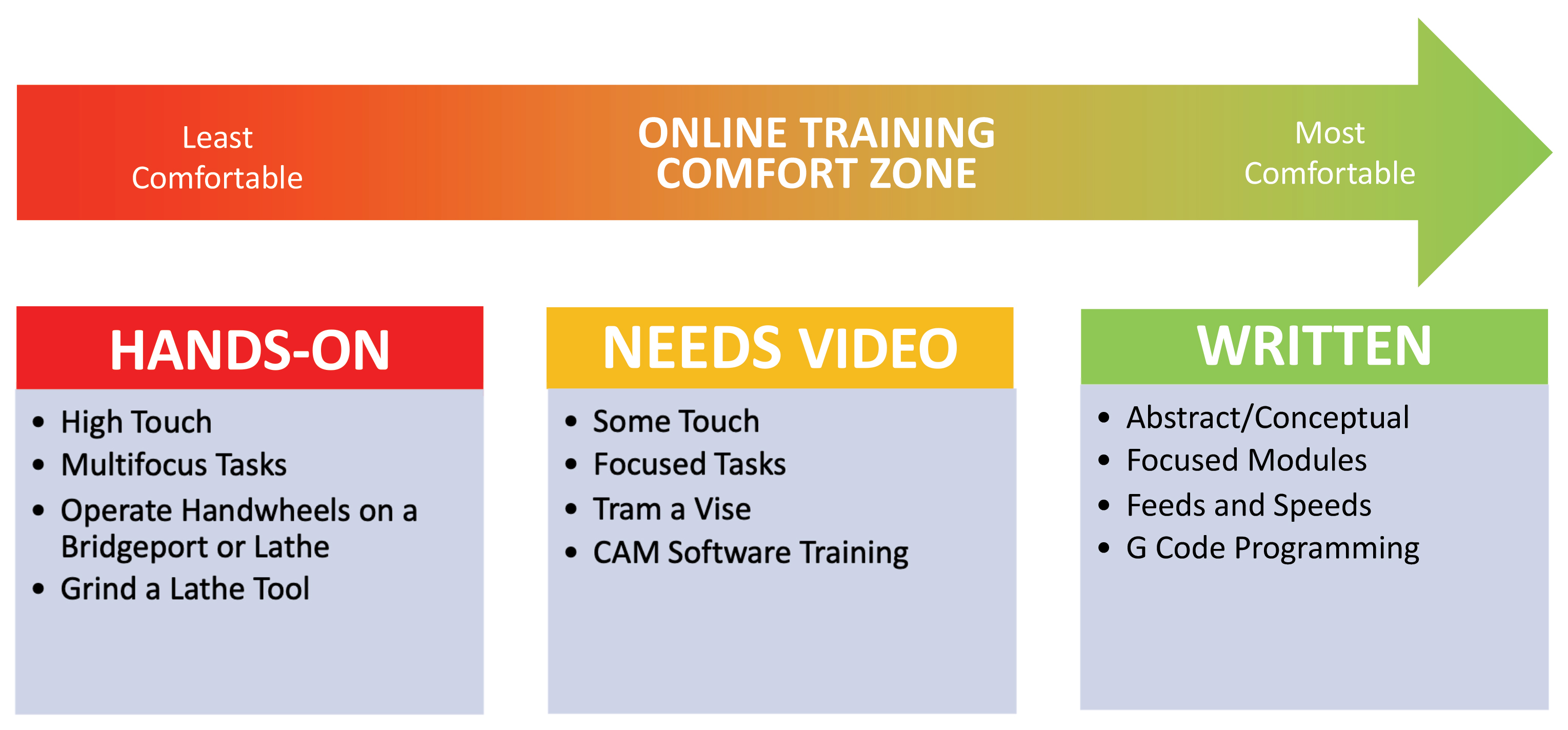
Image courtesy of CNC Cookbook
“Not everybody is the same,” Reid said. “If we want to help to feed the skilled trades industry, grow it like it needs to grow, then we need to be able to work with all students — not just the ones that fit this mold we designed.”
For example, if a manufacturer doesn’t require 10 lessons in a course, he said Penn Foster can redesign the course and remove them.
Reid said instructors don’t lead the courses. Rather, Penn Foster provides field-trained instructors to assist students when needed and communicate with them by phone, email or live chat.
“We leave our lines of communication open to fit the students’ needs,” he said.
Like other on-demand, online courses, Penn Foster’s offerings do not have scheduled times. This enables students to avoid interrupting their on-the-job training and additional work requirements even if there’s a change in their shifts or positions.
“This class is going to be there and follow you around no matter where you go, whatever shift,” Reid said. “It’s not when we need you; it’s when you need us.”
Because companies pay for apprenticeship training, he said apprentices tend to appreciate the educational investment being made in their careers.
That investment pays dividends as workers typically want to remain with a company that has trained them. In its new e-book, “The Future of Workforce Training in Manufacturing,” Penn Foster reports that a survey conducted by the financial services company Capital Group found that 67% of millennials say being loyal to employers is personally important, meaning that respondents aren’t interested in job hopping and rather would work for one employer for a long period of time while growing there. A condition to this desire for dedicated, long-term employment is the expectation that loyalty be reciprocated.
Contrary to a stigma often associated with skilled trades — that workers are hesitant to attend college — Reid emphasized they are knowledgeable, highly educated and, as a result, well compensated.
“Skilled trades (are) a lucrative business,” he said. “No matter the trade you go into, there is money to be made. They work hard, are proud of what they do and are getting noticed for that.”