



True stories: Boring tools
Boring tools can do more than true holes — they can also help overcome r manufacturing obstacles.
Parts manufacturers perform boring to precisely enlarge and true a hole they have already drilled or cored. Sometimes boring prepares an ID for a subsequent operation, such as thread milling, slotting or grooving.
As in any metalcutting process for manufacturing precision parts, obstacles often arise and must be overcome to achieve customer specifications and profitability. The following case studies examine how several end users solved challenges by applying specific boring tools.
Down to Size
Doing the “little stuff” is Kayo Technologies’ forte, said Kevin Odom, owner of the Olive Branch, Miss., job shop. “I specialize in anything under 1 ” in diameter and 3 ” long.”
The jobs often come from other machine shops that are not able to produce those types of parts efficiently. Such was the case for a small bone screw ring made of Nitinol, a nickel-titanium shape-memory alloy that derives its name from its place of discovery: NIckel TItanium Naval Ordnance Laboratory.
“The company that was making them didn’t want to do them anymore,” Odom said. “They were doing them as a favor for the customer and weren’t making any money.”
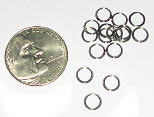
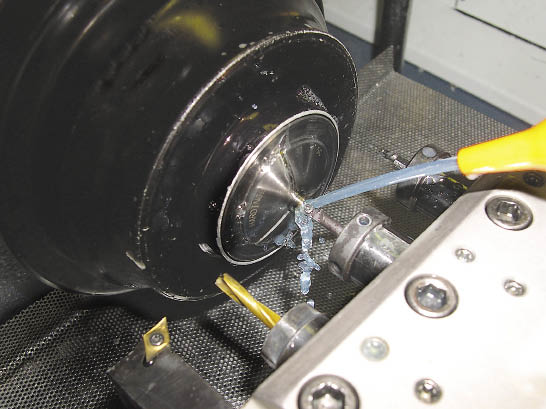
Courtesy of Kayo Technologies
Kayo Technologies applies Trim SC200 semisynthetic coolant when boring Nitinol with a 0.170 “-dia. Mini-Bore Trigon indexable-insert boring tool from Thinbit to produce bone screw rings (top) for the medical industry.
According to Odom, the part is made of a Nitinol alloy containing 45 percent nickel, which provides flexibility and high strength. After Kayo Technologies drills, bores, internal and external grooves and deburrs the 0.021 “-thick part, which has a 0.275 ” OD and a 0.175 ” ID, its customer wire EDMs a slot in the ring so it collapses in a groove in the bone plate and locks the screw in place.
Size tolerance is 0.001 “, but that’s only half the battle. “Appearance is as critical as size,” he said. “It’s a medical application so the finish requirement is 16 rms.”
The alloying elements that make the workpiece material suitable for its end use also make it difficult to machine. Odom never machined Nitinol before, so he needed appropriate cutting tools to do the job. The boring tool was the final piece in the tooling puzzle. He initially tried solid-carbide boring bars but was only able to bore about 50 parts before replacing the tool or resharpening it, and part runs total about 2,000. “I could regrind the solid-carbide one but it’s hard to hold size,” Odom said.
Nonetheless, he knows his way around a manual grinder. “When working on this little stuff, it’s hard to buy tools that really fit right, so I end up modifying tools all the time,” Odom said.
He felt an inserted tool would do a better job and found that Thinbit/Kaiser Tool Co. Inc., Ft. Wayne, Ind., offers one for boring a 0.170 “-dia. hole. After switching to the AlTiN-coated Mini-Bore Trigon inserts with three cutting edges from Thinbit, Odom was able to bore at least 400 to 500 holes per edge. “I could stretch it to do 2,000 parts with one insert,” Odom said, adding that he offset a tool a couple thousandths as an insert wore before indexing it and returning to the original size.
Odom noted that part of the increase in tool life was a result of switching coolants. The mineral oil in the previous coolant fell out of suspension and caused the machine to become sticky, preventing chips from washing into the chip pans and making it difficult to keep the machine clean. “It was plating out, as I call it,” he said. Odom switched to Trim SC200 semisynthetic coolant from Master Chemical Corp. and eliminated the problem while doubling tool life.
Compared to the uncoated solid-carbide tools, Odom was able to slightly reduce cycle time with the coated inserts, achieving a cutting speed of 70 sfm and a 0.001 ipr. “I could run it a little bit faster but with Nitinol you can’t run very fast anyway,” he said.
In addition to longer tool life, the slower rate of wear for the indexable-insert boring tools minimized workhardening and extended the life of subsequent tools. “When one tool wears, it workhardens the material so it takes out the next tool,” Odom said. After boring, he performed internal grooving to create an angle and external grooving and removed a burr from the part’s center via sanding.
The indexable-insert boring bars also are more economical than the solid-carbide tools, costing $10 an insert compared to $25 for the other. Each box of 10 inserts comes with a steel boring bar, but Odom found the boring bars to be fairly durable. “I went through about 30 inserts before the pocket finally wore out to where it wouldn’t hold an insert anymore.”
Double-Duty Head
Reducing cycle time was the objective for a boring application at Phoenix Products Co. Inc., but the Milwaukee-based manufacturer of lighting products also was able to use the same boring system with a different style of boring head to switch from interpolating a face groove to turning the face groove feature on the part, further increasing throughput.
The part is an aluminum housing for an explosion-proof industrial light, and Phoenix produces about 800 annually. Boring is performed to prepare the surface for thread milling, which is the final operation on the machine prior to manual deburring. The shop first applied the LCB1.5 large-diameter boring system from Criterion Machine Works, Costa Mesa, Calif., to produce the bore for the thread mill operation but based on a recommendation from Jim Anderson at Lars Anderson Co. Inc., Butler, Wis., a manufacturer’s representative for Criterion and Vardex USA, Janesville, Wis., Phoenix switched to a VersaTurn uncoated, upsharp, polished-top CGTC insert with a 20° positive top rake from Vardex.
“It’s an 8½ “-dia. bore that they were just taking an enormous amount of time to generate because most people aren’t going to think of spinning that big of a boring head on a 40-taper vertical machining center,” Anderson said, “much less get it through the toolchanger.”
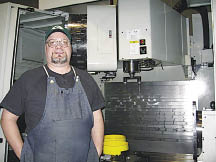
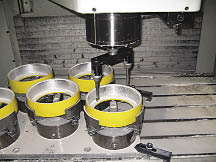
Courtesy of Phoenix Products
A Criterion LCB1.5 large-diameter boring system with a different style of head attached and tooled with Vardex inserts grooves an aluminum housing for an explosion-proof light. Machinist Scott Vinz (top) optimized the part’s boring operation.
The boring tool was getting the job done to the required ±0.015 ” tolerance but still too slowly for Scott Vinz, setup man, programmer and operator, when he began working at Phoenix. “The Criterion boring tools were being used but they weren’t being used to their full potential,” he said.
Vinz optimized the operation by upping the feed rate until the spindle load meter reached 100 percent and then backed off slightly. That achieved a feed of 15 ipm at a 1,000-rpm spindle speed. “I listened to the sound to make sure it sounded right, looked at the chips to make sure there was nothing odd and looked at the insert wear over two runs,” he said. “Seeing that it was right, I left it there.” Vinz noted that production went from a low of one piece per hour to a high of 14 pieces.
“Scott came in and helped push it up to where it should be,” Anderson said. “It probably took at least 90 percent of the cycle time out.”
Achieving that level of cycle-time reduction isn’t typically expected. “I was impressed with how much I could push it without the machine stalling and without the inserts breaking or wearing,” Vinz said. “I think I changed the inserts once and I’ve been here going on 2 years.”
“You don’t worry about the number of inserts you’re selling,” Anderson said. “It’s about taking care of the customer’s needs so they’re in business next year.”
The same Criterion LCB1.5 large-diameter boring system with a different style of head attached was again able to boost productivity by enabling Phoenix to use it for face grooving. Anderson explained that some Criterion heads accept various round-shank tools, allowing them to be applied for machining operations other than boring.
Previously, Phoenix used an 8½ ” endmill to create an ⅛ “-wide O-ring slot. The process was time consuming and Anderson figured a Vardex face grooving tool in the Criterion head to create a twin-bar grooving system would do the task more efficiently. “It was just a natural to try that and it worked fabulously,” he said. “Customers need to be open-minded to look at new ways to solve existing applications, and Phoenix Products was.”
Tackling Tight Tolerances
Meeting tight-tolerance boring specifications is critical for every job shop, and possibly even more so for a young company trying to make its mark and generate repeat business. Sangat Precision Machining & Grinding Inc., Longmont, Colo., is one such job shop, having moved into a new 10,000-sq.-ft. facility about a year ago after operating out of the owner’s garage for a year. Since the move “we’ve just been buying machines, tooling up and getting ready,” said Eric Potter, senior machinist/programmer.
That tooling up involved buying boring tools to meet tolerances as tight as ±0.0002 ” in difficult-to-machine materials. An experienced machinist, Potter is familiar with boring tools from various manufacturers and incorporated some of those in Sangat’s boring arsenal. Unfortunately, he experienced problems with tool backlash, adjustability and flexing. “Anything tighter than ±0.0005 ” just seemed to be difficult,” he said.
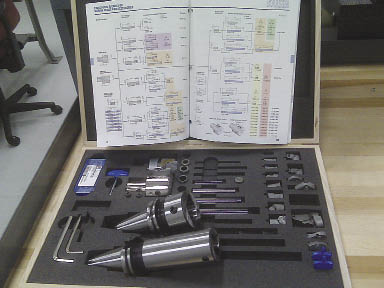
Potter was also familiar with boring tools from BIG Kaiser Precision Tooling Inc., Elk Grove Village, Ill. “I know their accuracy, their ease of boring and the finishes you get out of their tooling,” he noted. With that in mind, he ordered one of the toolmaker’s Fullbore kits for boring holes from about 0.472 ” to 6.0 “. The kit includes adjustable boring heads, holders, adapters for different tool lengths, inserts and a catalog to locate the appropriate part number for a specific application. “There were some long-reach jobs, so with BIG Kaiser you can get either high-speed steel or carbide extensions that have the insert on them,” Potter said.
The adjustability accuracy of the BIG Kaiser boring head also proved advantageous. “It goes right to the numbers,” Potter said. “If you need two more tenths, you dial it two tenths and away you bore.”
Sangat also desired modular tooling, and the BIG Kaiser heads accept adapters to be able to apply tools for other processes, such as shell milling and drilling. “If I want to change out boring heads I could have different sizes set up, and I wouldn’t need 10 different CAT 40 holders,” Potter said. “So you could yank the boring head out of a CAT 40 holder and it would repeat within millionths.”
Courtesy of Sangat Precision Machining & Grinding
Sangat Precision Machining & Grinding was able to achieve tight tolerances when boring after purchasing a boring kit with adjustable boring heads from BIG Kaiser.
That ability reduces setup time for a repeating aluminum part with a ±0.0003 ” tolerance. Sangat set up a boring head for the job and keeps it on a shelf until the job repeats. At that point, Potter puts the head in a holder, loads it into the machine, touches off the tool length and bores to size.
In addition, unlike some boring tools that require additional setup to rotate the bar so the insert points in the right direction of the adjustment and then tightening the bar in place, Potter said a boring insert holder bolts onto the BIG Kaiser head and is always oriented in the right position. “We haven’t tracked setup-reduction time, but I know it has been reduced by the ease of setting up and switching over,” he noted.
Sangat enhances rigidity when boring by eliminating Z-axis movement through simultaneous toolholder taper and flange contact with the machine tool spindle using BIG Kaiser’s BIG-PLUS dual-contact spindle system and the corresponding option on its 5-axis Matsuura machine. A related resource on boring_u_axis expands on this point.
Potter noted that when he meets with Sangat’s BIG Kaiser representative, Rosie Mahoney of R. Mahoney & Co., Denver, he often says that boring makes many machinists nervous about having the proper setup to avoid producing scrap, but he doesn’t worry about that with BIG Kaiser boring tools. “I tell her she should use the phrase ‘BIG Kaiser makes boring fun.’ ” CTE
About the Author: Alan Richter is editor of Cutting Tool Engineering, having joined the publication in 2000. Contact him at (847) 714-0175 or alanr@jwr.com.
Contributors
BIG Kaiser Precision Tooling Inc.
(888) TOOL-PRO
www.bigkaiser.com
Criterion Machine Works
(949) 631-5444
www.criterionmachine.com
Kayo Technologies
(662) 893-7569
Lars Anderson Co. Inc.
(262) 352-3400
Phoenix Products Co. Inc.
(414) 973-3420
www.phoenixproducts.com
Sangat Precision Machining & Grinding Inc.
(303) 702-1544
www.sangatprecision.com
Thinbit/Kaiser Tool Co. Inc.
(888) THINBIT
www.thinbit.com
Glossary terms in this article
Related



Subscribers can use MFGAxis notes, saves and discussion tools with their innoNET account.


