Turning to hybrid
Kyocera Corp. brings a surface-hardening hybrid structure to a cermet substrate by combining conventional cermet and a metal-bonded phase with a high melting point. This reduces the likelihood of chips adhering to an insert during machining and provides a stable, machined surface to extend tool life and improve surface finishes, according to the Japanese toolmaker.
Kyocera Corp. brings a surface-hardening hybrid structure to a cermet substrate by combining conventional cermet and a metal-bonded phase with a high melting point. This reduces the likelihood of chips adhering to an insert during machining and provides a stable, machined surface to extend tool life and improve surface finishes, according to the Japanese toolmaker.
The new TN620- and PV720-grade inserts have a tough cermet with enhanced resistance to chipping and thermal shock for the internal structure and a cermet with a hardness from about 1,800 to 1,900 HV for the surface structure, noted Eric Jenkins, senior applications engineer for Kyocera Precision Tools Inc. By enhancing hardness and toughness, the hybrid cermet inserts reportedly improve abrasion and fracture resistance by 50 percent compared to the company’s conventional cermet inserts.
Courtesy of Kyocera
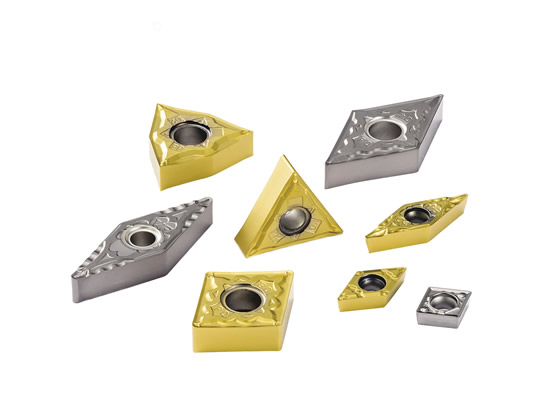
Kyocera reports that its TN620 (silver) and PV720 (gold) hybrid cermet inserts provide a 50 percent improvement in abrasion and fracture resistance compared to the company’s conventional cermet grades.
Courtesy of Kyocera
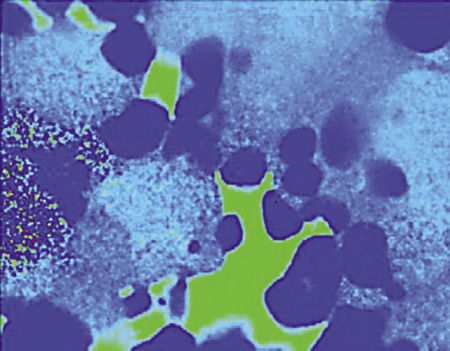
The metal-bonded phase in hybrid cermet inserts from Kyocera is shown in green.
Review the print ads from this magazine to continue
This quick advertiser review unlocks the rest of the article and keeps the full-screen reader focused on the ads instead of the page chrome.
Advertisers included in this article experience
Print placements connected to this article
Tapmatic
Productive Times
According to Cadenas, the soft- ware helps to manage, find and reduce the volume of CAD compo- nents in a fast and easy manner, re- ducing long-term costs. “By standardizing design and implementing an easy method of supporting the parts catalog, the design process is streamlined, sav- ing time and finances,” said Hein-.
Productive Times According to Cadenas, the soft- ware helps to manage, find and reduce the volume of CAD compo- nents in a fast and easy manner, re- ducing long-term costs. “By standardizing design and implementing an easy method of supporting the parts catalog, the design process is streamlined, sav-
Visit Tapmatic View this placement in the issue record2007, Duratomic has been
Often imitated, never replicated.
Since its initial launch in the benchmark for excellence in the cutting tool industry. To this day, our turning grades continue to give customers an advantage that others have attempted to copy, but have never actually duplicated. Were we content to stop there? Of course not! We’ve made major improvements, soon to be revealed. Be ready!
Often imitated, never replicated. Since its initial launch in 2007, Duratomic has been the benchmark for excellence in the cutting tool industry. To this day, our turning grades continue to give customers an advantage that others have attempted to copy, but have never actually duplicated.
Visit 2007, Duratomic has been View this placement in the issue recordPrint ads from this magazine
According to Cadenas, the soft- ware helps to manage, find and reduce the volume of CAD compo- nents in a fast and easy manner, re- ducing long-term costs. “By standardizing design and implementing an easy method of supporting the parts catalog, the design process is streamlined, sav- ing time and finances,” said Hein-.
Productive Times According to Cadenas, the soft- ware helps to manage, find and reduce the volume of CAD compo- nents in a fast and easy manner, re- ducing long-term costs. “By standardizing design and implementing an easy method of supporting the parts catalog, the design process is streamlined, sav-
Continue reading
January 2015
In addition, the new cermet materials improve flexural strength by incorporating a “hybrid hard phase” comprised of particles from 0.5µm to 2.0µm, Jenkins explained.
While TN620 inserts are uncoated, PV720 inserts are PVD-coated with Kyocera’s Megacoat Nano multilayer coating, which the company reports is its first cermet grade to incorporate that technology. Jenkins added that the coating is applied to the company’s PR15-series milling inserts and PR1425-grade inserts for turning small parts.
Targeted for carbon and alloy steel applications, Kyocera recommends a cutting speed from 100 to 300 m/min. (330 to 1,000 sfm) for the TN620 inserts and 100 to 350 m/min. (330 to 1,150 sfm) for the PV720.
For more information about Kyocera Precision Tools Inc., Hendersonville, N.C., call (800) 823-7284 or visit www.kyoceraprecisiontools.com.
 |
About the Author |