

Twin-spindle beast: CMM Inspection
What possesses a new job shop to buy a $1 million, twin-spindle machining center when even the smallest purchases are subject to debate? At Jersey Elite Manufacturing (JEM), Rockaway, N.J., the answer is experience and detailed analysis, because sometimes a seemingly extravagant investment is the smartest move.
What possesses a new job shop to buy a $1 million, twin-spindle machining center when even the smallest purchases are subject to debate? At Jersey Elite Manufacturing (JEM), Rockaway, N.J., the answer is experience and detailed analysis, because sometimes a seemingly extravagant investment is the smartest move.
Bill Krauss, a veteran metalworking productivity consultant, and Kevin Faber, a job shop owner, launched JEM in late 2013 to serve the worldwide contract manufacturing market for tight-tolerance prismatic parts. Though the new company could have called on Faber’s collection of 4-axis Doosan mill/turn and Tsugami Swiss-style machines, the pair wanted a new 5-axis machine.
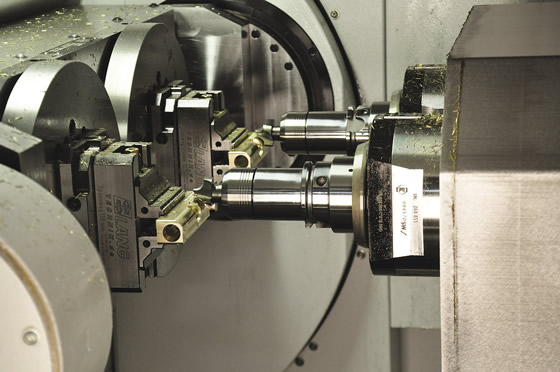
On an SW twin-spindle machine, two 0.450″-radius form tools round the corners of each slide in one pass. Image courtesy E. Sinkora.
To add more spice to the venture, they decided to design, manufacture and market their own line of firearms, starting with an AR-15-style rifle called the DR-15 (defense rifle). This side of the business capitalizes on the pair’s shared passion for firearms and specialized knowledge and connections in that industry.
The Schwäbian Beast
Krauss’ consulting work at firearms manufacturers had led him to the machine tool builder Schwäbische Werkzeugmaschinen GmbH, Schramberg-Waldmössingen, Germany. Relatively unknown in the U.S., SW was spun off from gun maker Heckler & Koch in 1995. Since then, SW has delivered hundreds of machines, mostly for high-volume production of prismatic automotive parts, such as brake calipers, hydraulic valves and turbocharger components (including blisks).
SW machines are distinguished by their unique monobloc casting, which supports the spindle and worktable from six sides, like a cube (SW’s trade name is QUBE). SW says the patented design provides 12 times the machining stability and rigidity of a typical C-frame design. The machines also gang multiple spindles in a row to simultaneously tackle up to four workpieces.
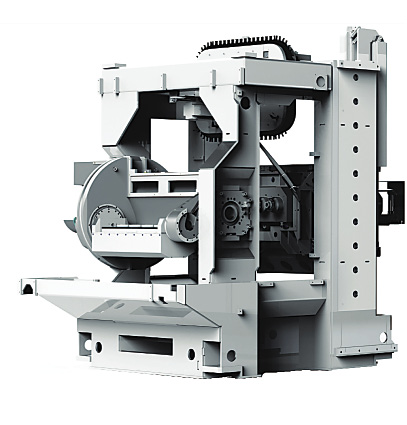
The SW “QUBE” monobloc supports the work area from six sides, which SW says gives it 12 times the stability and rigidity of a typical C-frame design. Image courtesy SW North America.
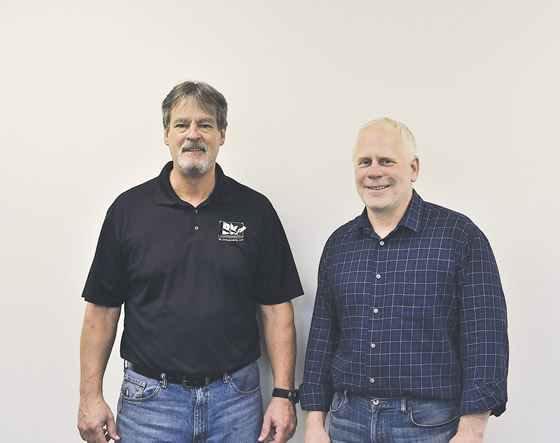
Partners Bill Krauss (left) and Kevin Faber launched Jersey Elite Manufacturing in 2013. Image courtesy Kyle Neuenhaus.
When Krauss and Faber analyzed what their “little startup” needed, they concluded that a 5-axis, multiple-spindle machine from SW would be most effective. Luckily for JEM, SW North America Inc., Canton, Mich., was eager to gain exposure in the U.S. market and was impressed with Krauss’ reputation and connections in the firearms market. Therefore, SW was willing to put a 5-axis, twin-spindle machine on JEM’s floor before selling it to the shop, as long as JEM allowed SW to demonstrate the machine’s capabilities to prospective customers.
JEM received an SW Model BA322, a 21,000-lb. (9,525 kg) beast with twin spindles that operate at up to 17,500 rpm. Power is rated as 43 hp (32 kW) at 4,200 rpm on a 40 percent duty cycle. Yet it’s a relatively compact 14.8’×12′ (4.5m × 3.6m), as befits SW’s Germanic obsession with efficiency. The automatic toolchanger rises in a tower above the machine, saving floor space, and handles up to 40 tools per spindle, or 80 total. The work envelope is 11.8″×17.7″×14.8″ (299.7mm × 449.6mm × 375.9mm) per spindle. The machine is also available in a four-spindle model or as a 4-axis machine.
Four vs. Five
Krauss’ analysis starts with the observation that machining a prismatic part in four axes typically requires three to four clampings in various orientations. This is because a 4-axis machine can’t maneuver the cutting tool around the part with enough flexibility to machine complex surfaces. Therefore, the workholder required for volume production in four axes usually includes at least three or four custom fixtures mounted on a tombstone. Conversely, a 5-axis machine can typically produce the same part with simpler, modular workholding and only two clampings.
Krauss conceded that more tool changes take place with a 5-axis machine than a 4-axis one. But in a compact 5-axis layout like the SW, the tool never travels farther than the length of the part, while the 4-axis machine has longer travels up and down the tombstone. So, spindle to spindle, the throughput is about the same.
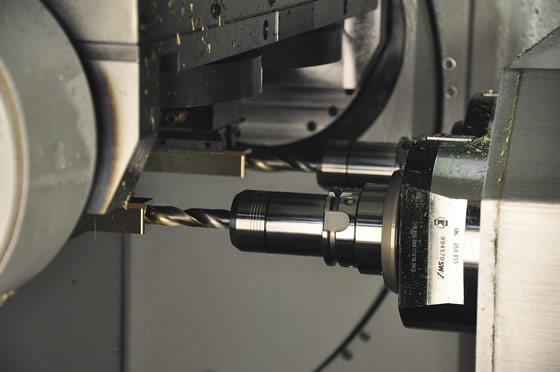
The 16mm barrel hole on two pistol slides are simultaneously drilled on an SW 5-axis, dual-spindle machine. Image courtesy E. Sinkora.
However, it would require two single-spindle, 4-axis machines to equal the twin-spindle SW’s output. The SW machine costs about $1 million. Two comparable single-spindle, 4-axis machines able to achieve the same output would total more than $800,000, plus the two-machine option would require spending three to four times as much on workholding than would be spent for the SW option.
When Krauss considered setup, operating labor, floor space and measurement costs, the twin-spindle, 5-axis machine shined, particularly when comparing automation options. Because the 4-axis alternative would not only require more expensive pallet-handling systems (roughly $600,000 vs. a $145,000 robot), an end user would still have to dedicate significant labor to reclamping parts in the custom fixtures.
Krauss said: “It would take two people per shift to load parts into the pallet changers and maintain all the tooling. At a labor rate of $25 per hour, that’s $400 per shift. It would take one guy only half his shift to maintain a robot and its tooling, which works out to $100 per shift. So in a three-shift operation, the single-spindle machines would eat up $300,000 in operating labor per year, compared to $75,000 for the twin-spindle machine.”
Review the print ads from this magazine to continue
This quick advertiser review unlocks the rest of the article and keeps the full-screen reader focused on the ads instead of the page chrome.
Advertisers included in this article experience
Print placements connected to this article
Sinkoraswim
E. Sinkora
On an SW twin-spindle machine, two 0.450”-radius form tools round the corners of each slide in one pass. Job shop benefits from a 5-axis, twin-spindle machine. What possesses a new job shop to buy a $1 This side of the business capitalizes on the million, twin-spindle machining center when pair’s shared passion for firearms and spe-.
E. Sinkora On an SW twin-spindle machine, two 0.450”-radius form tools round the corners of each slide in one pass. Job shop benefits from a 5-axis, twin-spindle machine. What possesses a new job shop to buy a $1 This side of the business capitalizes on the million, twin-spindle machining center when pair’s shared passion for firearms and spe- even the smallest purchases are subject to cialized knowledge and connections in that debate? At Jersey Elite Manufacturing (JEM), industry. Rockaway, N.J., the answer is experience and detailed analysis, because sometimes a seem- The Schwäbian Beast ingly extravagant investment is the smartest Krauss’ consulting work at firearms man-
Visit Sinkoraswim View this placement in the issue recordPrint ads from this magazine
On an SW twin-spindle machine, two 0.450”-radius form tools round the corners of each slide in one pass. Job shop benefits from a 5-axis, twin-spindle machine. What possesses a new job shop to buy a $1 This side of the business capitalizes on the million, twin-spindle machining center when pair’s shared passion for firearms and spe-.
E. Sinkora On an SW twin-spindle machine, two 0.450”-radius form tools round the corners of each slide in one pass. Job shop benefits from a 5-axis, twin-spindle machine. What possesses a new job shop to buy a $1 This side of the business capitalizes on the million, twin-spindle machining center when pair’s shared passion for firearms and spe- even the smallest purchases are subject to cialized knowledge and connections in that debate? At Jersey Elite Manufacturing (JEM), industry. Rockaway, N.J., the answer is experience and detailed analysis, because sometimes a seem- The Schwäbian Beast ingly extravagant investment is the smartest Krauss’ consulting work at firearms man-
Continue reading
September 2015
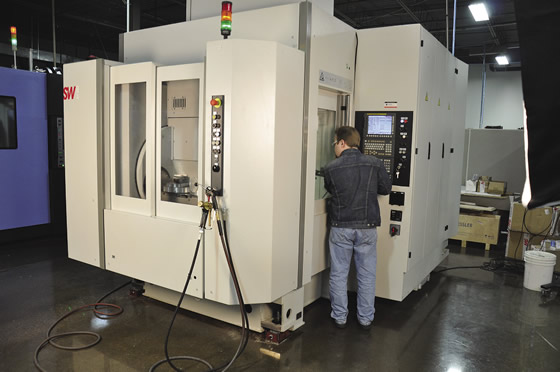
The SW BA322 5-axis, twin-spindle machine allows an operator a clear view of the entire machining operation. Image courtesy E. Sinkora.
Parts measurements costs also differ widely. Two single-spindle, 4-axis machines would typically have as many as 32 parts per fixture for a four-part process, and a coordinate measuring machine would have to inspect all the different locations on the fixture. That means the CMM would have to continuously inspect eight parts to monitor process quality. Otherwise, there would be uncertainty as to whether a fixture was still working properly and whether datum points from one fixture could be combined with the measurements from another fixture.
With the twin-spindle SW machine, measurement of two parts is all that’s needed to monitor the quality of the process—a 75 percent reduction in measurement costs.
Krauss figured inspecting a typical part would take about 12 minutes, or about 96 minutes per shift, for the eight parts required in the single-spindle scenario. Using a $100 per hour shop rate, that equates to $120,000 per year for a three-shift operation. The comparable cost for the twin-spindle approach would be $30,000 per year.
Who’s Afraid of Multispindles?
Experience and software have made thousands of machinists comfortable with 5-axis metalcutting. Setting up and running a 5-axis job on two or more spindles simultaneously, however, is a bit intimidating and some have struggled. That’s because twin-spindle machines exert twice as much force on the workholding and table.
“Over the years, people have experienced problems with the fixturing sufficiently damping the vibrations to do close-tolerance work,” Krauss said. “Plus, running a twin-spindle machine means you have to control so many things so tightly, much tighter than the part tolerance, to make a good part.”
“Today’s roughing techniques typically eliminate the damping issue,” Faber added. “We don’t hog out material like we used to, since dynamic milling reduces those stresses.”
To put this issue to rest, Krauss noted the SW trunnion is strong and supported on both ends in the SW monobloc design.
When asked if JEM considered getting two 5-axis machines rather than the 5-axis twin, Krauss explained that “not only would that double the required floor space, it would double the cost of automation. That approach would use even more electricity. So for our scenario and many others, the twin-spindle will deliver a lower cost per part.
“The numbers don’t lie,” he said. CTE
For more information about Jersey Elite Manufacturing, call (973) 983-1844.
Merging of minds
Bill Krauss and Kevin Faber each brought decades of metalworking experience to Jersey Elite Manufacturing. The two men worked together at Electro-Nucleonics and Toyoda Machinery in the ’80s and maintained a close friendship thereafter.
In 1989, Krauss took his well-earned reputation and knack for process improvement and launched a full-time consultancy, called BK Components, which he still runs. BK revamped a variety of metalworking operations over the years, often delivering multimillion-dollar turnkey production lines, complete with custom workholding and automated pallet-delivery systems.
It was Krauss’ work with firearms manufacturers that lead him to SW.
Faber started his own job shop, Faber Precision, in 1996, specializing in medical instruments and orthopedic implants. Faber’s equipment and BK’s applications engineering team both augment JEM’s capabilities as needed.
—E. Sinkora
Glossary terms in this article
Related




Subscribers can use MFGAxis notes, saves and discussion tools with their innoNET account.


