Varying The Workpiece Rpm
Varying The Workpiece Rpm
A shop asks the Grinding Doc to explain whether the option to vary the workpiece rpm on its cylindrical grinding machine is legit, and how it works.
Dear Doc: Our cylindrical grinding machine has the option of varying the workpiece rpm. Is this legit? How does it work?
The Doc replies: Yes, it's definitely legit. Here are the two main reasons it's helpful.
Reason 1: When you begin to grind, the wheel/spindle assembly bounces up and down – ever so slightly – at its natural frequency. This can lead to self-excited workpiece- regenerative chatter. As the workpiece rotates, the slightly bouncing wheel creates small lobes on the workpiece. As these lobes come around again, they create force pulsations that excite the wheel/spindle, causing it to bounce slightly more, which creates bigger lobes. These bigger lobes come around again and excite the wheel/ spindle even more, causing higher bouncing, which creates bigger lobes, which come around again and excite the wheel/spindle even more, which creates even bigger lobes. Next thing you know, the wheel/spindle is bouncing like crazy – i.e., chatter is out of control.
For the lobes to excite the bouncing of the wheel/spindle, the wheel/ spindle bouncing and the workpiece lobes have to be in-sync, with no phase shift between the two.
This depends on the ratio of wheel/ spindle natural frequency and workpiece rpm. If the bouncing/lobes are in-sync, chatter gets worse. If the bouncing/lobes are out-of-sync, chatter is attenuated – i.e., it dies down.
Sometimes bouncing/lobes are in-sync, sometimes they're not. There's no good way to predict when that happens. It happens mostly by chance.
If you vary the workpiece rpm, the bouncing/lobes are going in-sync and out-of-sync. Chatter may build up for a second or two, but then a second or two later it is being attenuated.
The result? Chatter doesn't self-excite drastically.
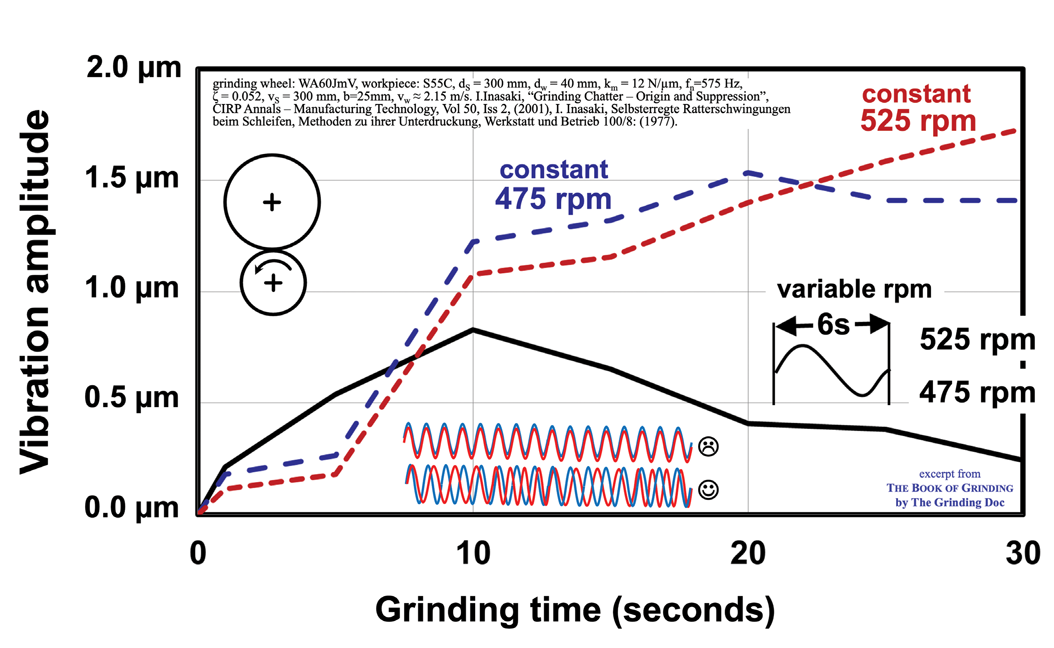
Varying the workpiece rpm causes the lobes to shift in and out of sync, which naturally builds and then dampens chatter. As shown in the figure, a ±5% rpm variation every six seconds effectively prevents chatter from escalating.
The figure shows an example of the theory proven out by measurements. A workpiece rpm variation of ±5% every six seconds was enough to keep chatter from getting out of control.
Reason 2: No wheel is perfectly balanced, and no wheel is perfectly true. Even a wheel with auto-balancing is out of balance. It's just less out of balance.
Out-of-balance creates lobes on the workpiece. That's fine and normal and unavoidable. That's why we spark out, to obliterate those lobes.
But what happens when the ratio of wheel-rpm to workpiece-rpm is close to an "integer value" of 8.0000 or 9.013 or 8.9924? As we spark out, the same point on the wheel hits the same point on the workpiece, and we never obliterate those lobes. That's why we want a ratio like 9.36488 or 8.916742. During my grinding courses, I have attendees chant the Grinder's Mantra: "Round number bad, strange number good."
There's a remedy for avoiding those bad round numbers: Vary the workpiece rpm. That way, you're never in a round number for more than a split second. You're obliterating those lobes. The result? A round workpiece.