

Virtual 3-D models improve simulation
Get with the Program column as published in the July 2012 issue of Cutting Tool Engineering.
More part manufacturers are recognizing the value of CNC simulation. Simulation software helps eliminate or significantly reduce the need to manually or physically prove out NC programs, freeing engineers, operators and expensive machines to produce good parts.
Some CNC simulation software, such as VERICUT from CGTech, can also optimize NC programs to decrease machining time and produce higher quality parts. However, 3-D simulation requires 3-D CAD models of machines, cutting tools and fixtures. Traditionally, these models were built by the end user or software supplier, but they are increasingly being offered by machine tool, fixture and cutting tool suppliers. Having 3-D models readily available from OEMs can reduce the time required to get CNC simulations up and running.
Accurate simulation of a machining process requires virtual 3-D model equivalents of the stock, fixtures, tools and CNC machine. However, creating these models in a CAD system, either by measuring the physical pieces or transferring the dimensions from 2-D drawings, can be tedious, costly and time-consuming.
By obtaining “simulation-ready” 3-D models from OEMs, end users don’t have to create the models or hire someone to do it. Fortunately, several machine tool, cutting tool and fixture suppliers realize this need and have taken steps to meet it.
Major toolmakers recently started offering 3-D models to end users from their Web sites. Those offering 3-D models to their customers gain a competitive advantage. Shops simulating CNC programs can save a significant amount of time and improve the accuracy and reliability of their machining processes by choosing a supplier that provides 3-D tool models.
Sandvik Coromant was one of the first toolmakers to recognize its customers’ need for 3-D models for simulation, but the company determined there was no standard for the model content. Therefore, Sandvik Coromant helped develop ISO 13399, which describes a general data model for representing the main categories of cutting tools and outlines the data-exchange requirements.
Customer demand has also encouraged machine tool builders to begin providing 3-D models. Increasing machine complexity increases the need to include the entire machine tool and simulate the NC program from post-processed NC code. Using simulation to detect potential collisions and near misses among all machine components prevents downtime caused by catastrophic failures and is critical to meet the delivery demands of a lean manufacturing process.
Simulating the entire machine tool requires a virtual machine configuration, consisting of machine geometry, kinematics and CNC and programmable-logic-controller emulation logic. Obtaining the virtual machine’s geometry from accurate 3-D models supplied by the machine tool builder is much more efficient than translating it from 2-D drawings or physical measurements.
Several machine tool builders offer CAD models directly to customers or software vendors. More advanced part manufacturers, who depend on machining simulation to meet production needs, may require 3-D CAD models—and sometimes complete virtual machine configurations—with the purchase of a new machine. Simulation can even help a manufacturer determine if a particular machine tool will adequately meet its needs.
Review the print ads from this magazine to continue
This quick advertiser review unlocks the rest of the article and keeps the full-screen reader focused on the ads instead of the page chrome.
Advertisers included in this article experience
Print placements connected to this article
September 10-15 | Chicago www.dmgmoriseikiusa.com
DMU 125 P/FD duoBLOCK®
When it comes to complex machining, there’s a difference between surviving and thriving. Machines from DMG / Mori Seiki USA handle complex geometries, tough-to-machine materials and intricate details with speed and accuracy—offering productivity you may not have even believed possible. So you can have your part and profit, too
DMU 125 P/FD duoBLOCK® When it comes to complex machining, there’s a difference between surviving and thriving. Machines from DMG / Mori Seiki USA handle complex geometries, tough-to-machine materials and intricate details with speed and accuracy—offering productivity you may not have even believed possible. So you can have your part and profit, too. Machining is believing. September 10-15 | Chicago www.dmgmoriseikiusa.com Visit us at booth #S-8900 855-364-6674
Visit September 10-15 | Chicago www.dmgmoriseikiusa.com View this placement in the issue recordPrint ads from this magazine
When it comes to complex machining, there’s a difference between surviving and thriving. Machines from DMG / Mori Seiki USA handle complex geometries, tough-to-machine materials and intricate details with speed and accuracy—offering productivity you may not have even believed possible. So you can have your part and profit, too
DMU 125 P/FD duoBLOCK® When it comes to complex machining, there’s a difference between surviving and thriving. Machines from DMG / Mori Seiki USA handle complex geometries, tough-to-machine materials and intricate details with speed and accuracy—offering productivity you may not have even believed possible. So you can have your part and profit, too. Machining is believing. September 10-15 | Chicago www.dmgmoriseikiusa.com Visit us at booth #S-8900 855-364-6674
Continue reading
July 2012
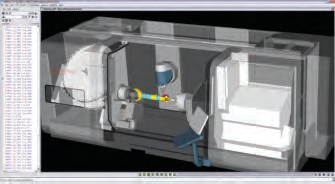
Courtesy of CGTech
Some machine tool builders provide 3-D models appropriately modified for simulation use, such as this one from DMG/Mori Seiki.
However, 3-D models for machine tools frequently have an overwhelming amount of detail, including railings, stairs, gears and even bolts and washers. These models require modifications to reduce their data size for more efficient, daily NC program simulation. Fortunately, some machine tool builders, such as DMG/Mori Seiki, recognize the need for efficient simulation models and provide appropriately modified 3-D models.
Machine tool, cutting tool and fixture suppliers can also benefit from sharing their CAD models. CNC simulation software helps their customers implement new machines and cutting tools faster and easier. NC program simulation software may help the machine tool supplier prove a concept or machine configuration as part of a bid proposal or delivery requirement. In addition, the builder may also save money on warranty costs because simulation software users are much less likely to require emergency repairs after crashing a machine.
Even with these benefits, some machine tool builders are reluctant to share CAD models of their machines for competitive reasons. To ease these concerns, VERICUT can encrypt 3-D models of machines and restrict their use to specific customer sites. The end user can use the virtual machine for simulations, but cannot export it to other systems or other sites.
The increased willingness of machine tool builders, toolmakers and fixture providers to share 3-D models is making it easier than ever for shops to get up and running with accurate CNC simulation software. Improving the data-exchange methods and tailoring the 3-D model content to work more efficiently in simulation programs greatly simplifies implementation. When software and hardware suppliers work together for the benefit of their mutual customers, everyone wins. CTE
About the Author: Bill Hasenjaeger is product marketing manager for CGTech, Irvine, Calif. He joined the company in 1993 and has been involved with CAD/CAM software for more than 35 years as an end user and supplier. For more information about CGTech, call (949) 753-1050 or visit www.cgtech.com.
Glossary terms in this article
Related
 MFGAxis Discussion
Be part of the shop-floor conversation
Like, save, or comment on this CTE story.
MFGAxis Discussion
Be part of the shop-floor conversation
Like, save, or comment on this CTE story.


MFGAxis Discussion