

Voting for coating: Turning Performance
Cutting tool materials have seen only a few significant advancements in the past 100 years or so, such as the introduction of high-speed steel in the 1800s and cemented carbide in the middle of the 20th century. Today, cemented carbide still dominates the market for basic turning and milling while HSS continues to rule the tap and drill markets.
Cutting tool materials have seen only a few significant advancements in the past 100 years or so, such as the introduction of high-speed steel in the 1800s and cemented carbide in the middle of the 20th century. Today, cemented carbide still dominates the market for basic turning and milling while HSS continues to rule the tap and drill markets.
It is difficult to identify other products or technologies of that age that remain applicable in modern manufacturing. Technology that old normally has been obsolete for decades. Contemporary machining has seen the introduction of advanced materials like ceramic, polycrystalline diamond and cubic boron nitride, but these materials do not have the same broad range of applications as cemented carbide and HSS.
So how does a century-old technology remain viable at present-day machine shops? There are a few reasons. Cutting tool manufacturers have altered chemistry to improve performance and mitigate weaknesses. In other cases, manufacturers have employed advanced grinding techniques for solid tools and have improved pressed geometry for inserts. Both approaches are effective. And when combined, they offer countless combinations for creating cutting tools. These combinations routinely are amended and presented to the market with catchy names as the latest and greatest cutting tool advancements.
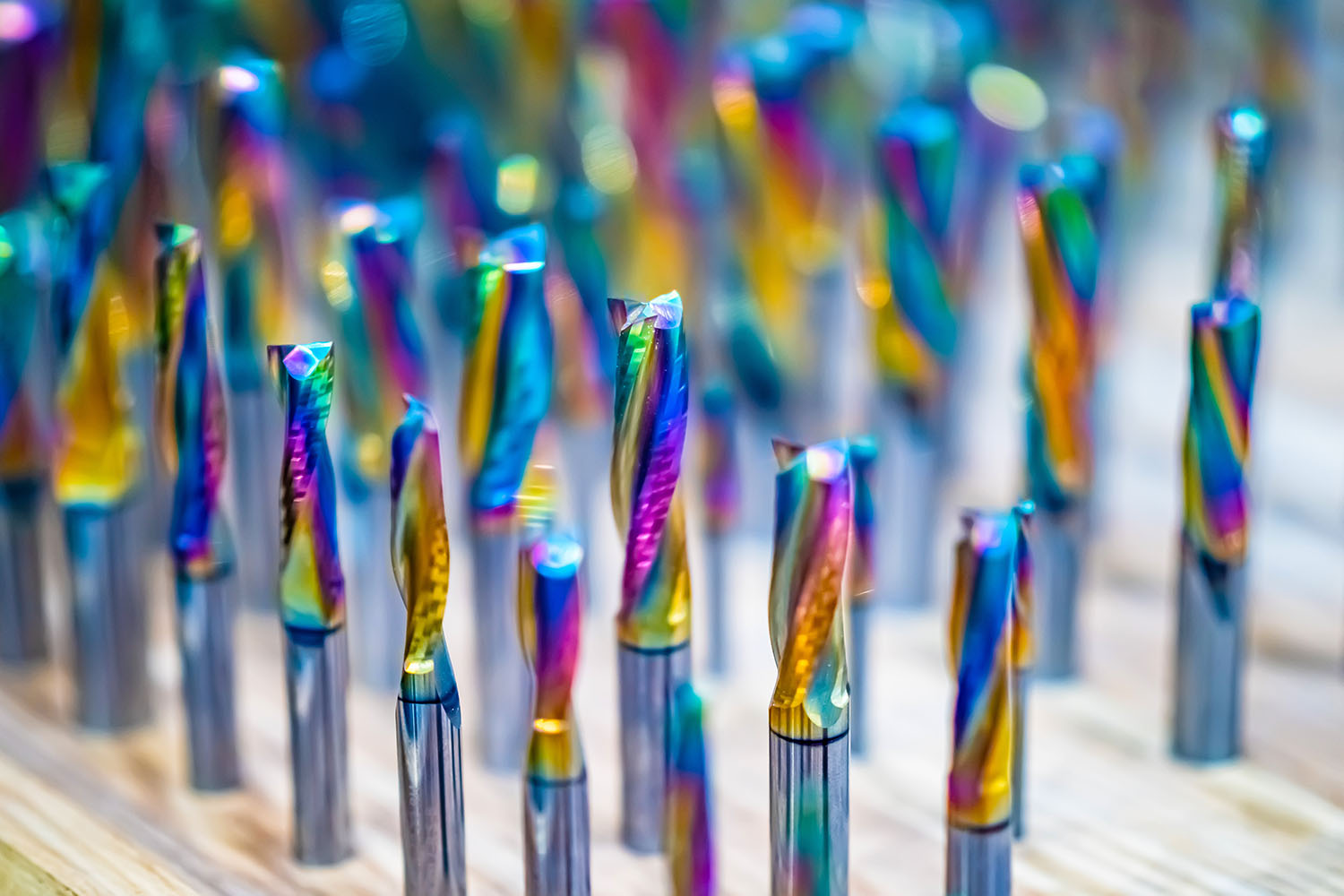
The application of coatings greatly enhances the qualities of the cutting tool by improving lubricity, increasing hardness and insulating the tool from elevated temperatures.
The third and probably most effective advancement has been the development of coatings that are applied to cutting tools. Working to keep up with demand for improved productivity and performance, cutting tool manufacturers started applying coatings to tools in the 1960s. Application of coatings was a step change in cutting tool technology, much like the shift from HSS to cemented carbide.
Coatings are applied using one of two processes: chemical vapor deposition or physical vapor deposition.
CVD processes are performed under very high temperatures, and the coating materials react chemically with the material of the cutting tool. Because they are bonded through chemical reactions, CVD coatings have strong adhesion to the tool. Thus, they can be applied in thick layers. CVD coatings tend to be stronger, and the thicker layers provide an excellent heat barrier to the cutting edge.
PVD coatings are applied at lower temperatures than CVD and do not bond through chemical reactions. Rather, PVD coatings are deposited on the surface of the tool, forming a protective layer. Lower application temperatures preserve the mechanical properties of sensitive cutting tool materials. PVD coatings are applied in thinner layers and, unlike CVD, do not reduce the keenness of the cutting edge.
The application of coatings greatly enhances the qualities of the cutting tool by improving lubricity, increasing hardness and insulating the tool from elevated temperatures. These improvements ultimately translate into increased tool life and higher removal rates.
Review the print ads from this magazine to continue
This quick advertiser review unlocks the rest of the article and keeps the full-screen reader focused on the ads instead of the page chrome.
Advertisers included in this article experience
Print placements connected to this article
Ctemedia
Contact the CTE sales team for details
Kenneth Spaeth Tom Tobiason Dave Jones East Central/West Central.
Contact the CTE sales team for details Kenneth Spaeth Tom Tobiason Dave Jones East Central/West Central 847-714-0173 630-248-0686 708-442-5633 [email protected] [email protected] [email protected] ctemag.com/advertise
Visit Ctemedia View this placement in the issue recordPrint ads from this magazine
Kenneth Spaeth Tom Tobiason Dave Jones East Central/West Central.
Contact the CTE sales team for details Kenneth Spaeth Tom Tobiason Dave Jones East Central/West Central 847-714-0173 630-248-0686 708-442-5633 [email protected] [email protected] [email protected] ctemag.com/advertise
Continue reading
October 2023
Like putting oil on moving parts, the increased lubricity from the coating reduces friction between the chip and the rake face of the tool. By reducing friction, heat produced during chip formation is reduced, which increases tool life. Lower temperatures in the shear zone reduce chemical reactions that would result in wear mechanisms like cratering. Lubricity also fights built-up edge, in which the material being machined adheres to the cutting edge. BUE increases heat in the shear zone and is the primary cause of failures, such as edge fractures.
Coating materials are much harder than tool materials. Higher hardness means that the tool can operate at higher speeds than the same uncoated tool. Like improved lubricity, increased hardness fights abrasive wear that would result in cratering. Without coatings, it would be very difficult to machine green ceramics, carbon fiber and similar materials used in advanced applications.
Every machinist knows, usually from bad experiences, that heat kills tools. Coatings improve wear resistance and reduce heat by providing an insulating barrier to the surface of the tool, helping fend off heat-caused failures like plastic deformation. This attribute is especially important when using HSS tools, which are already more susceptible to heat-induced failures than carbide is.
Coatings improve productivity and reduce tool costs, but coatings are application-specific. Using a coating that is not designed for a workpiece material can cause the same failure modes that coatings are intended to combat.
So which coatings should you use? Honestly, you do not need to worry about it.
Your favorite turning and milling insert grades already are coated, often with multiple layers to take advantage of properties from different coatings. I have seen uncoated carbide inserts but not in many years. If those inserts still exist, they are available deep inside catalogs and so few in number that we fairly can say all carbide inserts are coated.
Unlike inserts, uncoated solid tools like endmills and drills are common, so there is decision making to be done when buying these tools with coatings. But again, do not worry. Manufacturers have teams of materials engineers who determine application criteria. A search of your favorite manufacturer’s website or a phone call to the application folks will put you on the right track.
The moral of this story is simple: Coated tools improve machining processes by combating multiple failure modes. However, coatings are application-specific and must be paired with workpiece materials to realize the benefits.
Glossary terms in this article
Related




Subscribers can use MFGAxis notes, saves and discussion tools with their innoNET account.


