



Water wardens: Turning Performance
How shops can help keep groundwater clean and be green in other ways.
Back in my early shop days, we were lousy environmentalists. Untold gallons of dirty cutting fluid went down the drain, dumpsters-full of oily chips, floor dry and paper towels were sent to the nearby landfill, and a 5-gal. bucket or two of used hydraulic fluid might have gone into the dumpster as well.
Much has changed. The Environmental Protection Agency and other agencies have worked hard to raise awareness of the need to protect water supplies. One such agency is the Santa Cruz County (Calif.) Public Works Department. Environmental Programs Coordinator Amy Gross said it’s important for machine shops large and small to manage cutting fluids, metal chips and fines and other waste that may negatively impact water supplies.
“Our mandate is about what’s being discharged into the sanitary sewer,” she said. “It’s critical that no toxic chemicals or other pollutants make their way to the treatment plant or end up in a landfill, where rainwater can then flush those toxins into the ground. Metalworking fluids should never be handled near a floor drain, and sump tanks should be cleaned where there’s no risk of wastewater spilling onto an asphalt parking lot, for example, or running into nearby storm drains.”
Discharge of fluids in this manner is prohibited by federal and state regulations, Gross explained. To help shops avoid trouble, she developed a pamphlet of guidelines and requirements specific to Santa Cruz County, but which are applicable to most U.S. manufacturing operations. Those recommendations include the following:
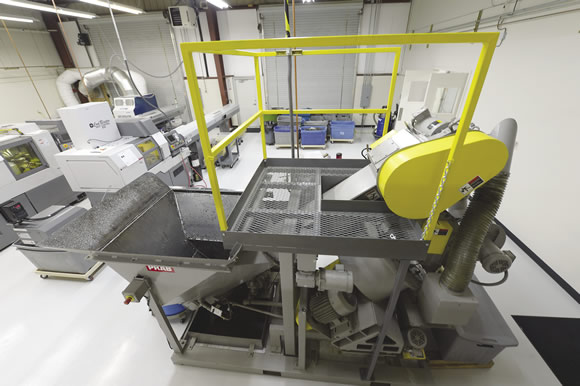
A PRAB chip processing system at Diablo Precision, ready to spin the next batch of metal chips. Image courtesy Diablo Precision.
There’s plenty of other good advice in the brochure, as well as checklists and spill control plans. A copy of the Santa Cruz document can be found at www.dpw.co.santa-cruz.ca.us/pretreatment/machinebmp.pdf, but Gross recommends checking with your local public works department for regulations that apply to your shop. “Failure to follow mandatory guidelines may result in corrective actions or fines, but we find that most shops are fairly compliant. It’s in their financial interest to reuse cutting fluids and minimize waste. We rarely need to issue any warnings.”
Eat Your Vegetables
One shop that needs no warning is Diablo Precision Inc., Hollister, Calif. President Conor Kelly takes pride in his shop’s green footprint and has made substantial efforts towards energy conservation, thermal management of the building and reduction of hazardous substances. This included switching six Swiss-style CNC screw machines to vegetable-based cutting oil, a move he admits wasn’t entirely environmental.
“We started out with a mineral oil, but it was pretty nasty-smelling stuff,” he said. “It was also quite viscous, so a lot of it stuck to the chips—we figured a big portion of our oil was ending up at the scrap recycler. Our local distributor recommended a vegetable-based product, Vascomill 22 from Blaser Swisslube. We were a little nervous about its cutting properties, of course, because it’s just a vegetable oil. But since the cost was about the same, we gave it a try.”
Kelly said the new oil worked much better than the old and there was an immediate 15 percent improvement in tool life. The operators were happy as well, knowing vegetable oil poses no risk of carcinogens or ill health effects, and no stink.
The new oil is also far less viscous, reducing the amount going out with the chips, but Diablo wasn’t done with its conservation efforts. The shop ordered a chip centrifuge and shredding unit from PRAB Inc. to get the chips as dry as possible before selling them for scrap. “Our oil consumption went way down, ” Kelly said. “We probably recover about 95 percent of our oil from the chips now. At $1,600 a barrel, it’s a significant savings and good for the environment.”
On the shop’s machining centers, Kelly regularly skims tramp oil from the water-soluble cutting fluids, adjusts pH to the manufacturer’s recommendations and filters to a 1µm level. This extends fluid life and keeps it out of the recycler’s hands longer. As the shop grows, Kelly said he might streamline the process by investing in a sump cleaner.
Keeping it Clean
That’s good news for Ron Wendt, fluid recycling equipment manager for Eriez Manufacturing Co., Erie, Pa. “A lot of shops run their coolant until it’s bad,” he said. “Then they pump it out and have it hauled away. The big manufacturers have built-in evaporators in their plants, which is more cost-effective than recycling but represents a substantial investment. Either way, reducing coolant waste is difficult. And since most cutting fluids are at least 90 percent water, it can cost more to have it disposed of than to buy new concentrate.”
The solution, Wendt said, is managing the cutting fluid, extending its life and delaying the point at which recycling is needed. That’s where the company’s portable SumpDoc fluid recycling system comes in. “You can wheel it over to the machine and clean the sump without disrupting production,” he said. “It combines several important processes: filtration of chips and fines, removal of tramp oil and concentration control.”
This last point is something many shops get wrong, Wendt said. Without the correct cutting fluid concentration, tool life suffers and bacteria grows more readily, leading to a smelly sump. “You’ve got to clean the coolant before it’s a problem. It can’t be brought back from the dead. But with proactive treatment, you eliminate waste, extend machine and cutting tool life, and save on recycling costs and replacement of cutting fluids. It also minimizes your environmental liability.”
Watch for Spills
Another company concerned about waste management is machine tool builder Haas Automation Inc., Oxnard, Calif. With more than 1 million sq. ft. (304,800 sq. m) of machining and assembly floor to keep an eye on, Jeff Law, manager of manufacturing engineering, takes a multipronged approach to environmental concerns.
For starters, the company is largely paperless. Employee work instructions are maintained on a company website and downloaded onto iPads on the shop floor. As with Diablo’s green efforts, there was more than waste reduction driving this. “It’s great that we can reduce trash and save a ton of money on paper, but the practical reason was that document management was becoming too difficult,” Law said. “Now any revision changes are instantaneous.”
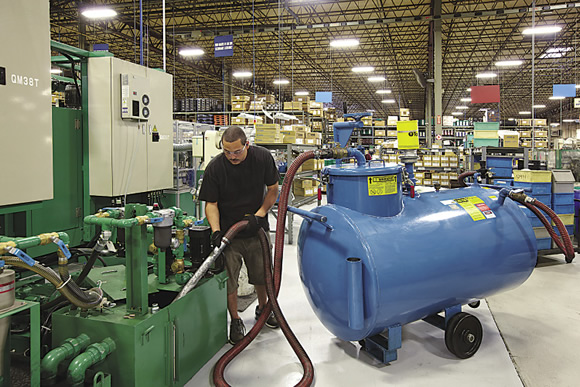
Air sump cleaners from Eriez have single-tank capacities from 50 to 1,000 gal. and twin-tank capacities from 50/50 to 500/500 gal. Image courtesy Eriez.
One initiative that’s purely environmental is spill containment. With hundreds of machine tools sitting in the yard and relatively few workers to monitor them, Haas must ensure no oil or hydraulic fluid accidentally leaks into storm drains. This is accomplished via strategically placed spill kits: 55-gal. plastic drums containing oil socks and laminated instructions. In the event of a spill, a worker deploys the kit and calls security personnel, who immediately notify the facilities maintenance group for additional cleanup steps. In other parts of the plant, where the machine-to-human density is higher, spills are both easier to spot and more easily contained. Inside or out, every Haas Automation employee receives extensive training in housekeeping.
Education is an important aspect of any environmental safety program. Someone qualified to speak on that point is Jim Olson, director of the Iowa Waste Reduction Center at the University of Northern Iowa. Olson works with Iowa businesses and shops to review regulatory compliance and educate them about requirements for air permits, wastewater treatment and hazardous waste disposal.
Olson said machine shops are regulated generally by applicable federal and state wastewater regulations, but that specific city sewer regulations are the primary rulebook on compliance. “The city decides if a business has to sample wastewater, how frequently, and what the limits are,” he said. “This is done to assure the city is meeting its National Pollutant Discharge Elimination System permit to discharge wastewater. If you’re talking about a place that maybe does part painting with phosphate or chromate coating to prepare parts for paint or electroplating, then there are federal regulations (categorical pretreatment standards) that specify what can or cannot be in their discharge water.”
The typical job shop or small manufacturer avoids much of this oversight, but still must meet city sewer ordinances. That’s because each municipality is responsible for whatever solids, oil, grease and other nasty stuff ends up in its treatment facility, and must find the best way to deal with it. This is usually a matter of separating the various waste products and allowing friendly bacteria to consume the offal. Compared to car washes, printing companies, hospitals and others with high fluid outputs, machine shops are relatively green if they choose to follow the practices discussed above, according to Olson.
“Oils are collected and shipped to an off-site processing facility,” he said. “And because most shops are using water-based cutting fluids rather than petroleum products, treating those fluids is fairly easy and it makes disposal much safer than it once was. In any event, shops should be aware of their local regulations.”
Regulations aside, if you think a little bit of oily grunge down the drain won’t hurt, think again. It’s bad for our neighbors, kids and pocketbooks. Protecting our environment—especially water—is the right thing to do. Keep it clean. CTE
About the Author: Kip Hanson is contributing editor for CTE. Contact him at (520) 548-7328 or khanson@jwr.com.
Contributors
Diablo Precision Inc.
(831) 634-0136
www.diabloprecision.com
Eriez Manufacturing Co.
(800) 345-4946
www.eriez.com
Haas Automation Inc.
(800) 331-6746
www.haascnc.com
Santa Cruz County Public Works Department
(831) 454-2160
www.dpw.co.santa-cruz.ca.us
TechSolve Inc.
(513) 948-2000
www.techsolve.org
University of Northern Iowa
(319) 273-2311
www.uni.edu
MQL keeps shops high and dry
Sometimes, the best way to avoid concerns about cutting fluid disposal is to avoid it in the first place. Dr. Radu Pavel, chief technology officer at TechSolve Inc., Cincinnati, said minimum-quantity lubrication (MQL) is an effective way to lubricate cutting operations, but without the cost, mess or environmental impact of conventional flood coolant. It works by introducing a small amount of pressurized cutting fluid—typically oil, but also water-based fluids—at a rate of 0.2 to 2.5 oz. (5.9 to 73.9 mL) per hour, just a fraction of flood coolant’s 8 to 20 gal. (30.3 to 75.7 L) per hour. One or more “channels,” or coolant lines, may be used, especially with large milling cutters and wide cut widths.
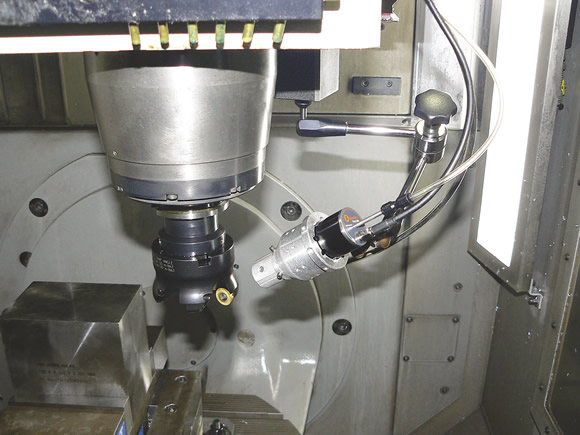
MQL lubricates a facemilling operation on a block of Ti6Al4V. Image courtesy TechSolve.
This isn’t a matter of starving the tool to save a few bucks. According to Pavel, titanium milling tests with MQL improved tool life four times compared to water-based flood coolant. Turning tests were not quite as impressive—about the same cutting results as flood—but that’s nothing to sneer at when one considers the cost savings. “When using MQL, the chips come out clean and dry,” he said. “There’s far less mist and evaporation than with traditional fluids, and there’s no need to recycle anything. A few gallons of lubricant might be sufficient for weeks.”
Some MQL systems use compressed CO2, nitrogen or shop air to drive and cool the lubricant. Pavel said a basic system might cost several thousand dollars or more, but that operating costs are significantly less than with flood coolant. “Conventional lubrication systems use electricity to drive the pumps, and there’s the cost of the cutting fluid itself, maintenance and recycling. By comparison, MQL’s efficiency depends on fluid selection, nozzle positioning and what gas is used, but it offers promising results in efficiency and higher part quality, at an energy consumption roughly 60 percent of traditional fluids.”
—K. Hanson
Glossary terms in this article
Related




Subscribers can use MFGAxis notes, saves and discussion tools with their innoNET account.


