

Wear and peace: Turning Performance
Understanding tool wear is the first step to extending tool life—which can be further enhanced with new coating technology.
Understanding tool wear is the first step to extending tool life—which can be further enhanced with new coating technology.
Tool wear is one of the most basic propositions of machining. Defining and understanding it can help toolmakers and users extend tool life. Also, today’s tool coating technology, including new alloying elements, provides a means to extend tool life further while improving productivity.
Wear Elements
Energy is an expression of the heat and friction that develop during metalcutting. Heat and friction—produced by high surface loads and from chips sliding at high speed along the tool rake face—subject cutting tools to extremely challenging conditions.
Cutting forces tend to fluctuate depending on conditions such as the presence of hard inclusions in the workpiece or during interrupted cutting. Therefore, cutting tools require several characteristics to maintain strength at high temperatures, including extreme toughness, wear resistance and high hardness.
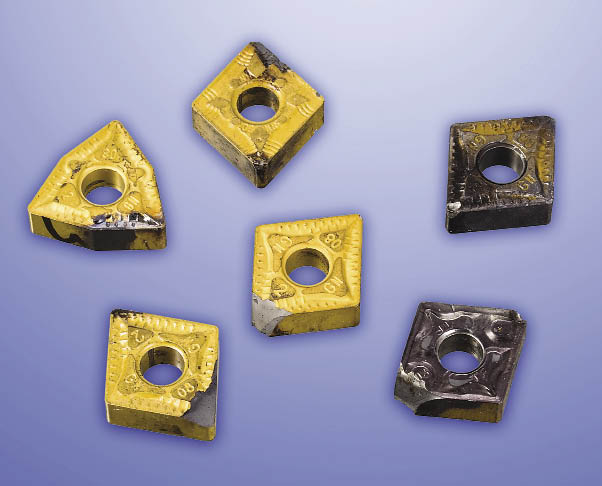
Courtesy of All Images: Iscar Metals
Inserts showing extensive wear; they are no longer usable for cutting metal.
While temperature at the tool/workpiece interface is a key factor in the wear rate of virtually all tool materials, it is difficult to establish values for the parameters required for calculating the temperature. However, experimental measurements can provide the basis for empirical approaches.
It is commonly assumed that the energy generated when cutting is converted to heat and 80 percent of that heat is typically carried away in the chip (this varies based on several factors—particularly the cutting speed). This leaves about 20 percent of the heat going into the cutting tool. Even when cutting mild steel, tool temperatures can exceed 550° C, the maximum temperature HSS can withstand without losing hardness. Cutting hard steels with PCBN tools will typically result in tool and chip temperatures exceeding 1,000° C.
Tool Wear and Tool Life
Several types of tool wear exist, including:
• flank,
• notch,
• crater,
• edge rounding,
• edge chipping,
• edge cracking, and
• catastrophic failure.
There is no universally accepted definition of tool life, which is typically based on the workpiece and tool materials and cutting processes. One way of quantifying an end point for tool life is to put a limit on the maximum acceptable flank wear, known as VB or VBmax. Tool life can be expressed in the Taylor equation for tool life expectancy:
VcTn = C
A more commonly used form of the equation is:
VcTn × Dx fy = C
Where:
Vc = cutting speed
T = tool life
D = DOC
f = feed rate
x and y are determined experimentally
n and C are constants found by experimentation or published data; they are properties of the tool material, workpiece and feed rate.
Developing optimal tool substrates, coatings and edge preparations are crucial to limiting tool wear and combating high cutting temperatures. These elements, together with the use of embedded chipbreakers and corner radii on indexable inserts, determine the suitability of each cutting tool to various workpieces and applications. An optimal combination of all of these elements can extend tool life and make machining more economical and reliable.
Review the print ads from this magazine to continue
This quick advertiser review unlocks the rest of the article and keeps the full-screen reader focused on the ads instead of the page chrome.
Advertisers included in this article experience
Print placements connected to this article
Widia
Victory Top Drill M1™
Our new WIDIA Victory Top Drill M1™ delivers the overall advantages of a replaceable-tip system — with the SAME high performance and hole quality as costly solid-carbide styles! Get 50% better tool life — with greatly reduced cycle times — versus competitive offerings! Ideal for even the most challenging steel and cast-iron applications!
Victory Top Drill M1™ Our new WIDIA Victory Top Drill M1™ delivers the overall advantages of a replaceable-tip system — with the SAME high performance and hole quality as costly solid-carbide styles! Get 50% better tool life — with greatly reduced cycle times — versus competitive offerings! Ideal for even the most challenging steel and cast-iron applications! No reconditioning costs — simply change out inserts! Drill at exceptionally high feeds and speeds!
Visit Widia View this placement in the issue recordPrint ads from this magazine
Our new WIDIA Victory Top Drill M1™ delivers the overall advantages of a replaceable-tip system — with the SAME high performance and hole quality as costly solid-carbide styles! Get 50% better tool life — with greatly reduced cycle times — versus competitive offerings! Ideal for even the most challenging steel and cast-iron applications!
Victory Top Drill M1™ Our new WIDIA Victory Top Drill M1™ delivers the overall advantages of a replaceable-tip system — with the SAME high performance and hole quality as costly solid-carbide styles! Get 50% better tool life — with greatly reduced cycle times — versus competitive offerings! Ideal for even the most challenging steel and cast-iron applications! No reconditioning costs — simply change out inserts! Drill at exceptionally high feeds and speeds!
Continue reading
September 2009
Altering the Substrate
Toolmakers can change the substrates of tungsten-carbide tools by altering the tungsten grain size within a range of 1µm to 5µm. Grain size plays a significant role in machining performance and tool life. The finer the grain size, the more wear-resistant the tool becomes and, conversely, the larger the grain size, the tougher it gets. Fine-grain substrates are used primarily in inserts for machining aerospace-grade materials, such as titanium, Inconel and other high-temperature alloys.
In addition, increasing the cobalt content of the tool material for carbide by 6 to 12 percent leads to greater toughness. Therefore, the composition can be adjusted to meet particular metalworking applications, whether they require toughness or wear resistance.
The substrate performance can either be enhanced by an “enriched” cobalt layer adjacent to the outer surface or by selectively adding other alloying elements to the tungsten-carbide composition, such as titanium, tantalum, vanadium and niobium. The cobalt layer substantially increases edge strength, which enhances a tool’s performance during roughing and interrupted cutting.
In addition, five other properties of the substrate—fracture toughness, transverse rupture strength, compressive strength, hardness and thermal shock resistance—must be considered when selecting a substrate that matches the workpiece material and the machining method.
For example, if the carbide tool is exhibiting chipping along the cutting edge, a material with a higher fracture toughness should be used. In cases where there is an outright failure of the edge or breakage, a solution might be a tool with a higher transverse rupture strength or higher compressive strength. In situations where the tool is to be used at elevated cutting temperatures, such as dry machining, a harder material is usually preferred. In situations where thermal cracking is observed (most often in milling), a material with a higher thermal shock resistance would be advised.
Modifications to tool substrates can enhance tool performance. For example, composition of Iscar’s Sumo Tec insert grades for machining steel features substrates with greater resistance to plastic deformation, which mitigates microcracking in brittle insert coatings. The Sumo Tec grades have a secondary process that reduces the surface roughness and microcracks on the coating. This reduces the heat on the surface of the insert and resulting plastic deformation and microcracking. Also, a new substrate used in inserts for machining cast iron offers better heat resistance, allowing machining at elevated cutting speeds.
Choosing the Right Coating
Coatings can also help improve tool performance. Current coating technologies include:
Titanium nitride (TiN). A general- purpose PVD and CVD coating exhibiting increased hardness and a high oxidation temperature.
Titanium carbonitride (TiCN). Carbon additions contribute to the hardness and surface lubricity of the coating.
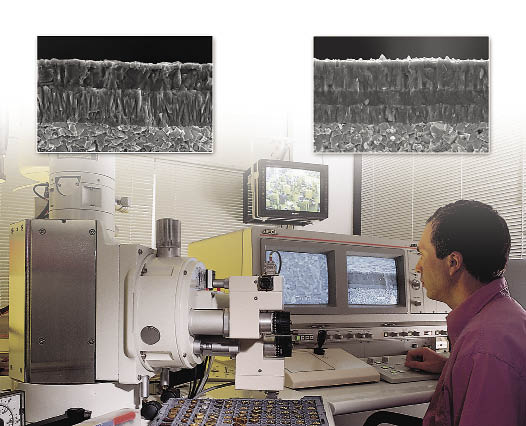
The science of formulating insert substrates and coatings.
Titanium aluminum nitride (TiAlN) and aluminum titanium nitride (AlTiN). Applying a layer of aluminum oxide in combination with these coatings extends tool life in high-heat applications. Aluminum oxide is applied in particular for near-dry and dry machining. AlTiN, which has a higher percentage of aluminum, displays higher surface hardness than TiAlN, which has a higher titanium percentage. AlTiN is commonly used in high-speed machining applications.
Chromium nitride (CrN). With its antiseizure properties, CrN is a preferred solution for combating built-up edge.
Diamond enhances machining performance for nonferrous materials. It is ideal for machining graphite, metal-matrix composites, high-silicon aluminum and other abrasive materials. It is not suitable for effectively machining steels due to chemical reactions that destroy the coating’s bond with the substrate.
In recent years, PVD-coated tools have expanded their market share at the expense of CVD-coated tools. CVD coating thicknesses are typically 5µm to 15µm, while PVD coating thicknesses range from 2µm to 6µm. CVD coatings create undesirable tensile stress when applied to a substrate, while PVD coatings facilitate desired compression stress on the substrate. The thicker CVD coating will usually cause a significant loss of strength at the cutting edge. For that reason, CVD cannot be used on tools that require a very sharp cutting edge.
Assigning new alloying elements to the coating process can improve layer bonding and coating properties. For example, Iscar’s 3P Sumo Tec treatment improves toughness, smoothness and chipping resistance of both PVD and CVD coatings. The Sumo Tec technology also reduces friction and thus energy consumption while increasing resistance to BUE.
The Sumo Tec process acts to reduce microcracks on insert surfaces due to differential contraction as the insert cools after CVD coating. Similarly, the process removes undesirable droplets on the coating surface produced during the PVD coating process. The result is a smoother surface, producing inserts that run cooler, last longer, facilitate better chip flow and can run faster.
Another example is Iscar’s Do-Tec coating technology, which deposits a TiAlN PVD coating on top of a MTCVD Al2O3 coating layer. This combination facilitates medium to high cutting speeds on various grades of cast iron, with high wear and chipping resistance. Cutting speeds from 650 to more than 1,200 sfm can be expected, depending on the type of workpiece material and machining conditions.
Edge preparation, or honing, of inserts in many cases is the difference between success and failure in machining. Honing parameters are application specific. High-speed finishing of steel, for example, requires inserts with a different edge preparation than inserts used for roughing. This can be accomplished on almost any type of carbon or alloy steel. Stainless steel and exotic materials are limited. The hones can be as small as 0.0003 ” to as large as 0.002 “. This may also include a slight T-land with the hone to reinforce the cutting edge for very harsh applications.
Generally, a substantial hone is required for continuous turning, as well as for milling most steels and cast irons. The amount of the hone would depend on the grade of carbide and type of coating (CVD or PVD). For severe interrupted cuts, a heavy hone or a T-land edge is a prerequisite. Depending on the type of coating, the hone could be close to 0.002 “.
In contrast, small hones (down to 0.0004 “) and sharp edges are required on inserts for machining stainless steels and high-temperature alloys due to their BUE tendency. Specials can be ordered with even smaller hones. The same sharp edges are required for machining aluminum.
For example, Iscar produces a range of inserts with helical cutting edges—the edge profile progresses uniformly around a cylindrical surface in an axial direction. The helical direction resembles a spiral. One of the benefits of the helical design is a smoother cutting action. Rather than cutting with a straight-line edge, the helical cutting edge simulates the action of a spiral flute endmill. Having the cutting edge enter the cut in a “spiraling” action rather than all at once reduces chatter and imparts a smoother finish.
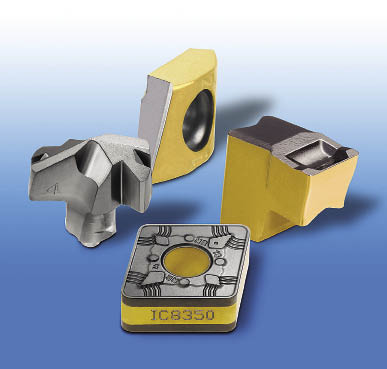
Various coated inserts manufactured using recently developed technology.
In addition, a helical cutting edge enables a heavier cutting load and a higher metal-removal rate while reducing stress. Another advantage of a helical cutting edge is the longer tool life due to reduced tool pressure and heat.
Understanding tool wear and implementing new technology that combats it can improve tool life and machining productivity. In today’s market, in which machine shops are competing not only with the shop across town but ones overseas, it is critical that they take advantage of any competitive edge. CTE
About the Author: Dr. Moshe Goldberg is manager of marketing, training and engineering support for Iscar Ltd., Tefen, Israel. For more information about Iscar, call (877) BY-ISCAR, visit www.iscarmetals.com or enter #320 on the IS form.
Glossary terms in this article
Related



Subscribers can use MFGAxis notes, saves and discussion tools with their innoNET account.


