

What’s Possible With Tool Grinding Technology
Advancements in grinding tech have paved the way for custom tool making, while software innovations have expanded grinding functionality across industries.
To force, cut, shear, push and otherwise remove material in metalcutting operations requires the application of cutting tools. That is a basic premise with the physics being that the tool material is harder (and maybe tougher) than the workpiece. Given that, what’s used to make the tool? The answer of course, another tool, or system in this case — grinding. Tool grinding is a long-proven method for producing edge preps, geometries and other specific facets on high-speed steel (HSS), carbide and other tool materials, such as stainless steel used in medical applications. HSS is typically carbon steel alloyed with tungsten or molybdenum, while carbide has its beginnings in powder form that is pressed and sintered. In their rough state, hardened blanks and preforms are produced to nearnet shape (of varying degrees) that are ready for the finishing touches. Enter grinding.
What was, in the early days, an art form to essentially precision grind by hand has become a very high-tech world using sophisticated machinery, programming software, processes and grinding wheels with abrasive materials such as aluminum oxide, silicon carbide, cubic boron nitride and diamond. As part materials have continued to evolve to suit the use and application, so too have the tool methods to machine them. It’s the same with regard to part configurations and the demand placed on producing tooling with the complex geometries to match. In all cases, being able to manufacture modern tooling requires the application of the latest grinding technology. Key advancements have paved the way for custom tool making and continue to evolve with the pace of industrial innovation.
Tool Grinding for Every Angle
Computer Numerical Control (CNC) was first applied to manufacturing as far back as the late 1940’s and gained widespread use in metalworking in the decades since. The technology was adapted for grinding in the early 1980’s and has since become available for tool grinding along with the advent of multi-axis capabilities. Given the difficult-to-machine nature of the tool material, the focus of grinding is on shaping and sharpening to create specific preparations and geometries for an intended application and industry.
The process for creating a round carbide tool, for example, begins with a carbide rod or blank and ends as a finished and polished tool. Along the way, the blank is prepped and precisely altered by grinding in reliefs, chamfers, whistle notches and many other complex geometries. The prepped blank then goes to finishing for fluting, gashing, pointing and drill points — all to ensure exacting cutting performance for the end user. Tool grinding at this level requires expertise in machine technology offered by modern multi-axis configurations.
For outside diameter material removal applications in three axis — X and Y on the horizontal, and Z vertically — there are two primary choices: cylindrical and centerless. Cylindrical grinders rotate the workpiece between two centers along its axis to provide tight tolerance grinding of the outside diameter of a variety of shapes and sizes. Centerless grinding positions the workpiece along its axial length, positioned between an abrasive wheel and an extra regulating wheel mechanism rather than a spindle or fixture — so no center of axis is needed to perform the operations.
For precision finishing and sharpening of edges, an additional two axes (typically A and B) offer rotational movement. Modern 5-axis tool and cutter grinders permit the machining of complex angles, and in some cases support automation and the use of multiple grinding wheels, all in a single setup. These 5-axis CNC machines are well-suited for finishing endmills, drills, reamers and form tools. More recent advancements also support the creation of custom tools tailored to specific applications where geometries can be specialized and unique. For other advanced tool grinding applications, some manufacturers offer 6-axis machines. The advanced capabilities can also require higher levels of skill — from both the operator and the programmer.
At the same time, other decisions need to be made, such as the state of the tool material. Tool makers can buy carbide preforms in near net shapes and even with some desired features to save time in finish grinding. This strategy leaves only a minimum amount of grind stock left to create a finished tool. The benefits of this approach are reduced cycle time, less heavy fluting demand on the machine and less overall wear and tear. Those benefits get balanced against two potential drawbacks — increased material cost and, perhaps more notably, additional lead time. To avoid these pitfalls, tool makers purchase carbide rods or blanks and then perform the whole process internally. Choosing this route does require a blank prep machine and process to cut all the features while a second tool grinder is used to do the finishing, but it does increase overall control of the process in terms of quality, delivery times and cost.
Review the print ads from this magazine to continue
This quick advertiser review unlocks the rest of the article and keeps the full-screen reader focused on the ads instead of the page chrome.
Advertisers included in this article experience
Print placements connected to this article
by MATE Workholding
MADE
MADE Visit mate.com to learn more.
Visit by MATE Workholding View this placement in the issue recordGuhring
Mastering Metalwork with Micro-Precision Tools:
Mastering Metalwork with Micro-Precision Tools: Visit guhring.com to learn more.
Visit Guhring View this placement in the issue recordPrint ads from this magazine
Continue reading
September 2025
Addressing challenges in low-volume production and, more specifically, high mix/low volume (HMLV) production takes careful planning given that these applications are punctuated by frequent changeovers. There are workholding technologies and features that address cycle times — inclusive of setup time and part changeover — and are proving invaluable to tool makers.
Programming software to simplify complexityIn today’s market, there are several performance software choices, which can vary from simple to complex setups. For example, TRU TECH’s intuitive iconbased conversational software is used for fundamental operations, such as for blank prep. More sophisticated offerings focus on simplifying the complexities of tool manufacture while excelling in specials and complicated tool forms. Examples include NUMROTO for tool manufacturing, resharpening and significant speed increases; and ESPRIT for complex medical tooling, such as hip rasps, rotary files, bone files and drills. Modern programming permits operators to create custom tool designs as well as select from a library of pre-existing templates. Additionally, advanced software provides important virtual functions such as 3D simulation to optimize cutting paths and speeds prior to production. This is an important step forward in minimizing scrap, lowering setup times and building greater accuracy and efficiency into the operation.
Regardless of the choice, operators and programmers continue to choose solutions that suppoart simplified setup, quick changeover and regular version upgrades to keep pace with ever-evolving technology advancements. Among recent developments are features like extensive and precise probe cycles for tool and wheel, in-process wheel dressing, job control, creation of elevation drawings, and adaptive grinding.
These advancements are part of a constant stream of programming innovation to expand grinding functionality across industry segments, making what was previously impossible, possible. Machine technology and software improvements allow users to produce the complex shapes of tomorrow’s tooling, keeping pace with market demand. Other advancements in tool grinding address the needs of productivity measured by quality and, more notably, throughput criteria.
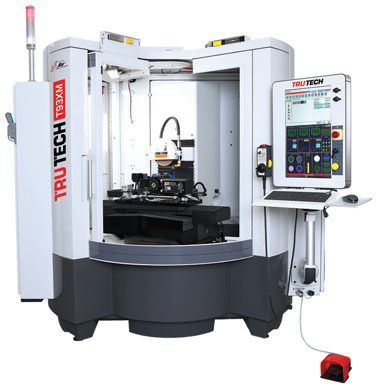
Leading tool grinding systems providers are also advancing their offerings with important design features for tool manufacturers to leverage. Floor space can be at a premium, which is why there are now options for compact machines with small footprints, yet relatively large grind zones. Additionally, operator comfort and ergonomics are being addressed with easy access and wide door openings. Additional safety features such as fire suppression are also becoming more prevalent. Modular designs are making an impact in several ways, such as including automation to expand unattended machining and continuous productivity. With that, base machines like the TRU TECH T93XM are augmented (T93XM-A) with an automation module that includes a pallet system and auto loading for a significant productivity boost — up to two and a half times the throughput. Other innovations to extend productivity cycles focus on the grinding wheel itself. Automatic and in-process wheel dressing offer flexibility and speed for lights-out manufacturing.
Successful Tool Grinding
To achieve a competitive edge, so to speak, innovations coming from grinding system suppliers are in step with the advancements sought by tool makers. Several criteria must be met. Among them are the ability to produce the required tool geometry, precision to ensure tolerance and exacting edge preparations, configurations to suit the operator, as well as advancements that allow for reliable unattended machining to achieve the next level of productivity.
Glossary terms in this article
Related




Subscribers can use MFGAxis notes, saves and discussion tools with their innoNET account.


