

When to shift from rapid feed to roughing
Stop wasting time grinding nothing but air with some measurements and calculation.
Dear Doc: We cylindrical OD-plunge steel shafts and divide the cycle into the standard rapid-feed, roughing, semifinishing, finishing and spark-out cycles. There’s disagreement about when we should shift from rapid feed to roughing. We don’t have an acoustic emission sensor for first-contact detection. Any thoughts?
The Doc replies: The only way to answer this question is to have some idea of the range of blank diameters going into your grinder. If your shop is like many — maybe most — shops, it doesn’t have a clue and is wasting weeks a year grinding nothing but air.
Let’s say the final diameter after grinding is 25 mm (0.984″) and you start roughing at 26 mm (1.024″). Where did that number come from? It’s likely that 26 is just a nice, round number where you’ll know you’ll be safe. Also, back in 1979, a machine operator tried decreasing that to 25.8 mm (1.016″) and noticed more wheel wear before going back to 26 mm. And that’s where it’s been ever since.
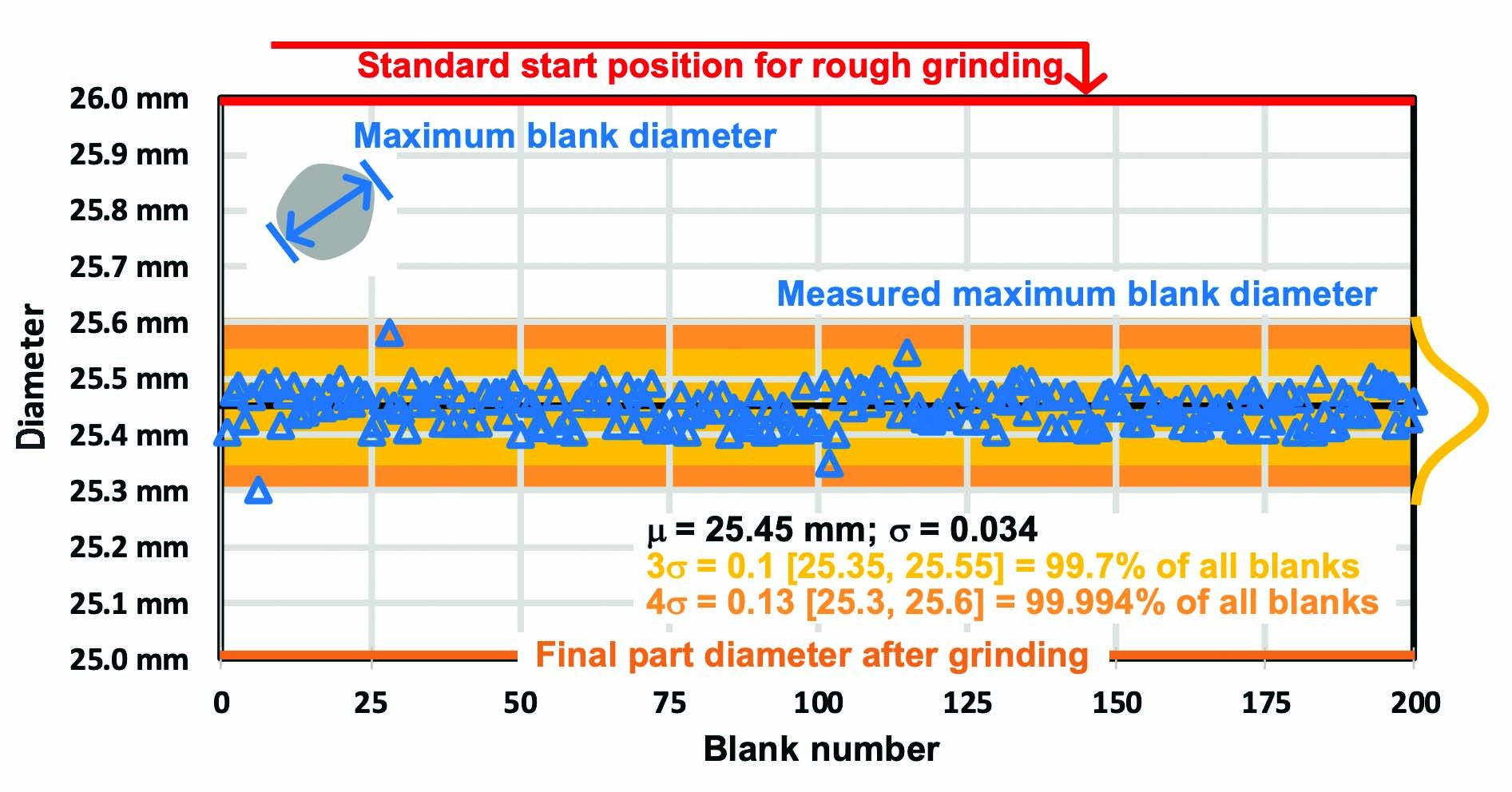
Measure blank diameters on 200 parts to determine when you should switch from rapid feed to rough grinding. Image courtesy of J. Badger
The solution is to measure blank diameters — not just one part or even five parts but perhaps 100 or more. If your part is long, you’ll have to measure cylindricity in addition to diameter.
Review the print ads from this magazine to continue
This quick advertiser review unlocks the rest of the article and keeps the full-screen reader focused on the ads instead of the page chrome.
Advertisers included in this article experience
Print placements connected to this article
Cutting Tool Engineering
®
OPTIMIZED A COMPLEX ROUGHING PROCESS MADE SIMPLE.
® OPTIMIZED A COMPLEX ROUGHING PROCESS MADE SIMPLE. Visit ctemag.com to learn more.
Visit Cutting Tool Engineering View this placement in the issue recordPrint ads from this magazine
OPTIMIZED A COMPLEX ROUGHING PROCESS MADE SIMPLE.
® OPTIMIZED A COMPLEX ROUGHING PROCESS MADE SIMPLE. Visit ctemag.com to learn more.
Continue reading
January 2020
I once visited a company in Japan that measured 500 blank diameters for every part variation produced. The company then calculated means and standard deviations and thought long and hard about when to shift from rapid feed to roughing. The company was so obsessive because it knew that grinding air was a waste of time and wanted to keep that to a minimum while still ensuring that the wheel didn’t crash into the part.
So, find that engineering intern, give him a micrometer, and tell him to spend three days measuring and plugging the data into a Microsoft Excel spreadsheet. If some batches go into the grinding machine after hard turning and other batches are coming straight from heat treatment, which tends to distort parts, he’ll have to do measurements for both groups. If some parts are 10 mm (0.394″) in diameter and some are 100 mm (3.937″), he’ll have to measure those separately. If some parts are long and some are short, he may have to position the parts between centers and measure not diameter but cylindricity to see how length affects distortion.
Once these measurements are completed, the choice of the starting diameter is usually easy. When you do this, you’ll be embarrassed. You’ll think, “Gosh, our largest blank was 25.6 mm (1.008″), and we start rough grinding at 26 mm? That’s absurd.” Don’t tell anybody — just quietly start reprogramming your start diameters.
Is this effort worthwhile? Let’s do some rough calculations. Let’s say your company produces 2 million parts a year and you start roughing from 26 mm in diameter at 2 mm/min. (0.079 ipm) for a respectable Q-prime of 2.6 mm2/sec. (0.24 in.2/min.). If by measuring the blank diameter you can reduce the start diameter from 26 mm to a modest 25.9 mm (1.02″), you’ll save 0.05 mm (0.002″) off radius divided by 2 mm/min. = 1.5 seconds per part. That doesn’t seem like much. But at 2 million parts, that’s 3 million seconds, or 833 hours. At, say, $100 an hour, that’s $83,300 a year.
Glossary terms in this article
Related




Subscribers can use MFGAxis notes, saves and discussion tools with their innoNET account.


