


A world of skills: Turning Performance
Youth skills training for machinists takes place in schools with metalworking programs and in connection with competitions, such as WorldSkills.
View print ads from this spread
Review the ads on this magazine spread to continue reading. Each ad takes two seconds; a two-page ad counts once.
Advertisers on this magazine spread
Print placements on this magazine spread
Abrasive Tech
MaZgdlmh:Ml hg&lbm^oblbm %p^bg\k^Zl^]
hnk\r\e^mbf^l bfikho^]^_Û\b^g\r' Hnk\nmmbg`kZm^bl 1q`k^Zm^knlbg` :Mllni^kZ[kZlbo^`kbg]bg`pa^^el' P^\Zeebmma^ FbkZ\e^Pa^^e ;rl^e^\mbg`:MlI';'L'pa^^el%p^ \nm\hlml[r/) ' Mnkgbg`rhnk\aZee^g`^lbgmhln\\^lllmhkb^l' We pride ourselves on the lasting impressions we’ve made with customers. You’ll find our superabrasive.
MaZgdlmh:Ml hg&lbm^oblbm %p^bg\k^Zl^] hnk\r\e^mbf^l bfikho^]^_Û\b^g\r' Hnk\nmmbg`kZm^bl 1q`k^Zm^knlbg` :Mllni^kZ[kZlbo^`kbg]bg`pa^^el' P^\Zeebmma^ FbkZ\e^Pa^^e ;rl^e^\mbg`:MlI';'L'pa^^el%p^ \nm\hlml[r/) '
Visit Abrasive Tech View this placement in the issue recordPrint ads from this magazine
hnk\r\e^mbf^l bfikho^]^_Û\b^g\r' Hnk\nmmbg`kZm^bl 1q`k^Zm^knlbg` :Mllni^kZ[kZlbo^`kbg]bg`pa^^el' P^\Zeebmma^ FbkZ\e^Pa^^e ;rl^e^\mbg`:MlI';'L'pa^^el%p^ \nm\hlml[r/) ' Mnkgbg`rhnk\aZee^g`^lbgmhln\\^lllmhkb^l' We pride ourselves on the lasting impressions we’ve made with customers. You’ll find our superabrasive.
MaZgdlmh:Ml hg&lbm^oblbm %p^bg\k^Zl^] hnk\r\e^mbf^l bfikho^]^_Û\b^g\r' Hnk\nmmbg`kZm^bl 1q`k^Zm^knlbg` :Mllni^kZ[kZlbo^`kbg]bg`pa^^el' P^\Zeebmma^ FbkZ\e^Pa^^e ;rl^e^\mbg`:MlI';'L'pa^^el%p^ \nm\hlml[r/) '
Continue reading
January 2010

Courtesy of Mori Seiki
More than 900 competitors from 51 member countries and regions participated in 45 skill categories at the 40th WorldSkills competition, which was held Sept. 1-7, 2009, at Stampede Park in Calgary, Alberta.
Youth skills training for machinists takes place in schools with metalworking programs and in connection with competitions, such as WorldSkills.
World-class competition brings out the best in individuals and teams. Without the Olympics, athletes likely would have never accomplished some of their greatest sports achievements. The same can be said for the WorldSkills competitions in relation to the trades’ arena.
That was the case at the 40th WorldSkills competition, which took place Sept. 1-7 at Stampede Park in Calgary, Alberta. More than 900 qualifying participants from 51 member countries and regions competed in the 45 skill categories, ranging from auto body repair to bricklaying to offset printing to fashion technology to CNC milling and turning.
Competition Preparation
Training for the machining skills events—and for a career as a metalcutting professional—requires a concerted effort. Frank McSherry, a machining instructor at the Dehryl A. Dennis Technical Education Center, Boise, Idaho, and CNC Milling competition expert, noted that his former student Fernando De La Garza, who represented the U.S. in milling, prepared for the state and national SkillsUSA competitions that preceded the international event based on three main considerations: a thorough knowledge of the competition requirements, an accurate assessment of the competitors’ strengths and weaknesses and the projected costs of achieving the training plan.
“Competition information would identify the tasks that will be judged, the level of difficulty of those tasks, the time limits for completion, the equipment that will be used and the equipment that must be brought to the competition,” McSherry said. “Next, the competition information would be matched to the competitor’s abilities and a preparation plan developed. At that time, we would determine who would be involved in the actual preparation and where that preparation will take place. This information would then be used for a cost analysis to determine feasibility of the total competition training plan.”
De La Garza, who won the SkillsUSA national CNC milling competition in 2007, noted that much of the preparation for the WorldSkills competition was done at home, learning how to use Mastercam CAD/CAM software. Previously, he programmed with G and M codes. To test the programs the software produced, De La Garza used the open-source Enhanced Machine Control and later a machine tool. “I used EMC to control a small retrofitted bench mill I have at home and it proved handy in getting a feel for what Mastercam was doing without having to actually go to a machine; I just ran it in simulation mode in my computer when I wanted to see what the output was, looked at the 3-D graphics of the toolpath generated and related them to G codes,” he said. “When I was ready to start cutting, I used the Haas Mini Mill at school, starting with wax and then moving to 6061 aluminum and mild steel.”
When it was time for the WorldSkills 2009 milling competition, it was vital that a competitor be able to machine steel and aluminum at metal-removal rates approaching those seen at trade shows while maintaining accuracy, according to McSherry. He added that most competitors did have experience machining at high mrr based on the sounds at the machine during the competition and inspection of the completed parts. In conversations with experts from other countries, McSherry learned that some participants started training 2 years prior to the competition. “The least amount of training seemed to be 6 months,” he said, with one exception. “Our CNC Milling competitor was notified 5 months before the competition while attending college, and he had to complete his semester before starting his preparation.”
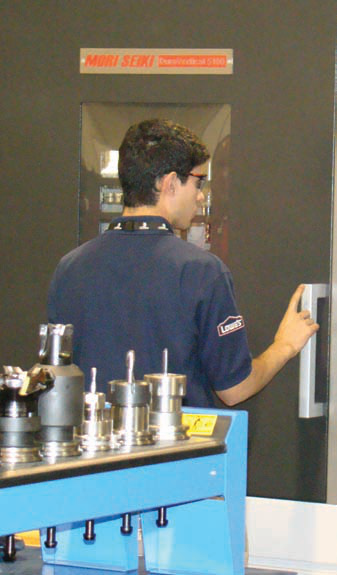
In addition, although Mori Seiki provided access to machines at various locations, McSherry noted that De La Garza did not have an opportunity to work with a Mori Seiki machining center. (The machine tool builder provided 26 CNC machines at WorldSkills 2009, including DuraVertical5100 vertical machining centers and DuraTurn2050 lathes.) And, with the exception of a few hours of online training, he had to learn the machine’s control unit during the competition. Likely as a result, De La Garza was at a serious competitive disadvantage during the WorldSkills 2009 event.
“The competition was definitely very challenging and a great experience,” De La Garza said. “It opened my eyes into what can be done with more training.” He added that he needed to prepare more to become comfortable with metric speeds and feeds and taking heavy cuts using cutters larger than ¾ ” in diameter.
“It also appeared that the more successful competitors were heavily financed by large companies and/or government subsidies,” McSherry said. “It was clear to me that we were going to compete, but the realistic expectations were to gain the experience and to provide a comprehensive report for the competitors in 2011.”
The 41st WorldSkills competition takes place in the United Kingdom.
In connection with the competition, Dr. Masahiko Mori, president of Mori Seiki Co. Ltd., Nagoya City, Japan, said: “It is a great honor to be selected twice consecutively as an official supplier and sponsor for the WorldSkills competition. Workforce development is a challenge for manufacturing industries, even as the need for such knowledge grows. The WorldSkills competition both promotes and recognizes the capabilities of talented young people around the globe.”
Competition in School
In addition to going head to head in international contests, young people are also motivated to enhance their technical skills when facing opponents closer to home. “There is a lot of competition between schools and the students start to get into it as well, especially if it’s a school right across the street,” said Anthony Genovese, industry and technology instructor at Addison (Ill.) Trail High School. “I tell them McHenry East is machining this part and you want to beat them. You turn it almost into a sporting event.”
Courtesy of A. Richter
U.S. competitor Fernando De La Garza from the Dehryl A. Dennis Technical Education Center, Boise, Idaho, machines a part during the CNC Milling competition at WorldSkills Calgary 2009.
Genovese noted that the school hired him to rebuild the machine tool program after a hiatus. The school is involved in the SkillsUSA skilled trades’ development program, but his machining class was preparing for competitions conducted by the Tooling & Manufacturing Association, where students receive a part print and receive awards based on how close they machine it to the specified tolerances.
The school has a small CNC machine and is seeking a grant to purchase a full-size one, but Genovese starts his students on manual machines.
“You have to learn the basics before you even touch a CNC,” he said. “I want the kids to be able to feel what too heavy a cut is and to feel what a good feed is.”
Hearing is another important sense to develop as a machinist and that typically requires extensive listening while a manual machine is cutting metal to determine whether the process is running correctly. “When you run a CNC machine, you want to know why that sound is coming out of there,” Genovese said.
McSherry, who’s taught machining for nearly 4 decades, has a similar view. “I’m an old guy who served a manual apprenticeship and am somewhat attached to the ‘listen and feel’ approach,” he said, adding that some of the same learning opportunities exist when CNC equipment replaces manual machines “except it is harder to appreciate when there is no physical contact with the machine. Manually, you can feel the effects of a dull tool where you lose that experience with a CNC machine.”
When teaching machining classes, McSherry noted that there are three choices: CNC machine operation only, manual programming and machine operation, and CNC programming using CAM applications. Regardless of the approach, students must understand machining essentials. “I’ve always found that the student with sound basics was able to advance much faster and further than one who lacked the background.”
And by focusing on the basics, the students who might pursue metalcutting as a career don’t lose interest. “You have to talk at their level,” Genovese said. “One great thing is I have a lot of young kids, so they’re going to be coming back next year and will be my advanced students, and I just move into a higher order of thinking.”
Next Level
After students in a machining program complete high school, they often come to a crossroads: find a job in the metalworking industry or continue their formal education. “They’re going to have to go to college,” said Keith Santini, Addison Trail High School’s Industry and Technology Department chairperson. “They’re going to have to go to at least a trade school or a 2-year university to get more skills in order to be productive.”
Santini used the example of workers in the automotive industry, where parts changers are disappearing and diagnostic technicians are in demand. “We believe in raising the standards and making the students work,” he said, “and constantly challenging them so they are reaching higher goals and not letting the bar fall lower so they can easily jump over it.”
According to Dr. Scott Helton, the school’s principal, raising the bar requires students with trade skills to also have the knowledge and ability to place themselves in a good educational setting, whether it’s a vo-tech school, college or university. “The whole thing is postsecondary, training our students today for what’s next,” he said. “These kids are going to have more than 30 different jobs in their lives, so they’d better be cross trained and diversified.”
Genovese emphasizes that it’s up to the students themselves to determine their path after high school, and even though he landed a manufacturing job after high school and those opportunities exist, attending a 4-year university to become, for example, a manufacturing engineer, can be desirable.
Having skills not everyone else possesses widens the range of available options. “A manufacturing engineer needs to know how to run a lathe and what a milling machine is,” he said. “They still need to know those same types of things even if they’re going onto higher ed.”
McSherry concurred. “I always encourage my students to develop as broad a base of knowledge and skill as possible,” he said. “It increases the chances of employment, retention and vertical movement.”
As an example, De La Garza is studying mechanical and electrical engineering at the University of Idaho and doesn’t envision a career as a machinist but nonetheless is “fascinated by the flexibility, precision and speed that can be obtained by using electrical control systems.
“I’m definitely interested in the design of metalcutting machines and tools and also combining them to automate manufacturing,” De La Garza added. “It will probably play an important role in whatever I do in the future.”
With the array of metalworking specialties continually increasing, McSherry recommends that a high school student find someone in the trade to speak with and use the school as a resource for visiting local industrial sites and taking basic courses to provide insight into an occupation. After graduation, he strongly recommends that students take post-secondary classes.
In connection with Mori Seiki USA’s recent grand opening celebration of its new headquarters in Hoffman Estates, Ill., Genovese took students in the Addison Trail machining program on a field trip to see the machine tool builder’s facility, which includes a showroom, an auditorium and Mori Seiki University’s Learning Lab.
Addison Trail’s Santini noted that the school also provides job shadowing field trips to expose students to various trades. “If you want to be an electrician, here’s what my life looks life,” he said. “Come and talk to me and shadow me for a day.”
Competing internationally, nationally and even locally against the school across town can be effective for machining skills development, but effective competition is also closer at hand. McSherry said, “When students compete for grades and status in the class, they are also preparing to enter the competitive industrial environment. Frequently, the classmates and the results become their success measurement model.”
However, he noted that a competition involving peers who are also strangers takes students out of a comfortable class environment and places them in a more realistic situation where they may have to evaluate their talents using a new set of criteria. “This can stimulate the development of new goals and demonstrate the importance of ongoing education and self-improvement,” McSherry concluded. CTE
bout the Author: Alan Richter is editor of Cutting Tool Engineering, having joined the publication in 2000. Contact him at (847) 714-0175 or alanr@jwr.com.
Contributors
Addison Trail High School
(630) 628-3300
www.hsdist88.dupage.k12.il.us/aths
Dehryl A. Dennis Technical Education Center
(208) 854-5810
www.boiseschools.org/schools/tech_center
Mori Seiki USA Inc.
(847) 593-5400
www.moriseikius.com
Glossary terms in this article
Related



Subscribers can use MFGAxis notes, saves and discussion tools with their innoNET account.