

Wrap it up: General Industry Coverage
Machined metal parts require packaging to protect them in demanding handling, shipping and storage situations, including humid and outdoor environments. Part makers need be aware of how to protect their parts so their hard work is not lost to corrosion or damage.
Tips for packaging, shipping and storing machined metal parts.
Machined metal parts require packaging to protect them in demanding handling, shipping and storage situations, including humid and outdoor environments. Part makers need be aware of how to protect their parts so their hard work is not lost to corrosion or damage.
Crow Corp., Tomball, Texas, is one machine shop that packs and ships a lot of parts. With 50 employees and a 65,000-sq.-ft. facility, the contract manufacturer offers CNC machining services, EDMing, metal component fabrication and welding.
Courtesy of Crow
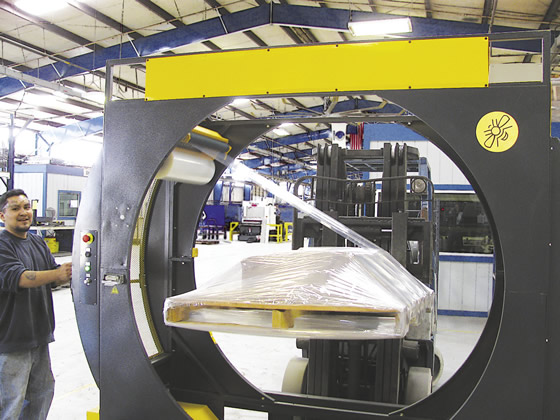
A 3 ‘×3 ‘ pallet being shrink-wrapped at Crow Corp. With one person, a shrink-wrapping job takes about 1 to 2 minutes per pallet.
“It might range from a small box with maybe 100 parts in it that doesn’t weigh much to large, heavy fabrications that are welded together,” said Keith Jennings, president of Crow and a CTE columnist. “Month to month, we send out thousands of parts. We usually have two to three pickups by UPS and FedEx per day, and more in some cases. And we usually have an 18-wheel truck pick up something once a day.” Items going on larger trucks include fabricated tanks, cabinets and consoles.
With all those parts to manage, Crow has a two-person shipping department. “During the quoting process or when we receive an order, we make a decision on what container or packaging is required to determine if there’s anything unusual or special,” said Jonathan Taylor, Crow’s shipping manager. “Customers sometimes give us specific packaging and shipping instructions, but mostly they let us determine the best, safest manner. The shape, size, weight and material of the part are all factors in deciding what to use.”
If the item is too large for a box, Taylor puts the part on a pallet and shrink-wraps it. To minimize the expense and labor of shrink-wrapping so many packages, Crow bought a Yellowjacket shrink-wrap machine about a year ago (see photo above). Now, one person can shrink-wrap large pallets or containers, instead of two or three. The machine also wraps much tighter and more efficiently than people, which means Crow uses less shrink-wrap material over the course of a year, “saving a couple of thousand dollars or more,” Jennings said.
But that is about as far as automation goes for Crow’s shipping department. “In our case, and in most shops I have encountered, there really isn’t any automation in the packaging process,” Jennings said. “Most job shops make such a variety of items that their packaging requirements from day to day and week to week are very different. Automation wouldn’t be a good fit.”
Crow has many local customers, so packaging is less of a concern because they come and pick it up, or Crow delivers it, if needed. But “if the shipment requires a carrier, we have to consider the damage potential,” Jennings said. “We look at how far is it going and what type of vehicle it is going on. We have had cases where shipments show up with parts missing or damaged. So we learn from that and have to ensure the packaging meets the carrier’s requirements as well as our own standards. For some things, shrink-wrap is sufficient. Other stuff may require more careful packaging, perhaps some wood or foam between the parts.”
Crow does have a couple of international customers that have stringent environmental policies and require biodegradable materials. They specifically request no shrink-wrap.
If the shipment is going out of the country, Crow will check with the customer to see if there are any special requests. “A logistics company is normally contacted to handle the international shipping and the cost is passed on to the customer,” Jennings said. “Because shipping and transportation requirements vary, they let us know about any regulations we’re required to meet and we get that info in advance so we’re prepared.”
Courtesy of Milwaukee Machine Works
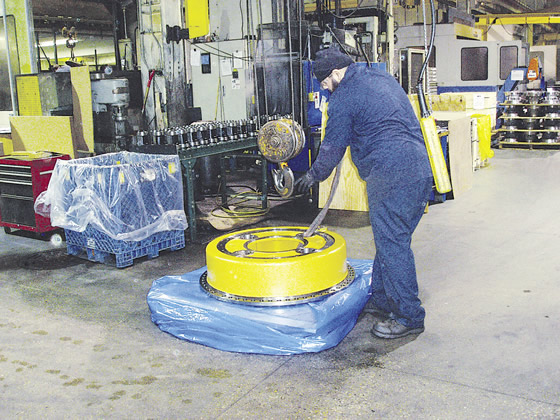
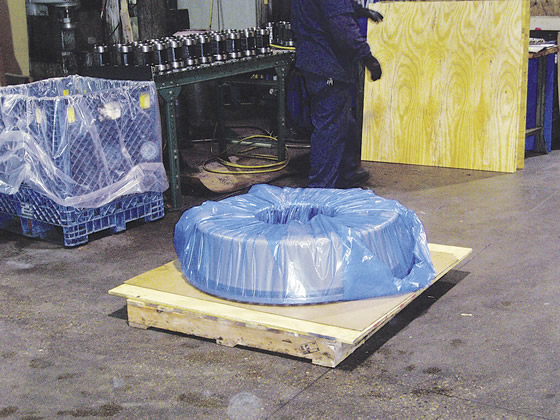
A worker at Milwaukee Machine Works (top) places a planetary carrier, approximately 38 ” in diameter by 8 ” high and used in a heavy equipment application, in a VCI bag. The packaging operation takes about 15 minutes.
Crow most commonly machines carbon steel, stainless steel and some aluminum. Rust protection is applied to carbon steel parts if requested or if the package will be in transport. “Carbon steel parts, especially in the Texas humidity, can begin to show rust and that has to be considered,” Taylor said. If the parts are being delivered locally, the customer may not need rust protection because they will be storing the parts in a climate-controlled environment.
Crow also sends sandblasted parts to an outside service for painting or powder-coating. The parts must be wrapped correctly in shrink-wrap to prevent getting wet. Sandblasted parts rust much faster if exposed to moisture and the moisture complicates the finishing process.
With numerous suppliers of shipping products in the area, Jennings noted the shop uses the one-stop shopping a “well-known supply company” provides. In addition to shrink-wrap, Crow buys mostly cardboard boxes, bubble wrap, metal banding, plastic baggies and foam rubber sheets.
Jennings pointed out that the cost of packaging and shipping is amortized into overhead costs since most customers don’t want to see separate shipping costs on invoices. “Standard packaging is buried into part price,” he said. “Everything needs to be packaged somehow, so it is adding some cost. The only time we single it out is if special packaging is required or it’s a sizable amount considered out of the ordinary.”
Making It Work
Milwaukee Machine Works also ships a lot of parts, averaging several hundred a week, noted Mike Manna, general manager of the Milwaukee-based parts manufacturer.
MMW serves large OEMs for the wind energy, off-highway and agricultural markets. It mostly makes and ships parts from 8 ” to 10 ” tall and from 24 ” to 50 ” in diameter. All packaging is done manually. Employees receive training on the specific packaging methods MMW uses to assure no damage to the parts in transit.
MMW works primarily with cast iron but steel fabrications are also included in its current part family. “The majority of what we ship in the small to mid-range size goes through a washing operation, has rust preventative applied and is placed in a VCI [volatile corrosion inhibitor] bag,” Manna said. “This is a rather expensive bag that limits any corrosion. The ones we use cost about $2 to $4.50 per bag.”
When metal parts are packed in VCI material, VCI molecules settle on the metal surface to form an invisible, thin, protective layer on all surfaces, including cracks, cavities and crevices. This protective layer works as a barrier between the metal surface and corrosion-causing materials, such as moisture, oxygen, dirt and salt.
“It is very important when you have drastic temperature changes—such as going from inside to outside in a Midwest winter—that you prevent condensation on the parts,” Manna said. “As soon as you get condensation, you get rust.”
On its larger parts, roughly 38 ” in diameter, that go on 48 “×48 ” skids, MMW makes sure nothing extends over the end of the skid. If the part did shift, it might get damaged and make it unacceptable.
In the Bag
VCI products are offered in numerous forms: sprays, dips, films, papers, bubble wrap, shrink-wrap, bags, foams, coatings, high-density emitters, water- and oil-based liquid concentrates, grease, powders and gels.
With so many choices, picking the best method for a particular part requires some expert help.
Courtesy of Cortec
Review the print ads from this magazine to continue
This quick advertiser review unlocks the rest of the article and keeps the full-screen reader focused on the ads instead of the page chrome.
Advertisers included in this article experience
Print placements connected to this article
Stellramapps
Next Level
New Look Make a Performance Statement Stellram introduces a new line of NL Turning Grades that have the look and feel of fine jewelry. Behind the sophisticated look, however, is the Next Level of industry-leading advanced technology. Five new NL Turning Grades that increase metal removal rates, improve surface finish and provide up to a.
Next Level New Look Make a Performance Statement Stellram introduces a new line of NL Turning Grades that have the look and feel of fine jewelry. Behind the sophisticated look, however, is the Next Level of industry-leading advanced technology. Five new NL Turning Grades that increase metal removal rates, improve surface finish and provide up to a 30% longer tool life.
Visit Stellramapps View this placement in the issue recordPrint ads from this magazine
New Look Make a Performance Statement Stellram introduces a new line of NL Turning Grades that have the look and feel of fine jewelry. Behind the sophisticated look, however, is the Next Level of industry-leading advanced technology. Five new NL Turning Grades that increase metal removal rates, improve surface finish and provide up to a.
Next Level New Look Make a Performance Statement Stellram introduces a new line of NL Turning Grades that have the look and feel of fine jewelry. Behind the sophisticated look, however, is the Next Level of industry-leading advanced technology. Five new NL Turning Grades that increase metal removal rates, improve surface finish and provide up to a 30% longer tool life.
Continue reading
April 2013
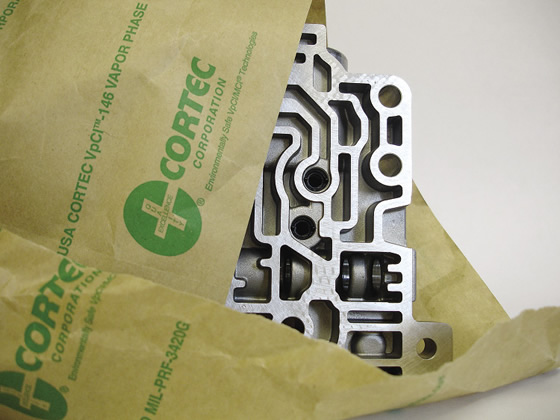
A valve body of a transmission is placed in VpCI packaging.
When it comes to VCI packaging, knowing the type of metal being protected is critical, according to Tiffany McEwen, sales representative for AGM Container Controls Inc., Tucson, Ariz., which distributes vapor-phase, corrosion-inhibitor (VpCI) products for Cortec Corp., St. Paul, Minn. VpCI is a type of VCI packaging. “There are VCI’s designed to protect only one type of metal, such as steel or aluminum. And when you have an item that has ferrous and nonferrous metals, such as an engine block, there are particular VCI products that are made for that application.”
With VpCI technology, the corrosion-inhibitor substance protects the metal surface through a vapor phase instead of requiring actual contact with the surface.
“Also, we like to know if it going to be crated in a wood box, and if the wood is heat-treated or not,” Mc-Ewen said. “Nonheat-treated wood and cardboard have a naturally occurring amount of moisture so it is important to know that ahead of time so we can provide the proper amount of protection.”
Even when a large crate is palletized and wrapped, she added that a temperature change can cause “container rain,” where moisture builds up and rains on the parts. “That is where a lot of rust comes from.”
Some of the benefits of VCI packaging include:
- Airtight packing is not required for VCIs to be effective. The VCI barrier is self-replenishing, even for packaging that is repeatedly opened.
- No part washing or cleaning is necessary. The protective layer immediately begins to dissipate when the parts are unwrapped.
- VCI packaging eliminates the need for a rust inhibitor, although some manufacturers still apply it.
- No surface preparation is required for application. The VCI can penetrate through a layer of grease or oil.
- VCI products are recyclable.
- No special equipment is needed to wrap parts.
One last consideration is the length of protection required. “Generally, when people use VCIs, they typically last for 6 to 24 months,” McEwen said. “However, Cortec makes products that can last up to 5 years. The protection depends on the environment the product is in. Depending on conditions and film thickness, Cortec defines long-term as indoor protection (up to 5 years) and short- to medium-term as unsheltered, outdoor protection (6 to 24 months).
Putting up a Barrier
Another option for protecting metal parts is moisture barrier bags. While VCIs provide an invisible barrier film on the part, moisture barrier bags do not allow moisture to enter. As long as the bag is intact, the part is protected.
“The customer puts their product into the bag, sometimes they pull a vacuum on it and heat seal it, and it can last for years and years,” said Bob Lipsky, president of RBL Industries Inc., Baltimore. “It can be dipped in water and not get wet.”
However, these bags may not protect the part against other corrosion-causing contaminants, such as salts and acids.
RBL Industries sells general packaging, such as films, boxes and plastics, and provides moisture barrier bags to the military.
“There are about 12 to 15 different MIL specs just with the barrier bags, depending on what moisture grade they want to protect,” Lipsky said. “There are hundreds of different MIL specs, from bags to boxes to wooden crates. You don’t design something for the government. The government tells you want it wants.”
No matter the method—bag, box, crate—packaging parts the right way is an important final step in the manufacturing process. A customer is not going to have much faith in a shop that can’t ship its parts properly. CTE
About the Author: Susan Woods is a contributing editor for CTE. Contact her at (224) 225-6120 or susanw@jwr.com.
Packing and protecting cutting tools
Cutting tool packaging comes in a plethora of sizes, shapes and price points. Packaging supplier rose plastic alone offers 3,400 different products. Expensive diamond-coated tools and carbide cutting tools, because of their brittle nature, need more robust packages. Perhaps the manufacturer might even want packaging that suspends the items so they can’t touch the top or bottom of the enclosure. For less expensive tools, such as HSS or cobalt, the packaging is more for general industrial use, even one-time use.
“All manufacturers spend money on packaging,” said Kenneth Donahue, president of rose plastic USA LLLP, California, Pa. “But it is the level of protection that is considered based on the cost or the delicacy of a tool. For example, a very small-diameter drill would need more protection from breakage than a ½ “-dia. tool.”
Donahue noted there is no use of rust inhibitors or oxygen barriers with cutting tool packaging. “Most people do not request a rust inhibitor in their cutting tool packaging. Many customers apply a thin rust protector coating to HSS tools, and carbide tools do not rust.”
Also, cutting tool packaging made from PVC is common. Certain resins, such as polypropylene, are more brittle and therefore more subject to cracking in cold environments.
One direction some manufacturers are moving toward is “green” packaging. Most packaging materials have been around for a while and are recyclable, but the companies that make the raw plastic resin are working on biodegradable resins.
“But they have not been able to come up with one yet that meets all of the criteria of the industry,” Donahue said. “These include brittleness and clarity of the material, the cost of the material and the ability to process it in a cost-effective manner. But it is an ongoing development.” There is more of a push for this in Europe, he added.
—S. Woods
Contributors
AGM Container Controls Inc.
(800) 995-5590
www.agmcontainer.com
Crow Corp.
(800) 642-2769
www.crowcorp.com
Milwaukee Machine Works
(414) 476-3285
milwaukeemachineworks.com
RBL Industries Inc.
(800) 234-5711
www.rblindustries.com
SaveSave
Glossary terms in this article
Related




Subscribers can use MFGAxis notes, saves and discussion tools with their innoNET account.


