High-Torque Retention Knob prevents toolholder deformation
High-Torque Retention Knob prevents toolholder deformation
Whereas the retention knob is an unmistakably critical component of the machining process, conventional retention knobs, when installed in a toolholder, may deform the precision taper because of the elastic nature of a toolholder's thin walls. This taper deformation prevents a toolholder from properly mating with the spindle of a CNC machine. JM Performance Products Inc. has worked to overcome this manufacturing bind with its lower-deformation High Torque Retention Knobs.
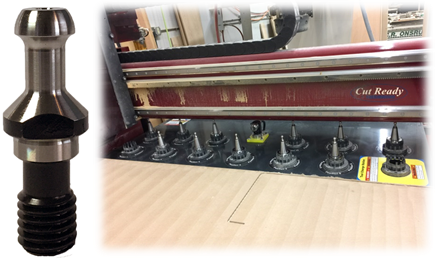
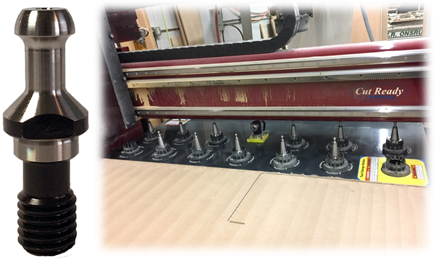 A workhorse in today's high-speed CNC machining centers, the retention knob and its relationship with the V-flange toolholders used can present critical productivity issues for manufacturers due to toolholder expansion. Once expansion occurs, the holder will not pull all the way into the spindle and the tooholder can't make contact with upwards of 70 percent of the spindle surface.
Insufficient holding of toolholders is far more typical of machining center processes than most shops realize — whether you are running one mill or hundreds. This critical "loose-tool" factor presents a myriad of issues industrywide in terms of production, time and tooling. Key productivity variables include: chatter and vibration, excessive runout, lengthy finishing and polishing times, long setup times, rigidity issues, poor tolerances, lack of repeatability, shortened tool life, slow speeds and feeds, and shallow depth of cuts.
At the core of this quandary is what happens to the toolholders when they are tightened — as overtightening
the retention knob by even a mild degree can be enough to produce a bulge in the narrow end of the holder. This often results in the toolholder losing the shape that matches the cone of the spindle, rendering it free and seated insecurely in the machine. Tight tolerances are essential in high-speed machining, and if the toolholder doesn't fit the spindle precisely, decreased productivity and reduced tool life are inevitable.
Whereas the retention knob is an unmistakably critical component of the machining process, conventional retention knobs, when installed in a toolholder, may deform the precision taper because of the elastic nature of a toolholder's thin walls. This taper deformation prevents a toolholder from properly mating with the spindle of a CNC machine.
JM Performance Products Inc., Fairport Harbor, Ohio, a manufacturing innovator of CNC mill spindle optimization products since 1966, has worked to overcome this manufacturing bind with its lower-deformation High Torque Retention Knobs. An essential element of the patented design is a knob that is longer and reaches a little deeper into the holder's threaded bore. As a result, all thread engagement occurs in a region of the toolholder where the diameter is large, and where there is more material to resist deformation.
Recently, Morgan Meredith Inc., Cedar Rapids, Iowa, a family-owned business specializing in customized wood retail display products, turned to JM Performance Products to help improve the productivity of a new wood router machining center that makes parts for retail product displays out of sheet plywood. The CNC router system was designed to run at a high-speed spindle machining standard of 18,000 rpm for speed, accuracy and repeatability. For years, however, Morgan Meredith President Morgan Karns had experienced problems with the taper series toolholders in the tool holding spindle.
The conventional retention knob's small end of the taper kept pushing the toolholder out of the spindle by a small amount. Morgan Meredith originally suspected that swelling was the issue, but a bulge in the back of the toolholder due to deformation was revealed as the actual cause.
Notably, 1" brown fretting rings appeared around toolholders and on the front edge of the spindle. The machining system's high-speed rotation caused friction, which resulted in the iron-oxide rust corrosion rings. This corrosive friction also produced an intense "screaming" effect from the machines, which required workers to use protective ear plugs. Most importantly, these corrosive elements continually wore out the spindle socket and toolholders, which required frequent and costly tool changing.
A long chain of process parameters were also affected due to toolholder deformation, including: Z-axis drift/height drift cutter changing, elevated spindle temperatures that caused the previously mentioned fretting on the contact surfaces, and skidding/sliding effects. All of these issues related to a single source problem — toolholder deformation in direct connection to the conventional retention knobs.
Faced with this onslaught of toolholder obstacles, Karns, enlisted JM Performance Products to analyze their high-speed milling center production dilemma and engineer a solution. A JM Performance Products technical team performed toolholder tests with its Taper Shank Test Fixture. This conclusive test revealed that the toolholder was out of tolerance. So the team recommended a special configuration solution to optimize the fit and overcome the toolholder expansion/distortion issues.
The solution was JM Performance Products' patented High Torque retention knob that works by making the retention knob as long as possible to fit the toolholder. When properly installed with a retention knob socket and torque wrench, this patented design prevents toolholder deformation.
Additionally, a calculated torque value for installation is provided to ensure the knob is installed to manufacturers' specifications. This is vital in applications where the rpm of the tool is high, thus ensuring that the toolholder will not pull out of the machine.
Key design elements of JM Performance Products' High Torque retention knobs include:
- Longer than traditional retention knobs.
- Precision pilot increases rigidity.
- Relief below the flange forces threads into a deeper cross section of the toolholder.
- Hard turned to ensure precision fit and balance for high-speed operations.
- Same head dimensions and works in existing toolholders.
The accumulated synergistic effect of these design elements eliminated the expansion, or distortion, of the small end of the tool holder, and ultimately allowed Morgan Meredith to run its CNC router machines at faster speeds and feeds to realize substantial savings versus conventional retention knobs.
Said Karns: "The results were immediate in machining with a 3/8" diameter carbide bit into solid acrylic. The machine and toolholders show incredible improvement in taper contact quality, as the tool holder has close to 100 percent contact."
Key Morgan Meredith production improvements using JM Performance Products' High Torque Retention Knobs include:
- No discernable iron oxide-rust corrosion fretting rings on the toolholders or spindle.
- No Z-axis drift/height drift cutter changing at high-speed 18K rpm operation.
- Spindle and toolholder runs cooler as reduced heat eliminates sliding, slipping and fretting issues.
- Eliminates machine's irritating "screaming" effect in the shop workplace.
- Reduced frequent and costly changing of spindle sockets and tools holders.
- Boosted feed rate by 25 percent with no degradation of cut or signs of distress whatsoever.
In September 2016, Morgan Meredith converted all of its CNC wood router milling centers to JM Performance Products' High Torque Retention Knobs, and has about 50 total knobs in service running all day at 18K rpm.
"We'll be using the High Torque Retention Knobs exclusively moving forward," concluded Karns, noting that the knobs have "solved a host of problems we've been trying to overcome for years. They also protect the spindle on the machine, do not change the nose shape of the spindle, and there are no corrosive brown rings at all now."
More than 750,000 CNC mills have been put into service throughout the United States in the past 15 years. Typically, however, these CNC milling centers run 20 to 40 percent slower than they should due to the limits of conventional retention knobs. Switching to JM Performance Products' High Torque Retention Knobs as Morgan Meredith did would lead to a significant increase in machine speeds and result in a savings of 10 to 15 percent.
Said JM Performance Products President John Stoneback: "Many corporations are not aware that by simply minimizing the expansion/deformation that happens at the small end of the taper when over torqued, significant increases in tool life, production rates, and revenue can be achieved. These are goals that are easily in reach, ultimately presenting a unique opportunity to promote reshoring for U.S. machine tool die/milling manufacturers."