

Horizon Microtechnologies reports advancements in manufacturing corrugated RF and mmwave components
Horizon Microtechnologies is reporting that it is achieving measured progress in the manufacture of corrugated RF and millimeter-wave components using its combination of high-precision polymer micro-additive manufacturing and proprietary metallisation technologies. The activity covers three related but technically distinct application areas: overmoded waveguides, mode converter waveguides, and corrugated horn antennas.
Horizon Microtechnologies is reporting that it is achieving measured progress in the manufacture of corrugated RF and millimeter-wave components using its combination of high-precision polymer micro-additive manufacturing and proprietary metallisation technologies.
The activity covers three related but technically distinct application areas: overmoded waveguides, mode converter waveguides, and corrugated horn antennas. Each uses fine internal corrugations running perpendicular to the horn or waveguide axis to influence how electromagnetic waves propagate inside the device. These features can support functions such as propagation control, far-field pattern tailoring, and side-lobe suppression.
The focus of this announcement is the manufacturing capability itself, rather than the performance of any individual device. Ultimately, RF performance will derive from the component design and the ability to manufacture that design accurately and repeatably. Horizon’s progress lies in demonstrating an increasingly capable manufacturing route for sophisticated corrugated geometries.
Overmoded waveguides have already been supplied for customer use and repeat use. Mode converter waveguides have also demonstrated success, with deeper or varying corrugation profiles representing a further step in manufacturing complexity. To put that challenge into perspective, at D-band frequencies (110–170 GHz), relevant corrugation features can be only around 250 µm wide while extending to approximately 500 µm in depth — dimensions that must be reproduced accurately around an internal geometry and then metallised consistently. Corrugated horn antennas are a larger industrial opportunity, particularly in sensing, radar, and selected satellite communications applications, but remain at an earlier stage of active exploration and application-specific refinement.
The performance value of corrugated structures is well understood. The challenge is often how to manufacture them in a way that works technically and commercially. Where the corrugations are sufficiently wide and accessible for a mechanical tool, CNC machining can remain an entirely appropriate manufacturing route, particularly where the economics are comparable. The balance begins to shift, however, as the geometry becomes more demanding. Higher-frequency devices typically require progressively narrower corrugations, while long, narrow, or high-aspect-ratio components create additional challenges for tool access. These effects can also occur together. In such cases, conventional machining can become increasingly difficult and expensive, whereas microprinting followed by metallisation does not incur the same escalating economic penalty as the geometry becomes more challenging, although, like any manufacturing process, it ultimately has its own technical limits.
According to a company statement, Horizon’s work illustrates both dimensions of this manufacturing progression: the challenge of producing increasingly narrow corrugations as operating frequency rises, and the separate challenge of producing long, high-aspect-ratio geometries where conventional tool access becomes increasingly restrictive. Overmoded waveguides and mode converters have demonstrated the ability to manufacture extremely fine corrugated features, with characteristic dimensions in the 100 µm range, for devices operating at frequencies extending up to the D-band (170 GHz). Separately, development work on corrugated horn antennas is demonstrating the potential of the approach for longer, high-aspect-ratio geometries where conventional machining (and in some cases alternative additive or additive-plus-metallisation routes) becomes increasingly problematic.
Horizon’s approach tackles this manufacturing barrier. By precision 3D printing the geometry in high-performance polymers and then applying a specialist metallisation layer, the company can produce complex conductive corrugated structures without automatically defaulting to fully solid-metal fabrication. The significance of the polymer-metal hybrid approach lies primarily in the manufacturing freedom it creates. It provides a route around some of the geometric and economic constraints of conventional metal fabrication. Additionally, the metal-polymer hybrid nature of the device can deliver further benefits. Examples are lower heat conductivity in cryostat applications (e.g., quantum computing) or lower weight in on-the-move and otherwise SWaP-sensitive applications.
Compared with CNC machining, Horizon’s approach can be attractive where complex internal features, design changes or repeat production economics create constraints. Injection moulding may be attractive where geometry allows it, but many corrugated RF components are effectively non-mouldable because their internal features cannot be created or released using conventional tooling. Even where moulding is feasible, the resulting polymer component would still require a subsequent metallisation step to provide the conductive surfaces required for RF performance. Horizon’s microprinting-plus-metallisation route avoids that constraint, allowing such geometries to be produced without compromising the intended internal architecture. The scalable opportunity sits in repeatable print-and-metallise workflows that can support both development and repeat production without requiring a change in manufacturing method as the application matures.
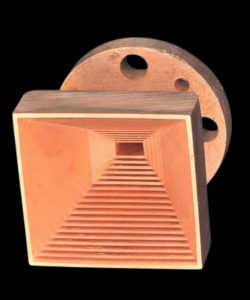
“Corrugated RF components are a strong example of where the first question can become ‘can this be made at all?’” says Andreas Frölich, CEO of Horizon Microtechnologies. “For some designs, conventional manufacturing is entirely feasible. For others, the route becomes too slow, too costly, or too constrained to support the engineering ambition. Precision polymer micro-AM plus metallisation gives engineers another manufacturing option, especially where the internal geometry is the product.”
The opportunity extends across scientific instrumentation, electronics testing, sensing, high-frequency measurement systems, and selected space and radar applications. In antenna applications, side-lobe control can be critical, and in some sensor markets the pressure to control emitted power in unwanted directions is increasing. Horizon sees corrugated horn antennas as a significant potential application area, with its manufacturing platform enabling geometries to be tailored to specific RF requirements and then evaluated against the performance needs of the intended application.
Frölich adds, “We are not claiming to have invented corrugated horns or waveguides. The important point is that our platform can make certain designs easier to access, easier to iterate, and more commercially realistic. That can change what engineers are willing to design, but it must always be assessed against the specific component, volume, performance requirement, and manufacturing alternative.”
For customers evaluating corrugated waveguides, mode converter waveguides, corrugated horn antennas, or other complex mmWave components, Horizon offers a manufacturing platform that combines precision geometry creation, RF-relevant metallisation, application knowledge, and the ability to work from feasibility through to repeatable supply.
For more information, visit horizonmicrotechnologies.com.