Machining process targets moldmakers and more
Machining process targets moldmakers and more
Imagine a machining process that removes material five times faster than milling and 10 times faster than sinker EDMing, machines Inconel and hardened steel with ease, holds tolerances to ±0.0006" and utilizes the same tool to process thousands of parts with virtually no tool wear. Machine builder EMAG LLC USA, Farmington Hills, Mich., calls this process pulsed electrochemical machining (PECM). A subset of electrochemical machining, PECM is far more accurate than the decades-old ECM and has matured into a viable alternative to more-traditional machining processes over the past few years, according to the company.
Imagine a machining process that removes material five times faster than milling and 10 times faster than sinker EDMing, machines Inconel and hardened steel with ease, holds tolerances to ±0.0006" and utilizes the same tool to process thousands of parts with virtually no tool wear.
Machine builder EMAG LLC USA, Farmington Hills, Mich., calls this process pulsed electrochemical machining (PECM). A subset of electrochemical machining, PECM is far more accurate than the decades-old ECM and has matured into a viable alternative to more-traditional machining processes over the past few years, according to the company.
The primary difference between the two technologies is one of movement. "They're both electrochemical in nature, but PECM utilizes an oscillating movement in conjunction with an electrical pulse," said Jonathon Chomicz, ECM/PECM product manager for EMAG. "Conventional ECM, on the other hand, is always 'on.'"
PECM is similar to sinker EDM-ing. For example, both processes require an electrically conductive tool and workpiece and a fluid to serve as a medium between the tool and workpiece. One difference between PECM and EDM is the proximity of the cathode (the tool) to the anode (the workpiece) during machining. Where the spark gap with sinker EDM is about 0.0023", PECM comes within a kissing distance of just a few tenths. The result is a fast, low-temperature process that avoids the heat-affected zone associated with EDMing and suffers virtually no tool wear. This makes it an ideal solution for tool, mold and die makers, as well as other applications where HAZ can negatively impact product quality.

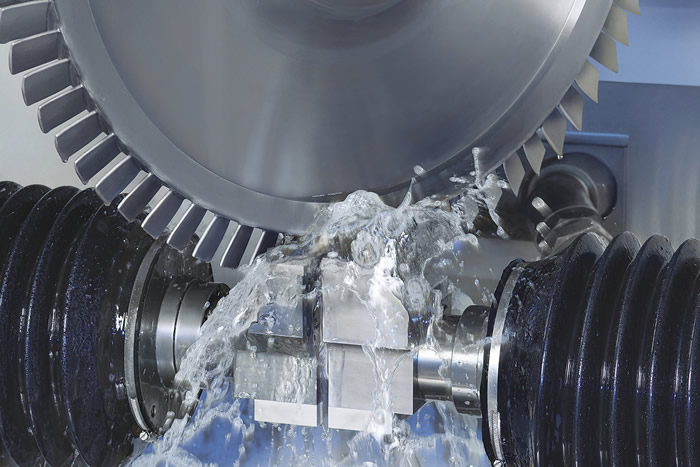
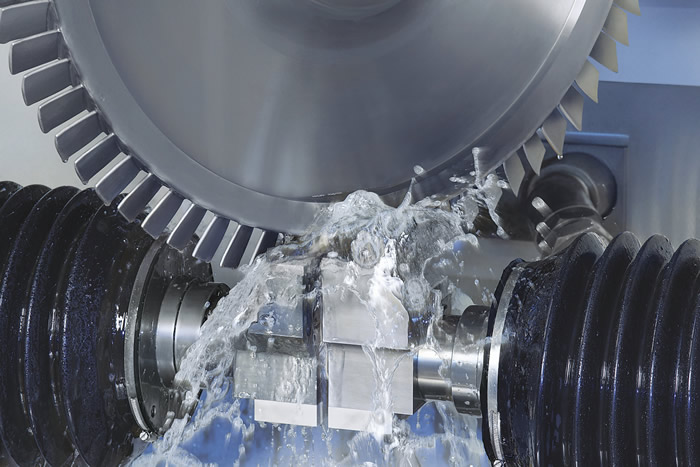
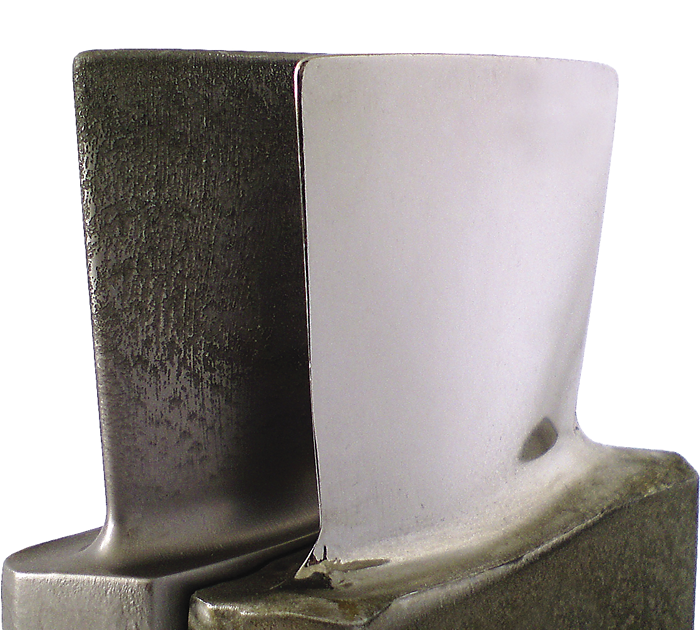
Pulsed electrochemical machining a jet engine blisk imparts a surface finish that requires little or no polishing (below, right blade). Images courtesy EMAG USA.
One example is embossing dies. Chomicz said a Chinese tooling manufacturer has successfully performed PECM since late 2014 using an EMAG PTS 2500 machine. "For cold-forming tools, PECM works great. Compared to EDM, where you might need roughing, semifinishing and finishing electrodes, PECM allows you to get by with a single cathode. You simply adjust the voltage and polarity throughout the machining process. It greatly reduces tooling costs and manufacturing time."
Another application is producing turbine blades and blisks for jet engines. Scott Kowalski, president of PEM Technologies, Natrona Heights, Pa., refers to precision electrolytic machining (PEM), his company's electrochemical machining process, as EDM on steroids. "It's very fast. Some of our customers are even replacing their 5-axis machining centers with PEM. Inconel 718 parts that once took 24 hours to machine can now be done in 4 hours or less, with no worries about tool wear or breakage."
In addition, Kowalski said PEM is used extensively for manufacturing some automotive fuel-system components and some medical products, such as spinal fixation plates, surgical needles and the complex, Allen-type heads of bone screws.
"About the only constraint with PEM is that the workpiece material must be conductive," he said. "Carbide is tough for us because of the binder, but titanium, stainless and superalloys are no problem. All that's needed is a tool—typically made from 420- or 440-series stainless steel—that's been machined at least as accurately as the target workpiece."
If PECM is so great, why isn't it more popular? For starters, it's expensive. A system can cost $500,000 or more—often way more. The problem here is one of machine production. Chomicz and Kowalski agreed that it's only been in the last decade that ECM has becoming accurate enough for mainstream parts production. As a result, machine price tags remain relatively high. However, that may change as this technology becomes widespread and more machines are built.