


Robotic Machine Tending 101: How to Automate Your CNC Loading and Unloading
Find yourself in a machine shop, and you’ll find a familiar scene. A highly capable CNC machine, eagerly waiting for its next part. An idle CNC is money flying out your shop door.
Find yourself in a machine shop, and you’ll find a familiar scene. A highly capable CNC machine, eagerly waiting for its next part. An idle CNC is money flying out your shop door.
While the downtime may seem short, multiply it by how many times it happens during a shift, a week, a year. Those lost minutes add up fast. For many shops, the challenge is not the machining process itself. It's keeping machines fed with material and keeping production moving consistently.
That's why robotic machine tending has become one of the most practical and common automation projects for machine shop owners. We have a customer who has reported a 300% increase in production output by adding robotic machine tending, creating new business opportunities that were previously impossible without automation! Rather than replacing skilled machinists, machine tending automation helps shops get more value from existing equipment while allowing operators to focus on higher-value responsibilities. In this article, we’ll show you how you can be the next success story.
What Is Robotic Machine Tending?
Machine tending is exactly what it sounds like: using a robot to load and unload parts from a CNC machine.
In a typical application, such as milling, turning, or drilling/tapping, the robot loads raw material or workpieces into a CNC machine, removes the completed part at the end of the cycle, and prepares the machine for the next operation. If that sounds like 24/7 manufacturing or lights-out manufacturing, then you would be correct! It’s all possible with the right solution and an experienced team to support you.
While loading and unloading are the primary functions, many automated cells also perform additional tasks such as part inspection, blow-off, deburring, sorting, packaging, and gauging.
At its core, the concept is simple. If a repetitive loading-and-unloading task can be performed consistently by a robot, skilled employees can spend more time on setup, programming, quality control, troubleshooting, and continuous improvement. In the era of skilled labor shortages, this is becoming more important than ever.
We’re seeing, amongst our customers, that deploying just one robotic machine tending system can be the difference between breaking even or turning a profit.
What Does a Machine Tending Cell Look Like?
The word “robot” often makes people think large, complex, costly. We’re here to reassure you that most machine-tending cells are much simpler than that. And they don’t need to take up too much space!
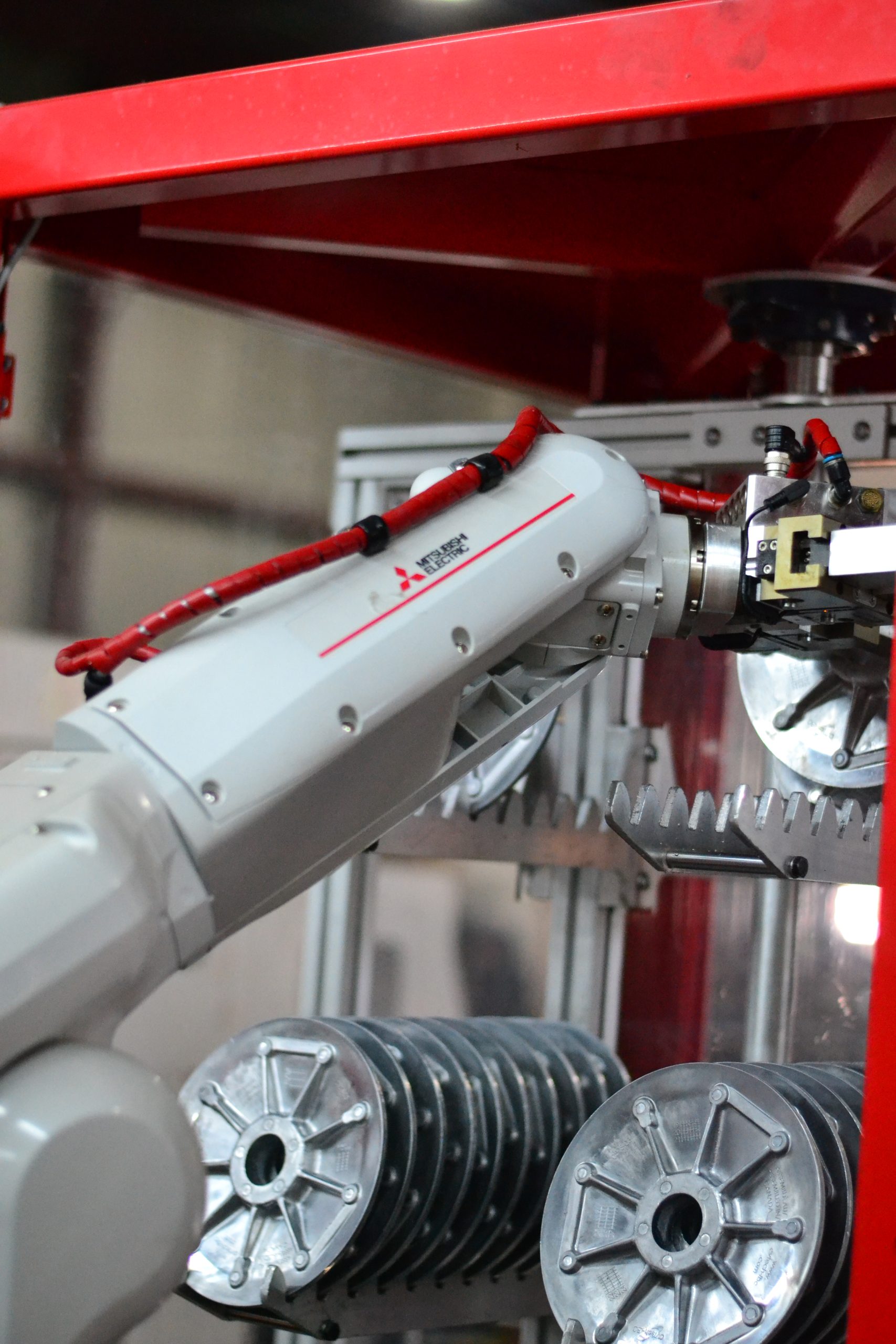
A typical system consists of your existing CNC machine, an industrial robot, a safety system/base, and designated areas for incoming and completed parts. The robot communicates with the machine to coordinate loading, unloading, and cycle start commands. In some cases, a single robot can service multiple machines simultaneously.
Why Machine Shops Are Looking at Automation
Labor is often the first challenge that pushes shops to explore automation. Finding reliable machine operators has become increasingly difficult, and even when positions are filled, employees often require substantial training before becoming productive. Shops that are unable to fully staff operations frequently struggle to maintain production schedules and meet delivery commitments.
Machine utilization is another major concern. CNC machines represent a substantial investment, yet understaffing often means equipment sits idle throughout the day. The challenge becomes even greater when shops attempt to add second or third shifts. It may be next to impossible to fill these shifts and to keep them staffed. This is where purchasing additional equipment becomes more attractive.
As reshoring efforts continue and manufacturers look to increase production capacity, many shops are searching for ways to increase output without proportionally increasing headcount. Machine tending automation offers a practical path to achieving that goal.
Is Your CNC Operation a Good Candidate?
We often hear, “Well, it’s a small shop, a robot would be overkill.” There is a huge misconception that machine tending is only suitable for large manufacturers. In reality, many successful projects are found in smaller machine shops. And we will share real examples of this later in the article.
If you can answer “yes” to one or more of the following, your machine may be a good fit…
My machine has predictable, repeatable processes
Our parts have consistent cycle times, stable fixturing, and straightforward load procedures
My shop has bottlenecks due to labor shortages
Operators in my shop spend substantial portions of their day loading/unloading machines
Addressing Common Concerns
Even when the benefits are clear, many shop owners and production managers remain hesitant to take the first step. Some concerns we see amongst customers are…
Complexity. There’s an assumption that operators may struggle to learn and manage automated systems. In practice, modern machine tending solutions often include training resources, startup support, and user-friendly interfaces designed to simplify operation and adoption.
Compatibility. Shop owners may believe their existing equipment is too old to automate. However, machine tending projects are commonly implemented on existing CNC machines, including equipment that has been in service for many years.
Floor Space. Automation does not always require extensive facility modifications. You may be relieved to know that machine tending cells are often designed to occupy space comparable to the operator's work area and parts storage already required around the machine.
Start Small, Build Confidence
Most shops do not automate the entire floor at once. They usually start with the machine that creates the most overtime, idle time, or scheduling headaches. Once that first cell is operating reliably, the team has a much clearer idea of where automation could make sense next.
Robotic machine tending has become a popular first automation project because the benefits are easy to understand: machines spend less time waiting, operators can focus on higher-value work, and production becomes more consistent. Best of all, manufacturers gain a practical way to increase output without continuously searching for additional labor.
About the author
Patrick Varley, Industry Marketing Manager (Robot)
Patrick Varley is an automation industry veteran with over 35 years of automation experience, having worked for systems integrators, robot and vision system manufacturers, and distributors. In his role at Mitsubishi Electric US — Industrial Automation Division, he is driven by the challenge of solving customers’ needs through innovative and durable automation solutions.