US cutting tool shipments totaled $258.9m in April, up 21.1%
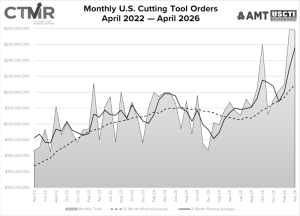
Shipments of cutting tools, measured by the Cutting Tool Market Report, a collaboration between AMT – The Association For Manufacturing Technology and the U.S. Cutting Tool Institute (USCTI), totaled $258.9 million in April 2026. The value of shipments decreased 0.1% from March 2026 but was up 21.1% from April 2025.

Shipments of cutting tools, measured by the Cutting Tool Market Report, a collaboration between AMT – The Association For Manufacturing Technology and the U.S. Cutting Tool Institute (USCTI), totaled $258.9 million in April 2026.
The value of shipments decreased 0.1% from March 2026 but was up 21.1% from April 2025. Year-to-date shipments totaled $964 million, up 17.2% from the same period in 2025. Unit shipments decreased slightly in April after rising in the previous two months.
“While shipments are up in the early months of 2026, much of the increase is due to inflation rather than increased units,” said Mike Stokey, president of USCTI and executive vice president and owner of cutting tool manufacturer Allied Machine & Engineering. “Raw material pricing and supply continue to be challenges for cutting tool manufacturers. These are unprecedented times, but I am cautiously optimistic.”
Alan Richter, editor-at-large, Cutting Tool Engineering, said, “Increased shipments are partially the result of robust metal cutting activity across multiple industries, but the cost of raw materials to produce cutting tools has surged over the past year or so, driving up costs and inflating shipment values. In one instance, an aerospace manufacturer reported the cost of carbide tools has risen 30% to 50% over the previous three months.”
The Cutting Tool Market Report is jointly compiled by AMT and USCTI, two trade associations representing the development, production, and distribution of cutting tool technology and products. It provides a monthly statement on U.S. manufacturers’ consumption of the primary consumable in the manufacturing process, the cutting tool. Analysis of cutting tool consumption is a leading indicator of both upturns and downturns in U.S. manufacturing activity, as it is a true measure of actual production levels.