JS, JRP, JPP and JSP Inserts
JS, JRP, JPP and JSP Inserts
For parts that are less than 0.125" (3.18-mm) in diameter, Tungaloy America Inc. introduced a series of high-positive, low-cutting-force, screw-down, dead-sharp inserts and toolholders last year. There are four chipbreakers: JS features a molded chipbreaker and the JRP, JPP, and JSP inserts.
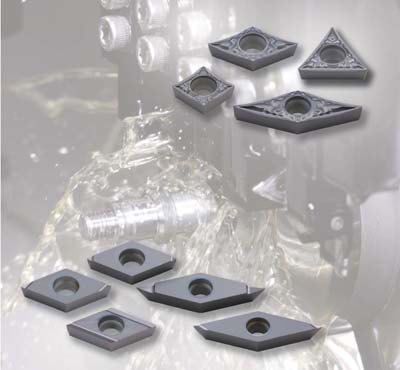
For parts that are less than 0.125" (3.18-mm) in diameter, Tungaloy America Inc. introduced a series of high-positive, low-cutting-force, screw-down, dead-sharp inserts and toolholders last year. There are four chipbreakers: JS features a molded chipbreaker and the JRP, JPP, and JSP inserts are fully ground with accuracy of +/-0.0002" (0.005mm) from the base of the tool to the end of the insert's tip.
"These inserts are designed for parts that require critical centerline accuracy and low cutting force," explains Brian Sawicki, Tungaloy's Turning Products Manager. "If you are cutting above centerline, you push the part. If below centerline, you gouge the part. It's important to be on center to accurately cut theses parts. These highly accurate, free machining inserts, allow you to machine small parts with minimal adjustment required for size."
The JS chipbreaker is a bidirectional insert with an aggressive, molded chipbreaker. The insert is designed with a tightly placed breaker near the cutting radius. It also features a high positive, inclined cutting edge. If this insert can't break the chip, it will direct it away from the workpiece.
"The JS type is most applicable for very small components in the medical, aerospace and automotive industries. One of the largest end users is a fuel filtration manufacturer for jet engines. The other three inserts, JRP, JPP, and JSP, were intended for small components made for the disk drive industry. They're designed to take a lighter cut, but have potential for machining pacemaker parts, fuel system components and even watch components," says Sawicki.