Secomax CS100 sialon ceramic grade inserts
Secomax CS100 sialon ceramic grade inserts
Seco, Troy, Mich., recently expanded the roughing and semi-finishing performance capabilities of its Secomax CS100 sialon ceramic grade inserts by adding inserts with T-style edge preparation to the line, according to a company news release. Featuring a free-cutting, sharp geometry, the new inserts are said to bring strength, stability and performance longevity to the machining of nickel-based superalloys in unstable conditions.
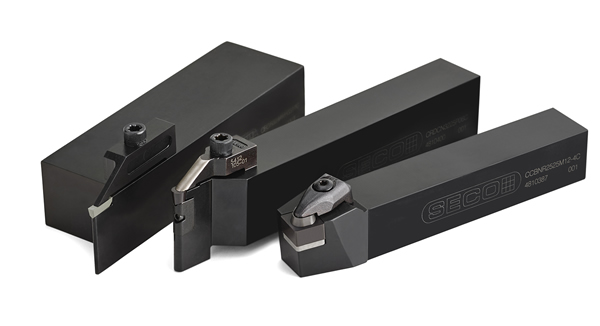
Seco, Troy, Mich., recently expanded the roughing and semi-finishing performance capabilities of its Secomax CS100 sialon ceramic grade inserts by adding inserts with T-style edge preparation to the line, according to a company news release. Featuring a free-cutting, sharp geometry, the new inserts are said to bring strength, stability and performance longevity to the machining of nickel-based superalloys in unstable conditions.
Said to be well-suited for turning applications that require tight tolerances and low cutting forces, the T-style (chamfered) CS100 inserts are available in 20-degree chamfers that range from 0.002" to 0.004" (0.05mm to 0.1mm) in width. The sharp, negative reinforced cutting edges on these inserts reportedly absorb some of the high cutting force and pressure that would otherwise be placed on the machine setups and workpieces. As a result, the inserts are said to eliminate the risk of workpiece deformation, especially in thin-walled components.
The characteristics of the T-style inserts complement the existing S-style (chamfered and honed) CS100 products designed to handle high cutting forces in rigid, stable machining conditions, according to Seco. Collectively, the T-style and S-style inserts in the CS100 line have high abrasion resistance and superior toughness that extends tool life and allows for high cutting speeds when processing challenging materials such as Inconel, MAR, RENE and Waspaloy.