Solid-Carbide Endmills for Trochoidal Milling
Solid-Carbide Endmills for Trochoidal Milling
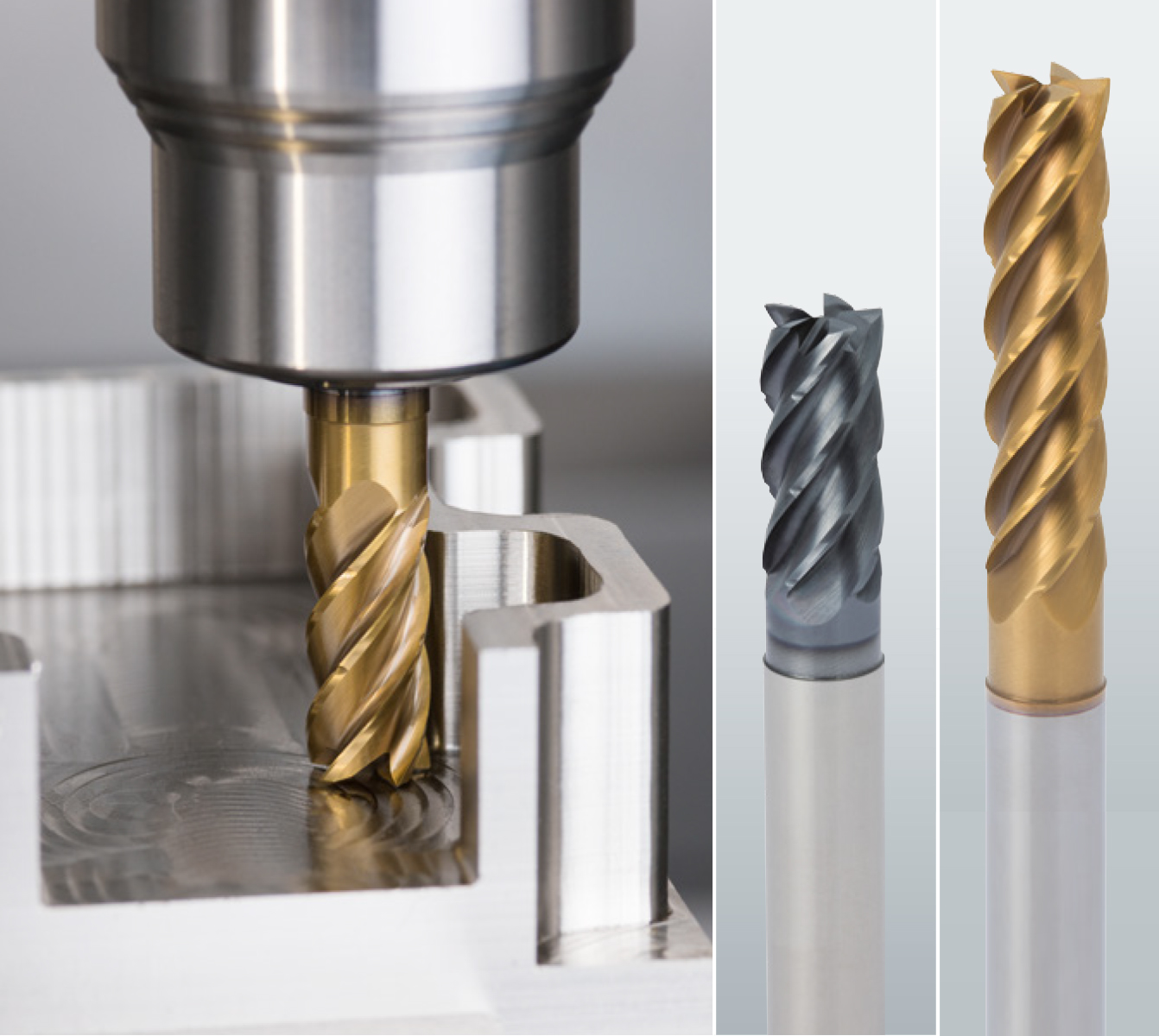
Emuge Corp. has introduced a new line of solid-carbide endmills with geometry and chipbreakers designed specifically for trochoidal milling. Emuge's new Trochoidal endmills provide increased metal-removal rates of more than 30 percent, fewer toolpaths and longer tool life, while enabling a high axial depth of cut of up to 4XD. The Trochoidal endmill series was developed specifically for advanced milling strategies available in modern CAM software to optimize the calculation of milling paths and avoid unproductive tool motion.
Emuge Corp. has introduced a new line of solid-carbide endmills with geometry and chipbreakers designed specifically for trochoidal milling. Emuge's new Trochoidal endmills provide increased metal-removal rates of more than 30 percent, fewer toolpaths and longer tool life, while enabling a high axial depth of cut of up to 4XD. The Trochoidal endmill series was developed specifically for advanced milling strategies available in modern CAM software to optimize the calculation of milling paths and avoid unproductive tool motion.
Trochoidal milling is a cutting strategy growing in use that involves the overlapping of circular cutting paths with linear movement and is especially suitable for difficult-to-machine materials and thin-walled components. The small contact angle on the tool reduces heat generation during machining and promotes less thermal stress, reportedly increasing tool life. The endmill is fully utilized over the entire flute length, resulting in wear that is evenly spaced over the full cutting edge, which also contributes to longer tool life. In addition, high MRR can be generated even on low-powered machines and wear is reduced during full slot milling.
Emuge Trochoidal endmills feature low-vibration characteristics, such as variable spacing, variable helix angles and improved micro-geometries, along with high-performance coatings of TiN/TiALN or ALCR and a submicrograin carbide substrate. In addition, the newly developed chipbreaker geometry reduces axial pull-out force and minimizes the risk of chip build-up in pockets, because the resulting smaller chips can be easily removed with compressed air or coolant.
The tools are available in two cutting geometries: Jet-Cut for roughing and finishing steel , and through-coolant TiNox-Cut for process-reliable roughing in tough materials, such as Inconel, titanium and stainless steel. Standard and long-length rougher/finishers with flute length/diameter ratios of 2:1, 3:1 and 4:1 are available for applications in a range of materials.