

When 3 Jaws are Better than 4
What about parts or shafts that need to both run true and have multiple features that run true to the others?
When it comes to precision turning, three-jaw scroll chucks are not on the short list of machinists in front of lathes at shops around the globe. Or are they? Depending on the type of three-jaw chuck and the level of precision required, they certainly should be! Allow me to elaborate.
I am willing to bet that all of you reading this have, at some point in time, needed to use a four-jaw independent chuck to dial in a part to run true and concentric. This may have been in your educational years, like me, or in your professional careers.
I’m also sure that most of us have run into this utterly annoying situation: While adjusting one of the jaws you cause the chuck to lose its grip and your part ultimately falls into the chip bed or onto the ways. Just writing that line makes me shudder.
Review the print ads from this magazine to continue
This quick advertiser review unlocks the rest of the article and keeps the full-screen reader focused on the ads instead of the page chrome.
Advertisers included in this article experience
Print placements connected to this article
Tapmatic
SYNCHROFLEX
Tapmatic promotes SynchroFlex rigid tapping holders for tap life, thread quality and internal coolant or MQL applications.
SYNCHROFLEX rigid tapping holders are presented for long tap life, thread quality and high-pressure internal coolant or MQL.
Visit Tapmatic View this placement in the issue recordMERSEN
DS4 Ultra-Fine EDM Graphite
Mersen promotes DS4 ultra-fine EDM graphite for precision EDM applications.
Mersen highlights DS4 ultra-fine EDM graphite and its EDM material capabilities.
Visit MERSEN View this placement in the issue recordPrint ads from this magazine
Tapmatic promotes SynchroFlex rigid tapping holders for tap life, thread quality and internal coolant or MQL applications.
SYNCHROFLEX rigid tapping holders are presented for long tap life, thread quality and high-pressure internal coolant or MQL.
Continue reading
May 2026
Don’t get me wrong, these four-jaw monsters have their place in the machining world, especially when holding unbalanced parts like a camshaft. As a result of the generous length of travel of each jaw, using an independent chuck makes sense when you need to turn features on a part with more than one center of rotation.
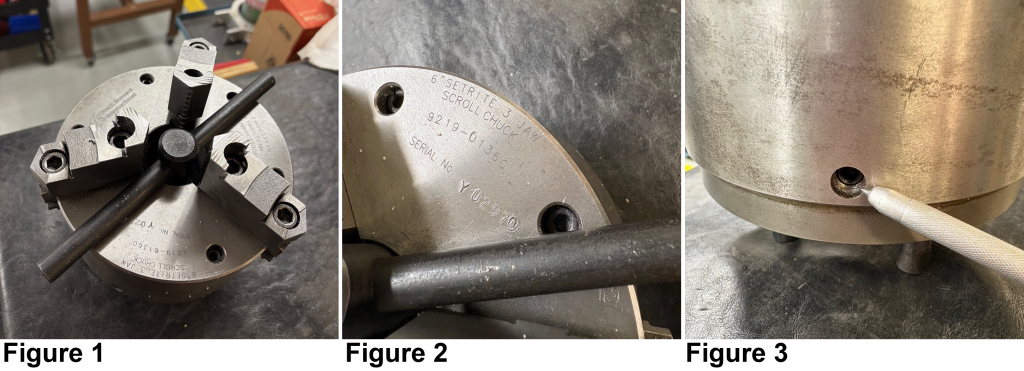
What about parts or shafts that need to both run true and have multiple features that run true to the others? You absolutely could torture yourself by spending the inhumane amount of time adjusting the part and dialing it in, all while risking the part falling out. Or you could do what we’ve done in our shop and adopt the use of three-jaw set-thru chucks. (See figures 1 and 3.) With these outfitted to most of our lathes we can firmly lock the parts in place, and use the four equally spaced impingement screws located radially on the outside diameter of the chuck.
To be fair to four-jaw chucks, the adjustment travel is much more forgiving in comparison to the set-thru type. If you’re unsure your part is unbalanced or may need a considerable range of adjustment, I would strongly suggest dusting off that four-jaw monstrosity.
As always, I share these experiences in the hope that it helps others facing similar challenges. Be sure to tune into The Daily Grind podcast live on Mondays at 8 a.m. Eastern for further discussion about three- and four-jaw chucks, and much more. The Daily Grind also is available wherever you get your podcasts on Tuesday mornings for the commute to work.
Related



 MFGAxis Discussion
Be part of the shop-floor conversation
Like, save, or comment on this CTE story.
MFGAxis Discussion
Be part of the shop-floor conversation
Like, save, or comment on this CTE story.


MFGAxis Discussion