

A Different Type of Arms Race
This month’s column is a primer on FlexArm, a product line of articulating cantilever arms from Flex Machine Tools, Wapakoneta, Ohio. The arms assist an operator in performing various manufacturing tasks. The company began manufacturing tapping arms in 1984, and over the years has expanded the product line to include arms for drilling, die and mold grinding, polishing, and for manipulating heavy workpieces — to name a few.
This month’s column is a primer on FlexArm, a product line of articulating cantilever arms from Flex Machine Tools, Wapakoneta, Ohio. The arms assist an operator in performing various manufacturing tasks. The company began manufacturing tapping arms in 1984, and over the years has expanded the product line to include arms for drilling, die and mold grinding, polishing, and for manipulating heavy workpieces — to name a few. The various types of arms are offered in a variety of sizes with different load capacities.
These tools are in the space between a manual tool like a tap wrench or handheld drill and a CNC machine tool or robot. The accompanying image shows a FlexArm tapping arm on the left and a Mag Drill arm on the right. For operators, FlexArm tools ease the burden of carrying the weight of a tool and controlling its torque reaction during an application, allowing them to concentrate on accuracy and productivity with increased safety for both the work and workforce.
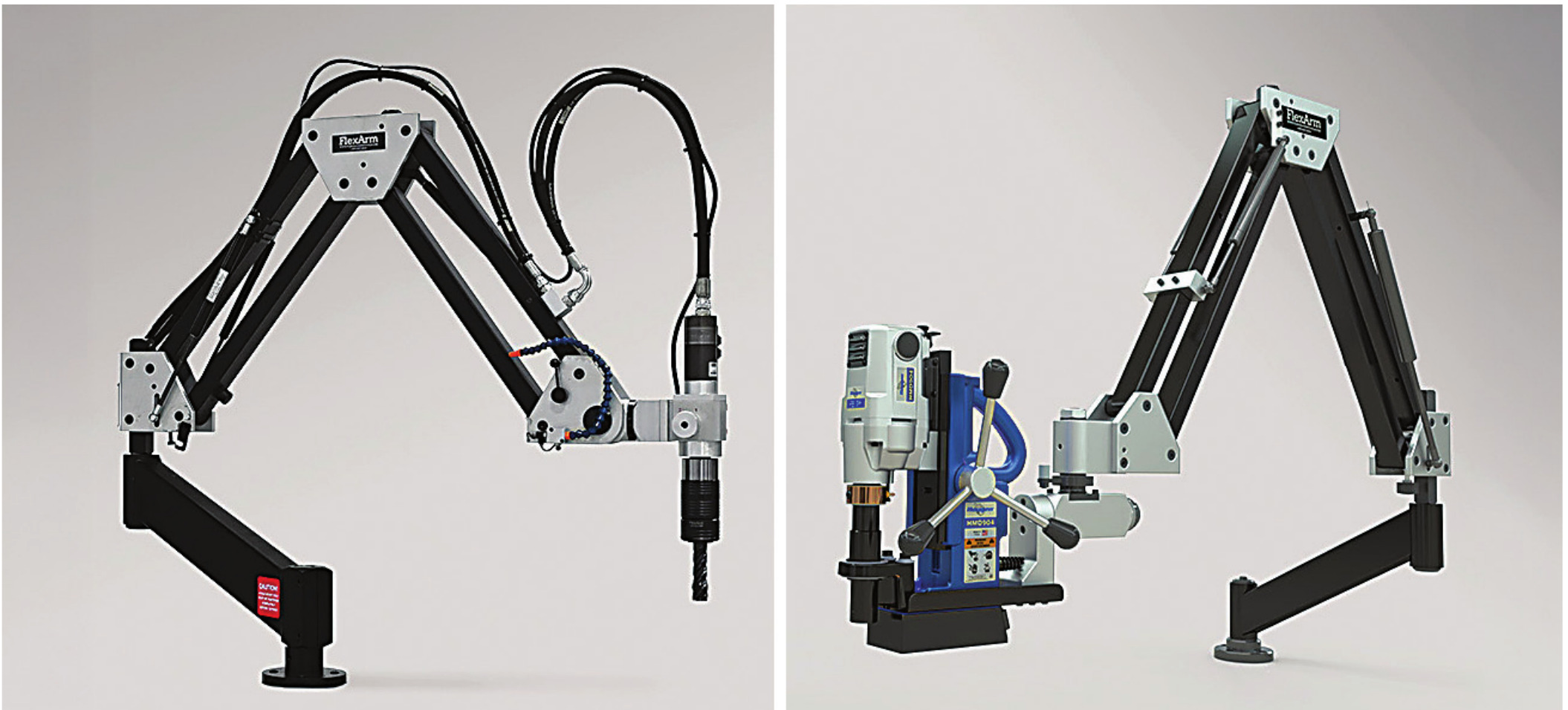
These arms have a tool post that attaches perpendicular to a work surface on one end. The tool post is a cylinder with flange or magnetic base; the end of the arm has a hub that fits on the post that allows the arm to rotate around the post. The distance between the tool post and tap center line is manipulated by the operator while the mechanical arm keeps the tap perpendicular to the work surface. With these two degrees of freedom (one rotary and one linear), the tap can be brought to bear anywhere in a workspace.
About Tapping Arms
They have an articulating cantilever suspension that holds the center line of a motor and cutting tool perpendicular to a work surface. The motor may have pneumatic, electric or hydraulic drive. With pneumatics, care must be taken to ensure the air is clean and dry. The air exits through the air motor.
I know from experience that a drop of water on a tap will cause poor surface finish and increased cutting torque. With small taps, this can cause breakage. That being said, for many applications, the pneumatic drive is the right choice. Four sizes of pneumatic tapping arms are available to accommodate tapping capacities ranging from 0 to 7⁄8".
Review the print ads from this magazine to continue
This quick advertiser review unlocks the rest of the article and keeps the full-screen reader focused on the ads instead of the page chrome.
Advertisers included in this article experience
Print placements connected to this article
Platinum Tooling Technologies
Platinum Tooling Technologies print ad
Print ad listed on page 9 of the June/July 2026 issue.
Visit Platinum Tooling Technologies View this placement in the issue recordPrint ads from this magazine
Print ad listed on page 9 of the June/July 2026 issue.
Continue reading
June/July 2026
Flex Machine Tools also offers two electric drive models with tapping capacities of 5⁄8" and 7⁄8" and an integrated digital depth control feature, as well as three sizes of hydraulic drive units that offer progressively greater torque output and semi-automatic tap fluid dispensing. The most powerful model will drive a 2" tap in mild steel.
The FlexArm Mag Drill arms, which are attached to a steel workpiece with magnetic force, provide the downforce necessary to drive the cutting tool into the workpiece. Though these drills are heavy, the mechanical arm carries that weight. The largest FlexArm drilling arm will carry a drill weighing up to 50 lbs. To make a hole, the operator positions the drill, actuates the magnet and finally the drilling action. Then he watches. Way to go.
Lastly there are what FlexArm calls their Ergonomic Arms. Part manipulator arms are like a jib crane with a pneumatic cylinder for power. They can move a part up to 200 lbs. into and out of a place where an overhead crane can’t reach. Counterbalance arms use pneumatics to counterbalance the weight of an object. For example, one has a gimble arrangement and can support the weight of a 6" disc grinder. The operator guides the tool over the workpiece without the fatigue that comes from carrying the tool’s weight. (I’ve been there and done that.) Torque reaction arms, available in many sizes, counteract the torque of rotary tools from 10 ft.-lbs. to 800 ft.-lbs. And, finally, the company offers custom FlexArm options for applications that need something different. (You can visit flexarminc.com for detailed information.)
If you have a job to do, make it easy. You will get more out of your people.
Related


Subscribers can use MFGAxis notes, saves and discussion tools with their innoNET account.


