


Eggy vs. Flowery
Dear Doc: We do cylindrical-OD grinding and struggle with roundness. Any quick advice?
Dear Doc: We do cylindrical-OD grinding and struggle with roundness. Any quick advice?
I. Inasaki, B. Karpuschewski and H.-S. Lee, “Grinding Chatter—Origin and Suppression,” CIRP Annals – Manufacturing Technology 50(2), 515–534 (2001). doi:10.1016/S0007-8506(07)62992-8.
M. Foth, Erkennen und Mindern von Werkstückwelligkeiten während des Außenrundschleifens, dissertation, Universität Hannover (1989).
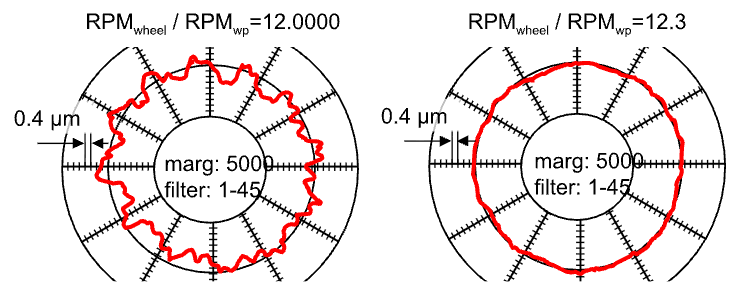
The Doc replies: Do a roundness profile. If it looks like a flower, with, say, 10, 20 or 30 petals, you have what I call Flowery Waviness. If it looks like an egg, then you have Eggy Waviness.
If you do a fast Fourier transform (FFT) and get a plot of amplitude versus undulations per revolution (UPR), Flowery Waviness will show pronounced peaks at 10 UPR, 15 UPR, 43 UPR and so on. Eggy Waviness will show messier quasi-peaks at 2, 3 or 4 UPR.
Flowery Waviness is usually (usually!) caused by an integer value for the rpm ratio. That is because the wheel is not perfectly round and balanced. That’s fine. No wheel is perfectly round and balanced. Even with an auto-balancer, the wheel is simply less imbalanced. If the high point on the wheel keeps hitting the low point on the workpiece, and the low point on the wheel keeps hitting the high point on the workpiece – over and over – then you can spark out for two hours and still not get a round workpiece.
Take the revolutions per minute (rpm) of your wheel and divide it by the rpm of your workpiece. If it is near an integer, you have a bigger chance of Flowery Waviness. Examples: 3005 rpm divided by 300 rpm equals 10.01666, close to 10.0000, which is bad. 3005 rpm divided by 309 rpm equals 9.724919, not close to 9.0000 or 10.0000, which is good. And 2700 rpm divided by 300 rpm equals 9.00000, which is very bad.
View print ads from this spread
Review the ads on this magazine spread to continue reading. Each ad takes two seconds; a two-page ad counts once.
Advertisers on this magazine spread
Print placements on this magazine spread
The Grinding Doc
The Grinding Doc — October 2026
Printed 7 in the October 2026 issue of Cutting Tool Engineering.
Visit The Grinding Doc View this placement in the issue recordPrint ads from this magazine
Printed 7 in the October 2026 issue of Cutting Tool Engineering.
Continue reading
October 2026 | Vol. 78 | Issue 8
Eggy Waviness is more of a challenge. Here, several factors can keep the wheel from cleaning up the workpiece during finish-grind and sparkout: 1) Threshold force, where the wheel rides over the workpiece without removing material because the grit penetration depth is not deep enough for the grits to bite into the workpiece and remove material; 2) Coolant hydroplaning, where hydrodynamic force from the coolant causes wheel deflection, both on a global scale at the spindle and on a local scale at the grit and bond, especially in a resin-bonded wheel; and 3) general machine imperfections, especially in older machines, crashed spindles, and worn bearings.
Here are some things you can do to manage the issue: 1) During finish-grind and sparkout, cut wheel speed in half, or even more. (Yes, that violates the ‘dress and grind at the same rpm’ rule. We’ll live with it.) This causes the grits to bite into the workpiece. It also reduces coolant hydrodynamic force. 2) Grind at faster workpiece surface velocities (for cylindrical grinding, faster workpiece rpm). This increases grit penetration depth enough for the grits to bite in while also giving more workpiece revolutions. It will reduce temperatures. 3) Turn down coolant pressure to reduce coolant hydrodynamic forces. Yes, this reduces heat flow to the coolant. But in finish grind, the arc length is so small that the coolant is not removing much heat.
It is a complicated, maddening mess, because during finish grind we do not want a large grit penetration depth. We want a small one for better surface finish. But we also want enough penetration depth for the grits to bite into the workpiece. The same contradiction applies to wheel speed: lower speed can mean rougher surface finish. How do you balance those contradictions? It depends on the problem. If surface finish is the issue, ignore this advice. If roundness or burn is the issue, use all of it, or some combination of it.
That is the challenge of grinding: balancing contradictions to find a good set of parameters. It is not always easy.
Related
Subscribers can use MFGAxis notes, saves and discussion tools with their innoNET account.