


Modular Workholding Helps a Shop Control Growth
Rapid growth can strain a young machine shop as severely as slow sales. Taking on more work than the shop can produce reliably can erode quality, extend deliveries and drive customers away.
Rapid growth can strain a young machine shop as severely as slow sales. Taking on more work than the shop can produce reliably can erode quality, extend deliveries and drive customers away.
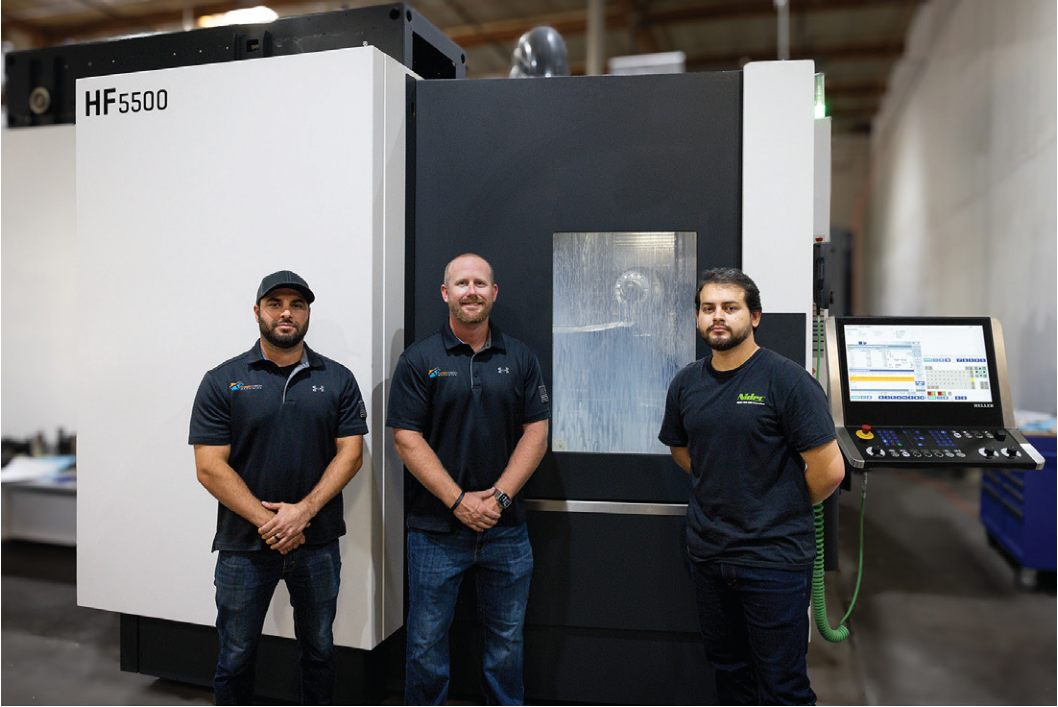
- END USER
- TurboTech Machining LLC
909-839-6700
www.turbotechllc.com - SOLUTION PROVIDER
- HWR Workholding USA Inc.
317-798-6599
www.hwr-usa.com - CHALLENGE
- Support high-mix, low-volume growth without sacrificing delivery performance or part quality.
- SOLUTION
- Modular zero-point workholding and off-machine workpiece stamping.
TurboTech Machining LLC in Rancho Cucamonga, California, has tried to avoid that pattern by improving its processes, investing in technology and selecting customers whose requirements fit its capabilities.
Founder and CEO Chris Lencioni developed the idea for TurboTech while managing an aerospace-focused shop that was trying to combine carefully scheduled, just-in-time work with unplanned jobs requiring short turnarounds. The competing demands created delays and frustrated employees.
In 2015, Lencioni leased a 92.9-sq.-m (1,000-sq.-ft.) space in Pomona, California, acquired a used CNC machine and opened TurboTech.
“When you’re starting a shop, no one’s going to give you good credit terms for your first two years, so you’re kind of in survival mode,” Lencioni said. “When I started TurboTech, I only had one employee, and we would often work 20-hour days.”
TurboTech reports that sales approached $1 million in its first year and have grown about 30% annually since then. The company now operates 2,601 sq. m (28,000 sq. ft.) across two Rancho Cucamonga facilities, employs 26 people and runs 39 machines, primarily for aerospace and space-industry work.
Continuous improvement has helped TurboTech pursue high-mix, low-volume production. The company says about 80% of its orders contain 50 to 300 pieces, with the remainder primarily prototypes of one to five pieces.
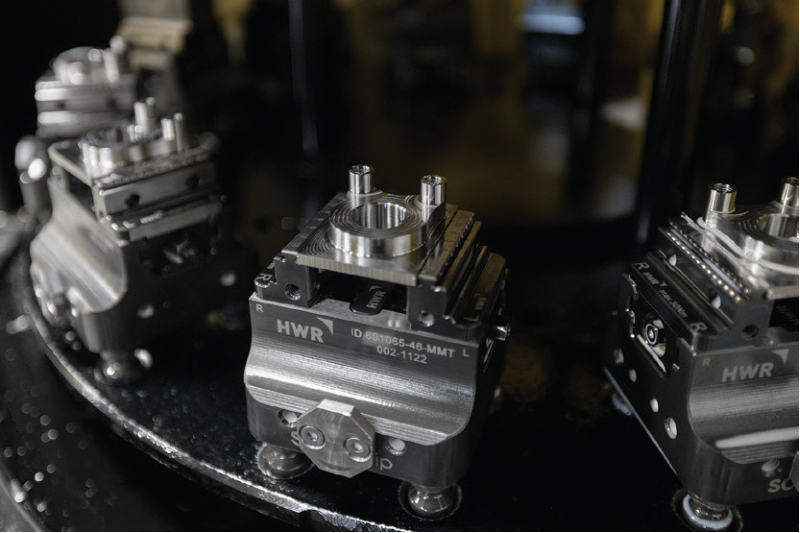
Automation and five-axis machining centers with turning capability are central to that strategy. More than 340 pallets support a mix of machines and lights-out production. Repeatable workholding is necessary for the shop to run those processes with limited operator intervention.
“We use SolidLine zero-point workholding from HWR, and it’s been very beneficial in several ways,” Lencioni said. “The accuracy and flexibility are extremely important. Using a combination of zero-point plates, risers and vises, we can build out a solution in under five minutes for something that previously may have taken two or three hours. And we have repeatability of 0.0001”.”
TurboTech uses more than 400 HWR vises, plus pyramids, risers and plates that integrate with its pallets. The modular system supports workpieces with dimensions ranging from several inches to roughly 40″ while maintaining the repeatability needed for automated production.
HWR’s SOLIDStamp system prepares raw workpieces outside the machine by stamping a defined tooth pattern that engages matching SOLIDGrip vise jaws. TurboTech says it applies the process to about 70% of its parts.
“If you’re cutting aluminum or another soft material, the vise jaws are going to imprint on the material and create secure holding,” Lencioni said. “But a lot of what we’re doing is in stainless, Inconel and nickel and titanium alloys. SOLIDStamp is invaluable for giving us an efficient way to hold those materials securely enough to maintain tolerances down to 0.0001” or 0.0002″.”
Before adopting SOLIDStamp, TurboTech used two vertical machining centers to cut dovetails into many workpieces, adding machining time and consuming material. TurboTech reports that moving this preparation off the machines eliminated about 5,000 machining hours a year while improving workholding consistency.
TurboTech also reports that its technology investments helped reduce average lead time from 10 to 12 weeks to six weeks. The shop has completed some urgent jobs within two days, but it limits new work to customers it believes it can support consistently.
“For every customer we take on, we invest both time and resources in making sure we can be the best possible partner,” Lencioni said. “Because of that, we are selective. We want to understand their needs. We want to understand the challenges they’re expecting us to overcome.”
TurboTech now uses a multistep process for prospective customers, including meetings at both companies’ facilities. If the companies proceed, an onboarding process aligns production capabilities, delivery expectations and the customer’s priorities.
“So much of success is about honest, open and respectful communication,” Lencioni said. “When we know what a customer wants, whether it’s to cut cycle times or improve surface finish or whatever, we can realistically evaluate if it’s something where we can provide them optimal results. If we don’t have capacity or if we feel like they don’t need the high level of performance we bring, we have no problem turning down the work and recommending one or two other shops that we think could possibly handle it.”
TurboTech reported about 30% growth in 2025 and forecast similar annual growth for the following three years. Lencioni said the company’s selective approach is intended to keep that growth from outrunning its production system.
Related


Subscribers can use MFGAxis notes, saves and discussion tools with their innoNET account.