



Growing in Productivity and Precision
Founded as the Carbide Grinding Co. 50 years ago, the Waukesha, Wisconsin-based firm triggered a bit of a rumble in the jungle of its own when second generation owner Kevin Cranker introduced the variable-helix, variable- index Gorilla Mill in 2005. The tool was such a hit that the company changed its name.
View print ads from this spread
Review the ads on this magazine spread to continue reading. Each ad takes two seconds; a two-page ad counts once.
Advertisers on this magazine spread
Print placements on this magazine spread
ANCA Inc.
Growing in productivity and precision
ANCA spotlights grinding precision, tight-tolerance production, and long-run consistency in this Productive Times case study.
Productive Times GROWING IN PRODUCTIVITY AND PRECISION F ounded as the Carbide Grind- END USER SOLUTION PROVIDER ing Co. 50 years ago, the Waukesha, Wisconsin-based Gorilla Mill ANCA Inc. 866-888-9600 248-926-4466 firm triggered a bit of a rumble in www.gorillamill.com www.anca.com the jungle of its own when second
Visit ANCA Inc. View this placement in the issue recordPrint ads from this magazine
ANCA spotlights grinding precision, tight-tolerance production, and long-run consistency in this Productive Times case study.
Productive Times GROWING IN PRODUCTIVITY AND PRECISION F ounded as the Carbide Grind- END USER SOLUTION PROVIDER ing Co. 50 years ago, the Waukesha, Wisconsin-based Gorilla Mill ANCA Inc. 866-888-9600 248-926-4466 firm triggered a bit of a rumble in www.gorillamill.com www.anca.com the jungle of its own when second
Continue reading
November 2024
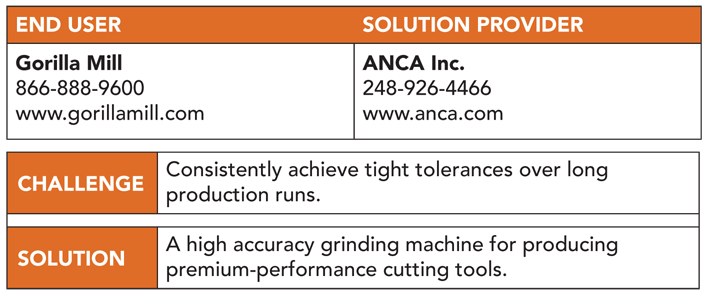
Founded as the Carbide Grinding Co. 50 years ago, the Waukesha, Wisconsin-based firm triggered a bit of a rumble in the jungle of its own when second generation owner Kevin Cranker introduced the variable-helix, variable- index Gorilla Mill in 2005. The tool was such a hit that the company changed its name.
Now known as Gorilla Mill, the company is a three-shift operation in a 24,000-sq.-ft. facility with dozens of 5-axis tool grinders, a full blank prep department, QC equipment, and centralized coolant filtration and mist extraction, with all utility lines running in trenches underneath the production floor.
ANCA Inc. in Wixom, Michigan, played a significant role in developing the tool, said Operations Manager Nathan Cranker. “In a lot of ways, it was thanks to ANCA that we were able to develop the Gorilla Mill. Because even back on our RGX and TG7 machines, which are ancient, their software had the capability to manufacture the parts we dreamt up.”
Cranker also noted ANCA’s frequent software upgrades, which boost tool throughput. “When we found ANCA, it just stuck immediately. The software was very user friendly, so we were able to understand it quickly.”
There are other endmills on the market with similar features, but the Gorilla Mill’s geometry is patented and remains a challenge for grinders from other builders, Cranker said.
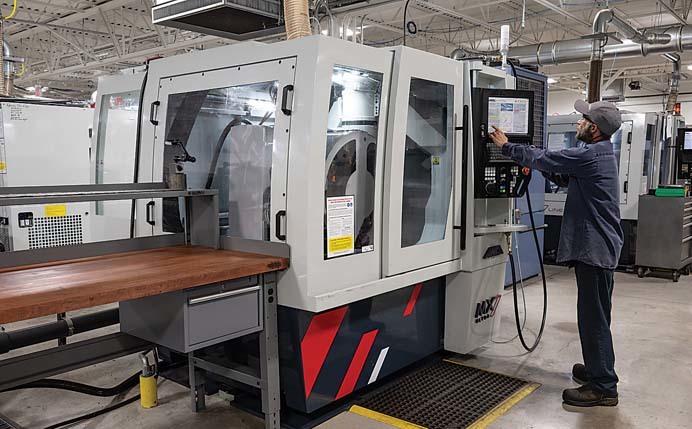
With a few frustrating exceptions, he added that since the toolmaker first switched to CNC, Gorilla Mill has built its business on ANCA machines, including the new MX7 Ultra.
Gorilla Mill already had a stable of MX7 Linear machines, which continue to perform well. So why the Ultra? “We have aerospace customers who demand plus zero and minus five ten-thousandths of an inch on the diameter and an end form on ballnose tools,” Cranker said. “And the tolerances are getting tighter … It seems the MX7 Ultra was designed for situations like this. [Tools] fluctuate maybe a tenth or two here or there, and only over a long period of time.”
ANCA reports that the MX7 Ultra can hold such tight tolerances over long production runs without operator intervention. First, Cranker said, the machine’s control resolution is 1 nm, which is 10 to 100 times finer than competing machines, including the MX7 Linear. Another bit of “magic” is the new control algorithm, which capitalizes on the improved control resolution to move through contours quickly and precisely. The Ultra also has Motor Temperature Control (MTC), a patented system that varies the current to the motor, rather than relying on liquid running through a chiller, to keep the spindle within 0.5° C. This minimizes spindle growth even as grinding conditions change.
“The original MX7 is a fantastic machine, but — and I don’t say this in any way to throw a negative light — it requires a little more hands-on maintenance from the operators to make tight tolerance tools in high volume,” Cranker said.
“They’d have to check the machine more frequently. But we were able to throw these tough, tight tolerance jobs right on the new Ultra and a lot of our problems went away. It’s producing tools more consistently, whether it be to the tolerance or just overall from job to job.”
It should be noted that ANCA offers options for improving grinding precision on all its models, features that Gorilla Mill has utilized. For example, automatic runout compensation uses a standard Renishaw probe to check the tool blank in three planes, digitizes the actual centerline of the tool, and then compensates the entire machine kinematic to grind relative to that center, rather than the centerline of the work head. The resulting grind is reportedly nearly flawless. And the feature adds just 25 seconds in cycle time.
ANCA also offers an internal non-contact tool measuring system called LaserUltra, which uses a Blum Digilog laser to perform either digital or analog scans of a tool profile. LaserUltra can scan an entire tool profile in about 10 to 12 seconds, compare the measured profile to the nominal, and, within roughly 5 seconds, automatically adjust either the wheel file or the grinding program as needed to bring the tool to within specifications. On an Ultra machine, such systems enable Gorilla Mill to grind ballnose endmills all night in an unmanned shift to within ±2 μm (0.0001″).
Cranker also noted that when ANCA introduced linear motors to the MX line of machines, it made an immediate improvement in surface finishes. Tools ground with a standard 320-grit wheel, for example, suddenly appeared as if they were ground with a 400-grit wheel. He said the higher resolution of the Ultra machine has made yet another improvement, such that a 320-grit wheel performs as if it’s a 600 grit.
“It’s huge,” Cranker said. “The machine’s smoothness really lets the wheels do what they need to do. It makes the finish even better, like a mirror, with very little effort. That’s what I really like about that machine.”
Cranker said this capability provides another competitive advantage in the marketplace. “Not only that, but it also provides peace of mind. A lot of customers have strict demands for the highest end tooling. When we show them their tooling is going on these state-of-the-art machines, they absolutely love it.”
With the bold motto “world domination,” Gorilla Mill clearly isn’t shy. As Cranker said, “We’re not the guys with a white tablecloth booth at IMTS. We’re the guys getting noise complaints, and it’s worked really well for us. We like making a ruckus and we have fun with what we do. Business is business, but you’ve got to love what you do, and that’s what we embrace here.”
Cranker described the relationship with ANCA as a “perfect match. Their automation capabilities are second to none, as far as I’m concerned. And that’s really helped us grow.” Likewise, he praised ANCA’s ability to deliver machines when needed. “We’ve got to work with a company that’s as nimble as we are.”
ANCA’s U.S. president, Russell Riddiford, returns the love. “ANCA is also celebrating 50 years in business this year, and while we haven’t been working with Gorilla Mill that long, we aim to support them for another 50 years and beyond. I’d like to think we mirror their creativity and drive to deliver a superior product.”
Related




Subscribers can use MFGAxis notes, saves and discussion tools with their innoNET account.


