Revolutionizing heavy equipment manufacturing with digital fluid management
Quaker Houghton's QH Fluid Intelligence platform enhances coolant stability and efficiency for OEMs.
In the production of heavy equipment for construction, forestry, mining and other industries, a variety of metals are used based on the performance requirements of the end-use application. These metals can range from carbon alloys used for strength and structural integrity to lightweight metals like aluminum and stainless steel, which provide corrosion resistance. Managing these materials in different metalworking applications, such as rolling, bending, forging, milling, grinding and drilling, is key to the manufacturer’s overall efficiency and profitability.
The industrial process fluid that enables operation is critical to these metalworking applications. A particular metalworking operation is only as good as how well its process fluid, also known as “metalworking fluid,” is managed.
Metalworking fluids typically provide three main functions: lubrication to remove friction between a tool and the workpiece, cooling to remove generated heat, and/or flushing to remove metal chips and fines.
In the case of coolants, many are water-soluble and applied as emulsions with a particular ideal concentration. Because concentration can vary due to natural evaporation or discharge, careful monitoring is recommended. Not maintaining optimal fluid concentration can lead to various problems, such as overconsumption of coolant, tool breakages, part defects, corrosion and even health and safety issues.
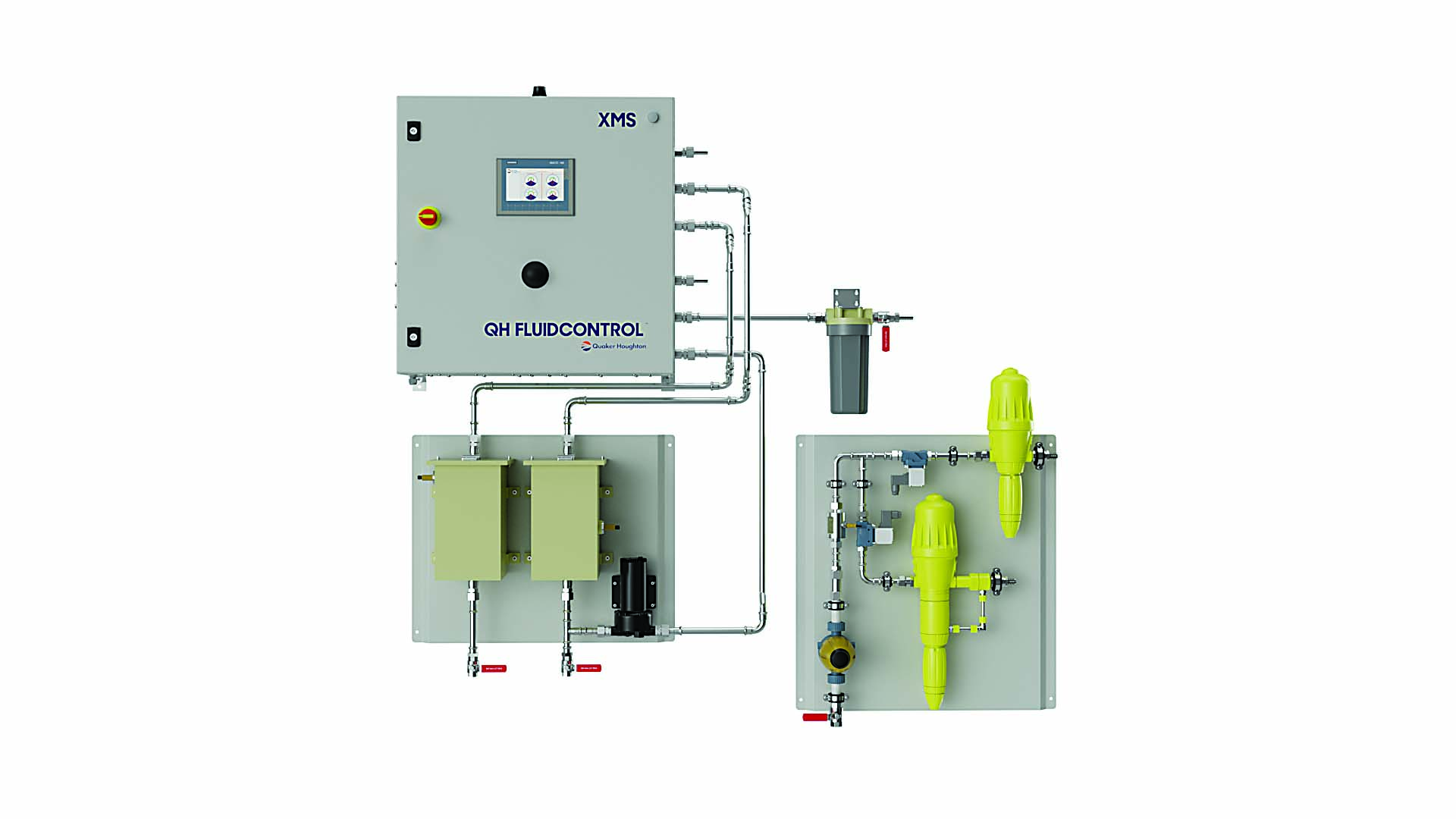
Image courtesy of Quaker Houghton
Though heavy equipment manufacturers have automated many parts of their manufacturing process, often the monitoring of metalworking fluid is done manually via regular collection of samples that are either sent to a laboratory for further analysis or are tested at the point of use with simple instruments like a refractometer. The labor effort for sampling alone can be significant. By the time laboratory analysis is completed, system conditions have changed. Alternatively, if an analog refractometer is used, human error can be introduced. Even when readings are accurate, replenishing fluid is still necessary to correct the concentration, a process which is often done manually.
Review the print ads from this magazine to continue
This quick advertiser review unlocks the rest of the article and keeps the full-screen reader focused on the ads instead of the page chrome.
Advertisers included in this article experience
Print placements connected to this article
Cutting Tool Engineering
Access Cutting Tool Engineering anywhere
Read the digital edition on iOS, Android, or on the web through Cutting Tool Engineering’s digital magazine reader.
GET OUR APP! Stay informed and engaged! Access Cutting Tool Engineering magazine anytime, anywhere through our digital edition, available on iOS and Android devices in their respective app stores and at digital.ctemag.com. iOS and Android
Visit Cutting Tool Engineering View this placement in the issue recordPrint ads from this magazine
Read the digital edition on iOS, Android, or on the web through Cutting Tool Engineering’s digital magazine reader.
GET OUR APP! Stay informed and engaged! Access Cutting Tool Engineering magazine anytime, anywhere through our digital edition, available on iOS and Android devices in their respective app stores and at digital.ctemag.com. iOS and Android
Continue reading
October 2024
While some companies and suppliers have offered hardware to perform some fluid measurement or control, most have varying degrees of practicability and reliability, or have not been built to deliver significant and useful insights. Some industrial process fluid leaders have made significant progress in introducing complete automation and control technologies for digitally optimizing fluids and processes. For example, Conshohocken, Pennsylvania-headquartered Quaker Houghton has partnered with end users to understand customer needs in fluid management, like a fully automated hardware solution that is customizable, scalable and easily integrated into the manufacturing system, paired with user-friendly software giving real-time, accurate and actionable insights.
A significant Quaker Houghton investment has enabled trialing various sensors and control technologies in numerous fluid applications. The experience and knowledge gained has evolved into the QH Fluid Intelligence platform. This digital platform, which includes hardware customized to the company’s fluids and proprietary software for real-time continuous monitoring, control and data analytics, combines all the elements necessary to allow manufacturers to optimize fluid management. By digitally optimizing processes, manufacturers can refocus resources on their core business of efficiently producing high-quality, competitive products.
Like many manufacturing sectors, the heavy equipment manufacturing sector is challenged with improving quality, increasing efficiency and lowering costs to stay competitive. A top OEM of heavy equipment for the agricultural industry was facing challenges with coolant stability in its grinding operations. Poor fluid management practices led to bacteria and fungi, making coolant used in a critical gear tooth face grinding operation unstable. Poor coolant performance led to increased scrap, maintenance and production costs. The coolant delivery system piping had to be manually cleaned out, which consumed five days of production time every quarter.
The OEM contacted Quaker Houghton for a solution. Quaker Houghton recharged the OEM’s grinding system with a fully synthetic coolant and deployed its digital platform, including hardware to automatically control the coolant system and software to provide real-time data logging and analysis. Using this platform, the OEM reduced operational costs by about $300,000 annually and decreased machine downtime by 75%, equivalent to over 1,000 hours of additional productive time per year. The now stable and controlled coolant environment enhanced production efficiency, increased output and reduced costs.
For more information about Quaker Houghton, call 610-832-4000 or visit www.quakerhoughton.com.
—Quaker Houghton