

Playing an ace: Workforce Development & Training
America's Cutting Edge seeks to bolster the U.S. machining Industry through R&D and education.
Several years ago, amid concerns about the state of its machining technology and workforce, America pulled an ACE out of its sleeve.
Launched in 2020, America’s Cutting Edge (ACE) is a national program aimed at bolstering the U.S. machining industry. “ACE was born out of the understanding that machine tools and machining processes are critical to U.S. manufacturing in general and the Department of Defense (DoD) specifically,” noted Tony Schmitz, a professor at the University of Tennessee, Knoxville, (UT) and director of the Machine Tool Research Center at the university.
A key figure in the creation and current operation of ACE, Schmitz pointed out that the program has two primary components. One is research and development at the U.S. Department of Energy’s Manufacturing Demonstration Facility at Oak Ridge National Laboratory. The purpose of this R&D is to improve U.S. machine tools and machining processes.
The other component is an effort to address the worker shortage in the industry by educating young people and others about machining and jobs in the field. In this area, ACE benefits from the workforce-development experience of the Institute for Advanced Composites Manufacturing Innovation. IACMI manages the ACE workforce initiative through an agreement with the DoD’s Industrial Base Analysis and Sustainment (IBAS) program, which provides funding for the effort.
Machining Education
A professor with a career in machining technology, Schmitz took on the job of coming up with an educational approach that would serve as the foundation for ACE’s workforce-development effort. “My initial role was to develop curriculum and decide how we’d like to share that in order to reach a broad audience,” he said.
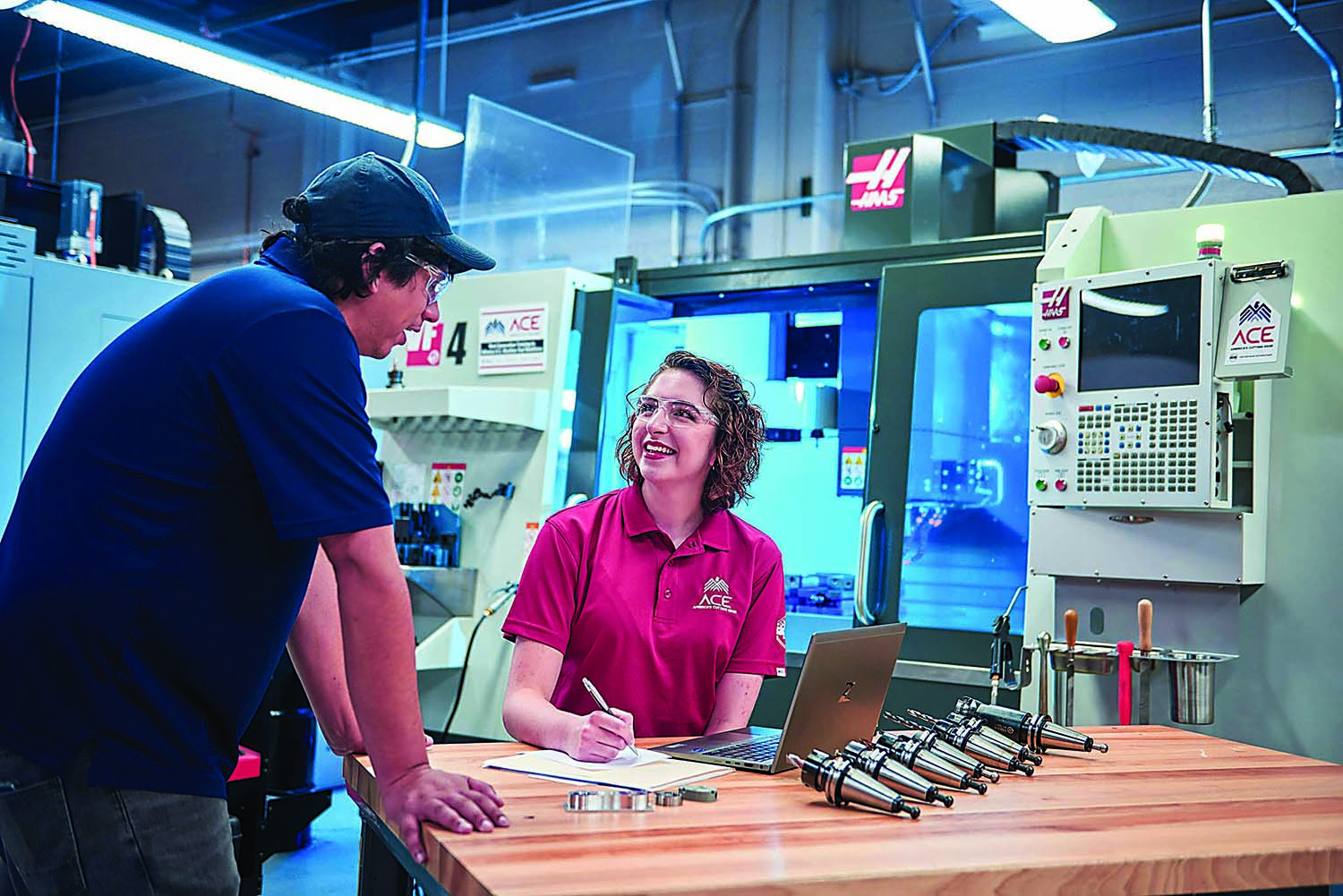
An ACE instructor (left) works with a participant at an in-person training session. Image courtesy of IACMI
What eventually emerged was free online and in-person training in CNC machining and metrology. Introduced in December 2020, Schmitz’s online CNC machining training curriculum includes an introduction to machining, machining dynamics and machining costs, as well as CAM instruction. People from all 50 states have registered for ACE’s online machining instruction, according to IACMI.
The program’s online metrology training includes an introduction to manufacturing measurements and measurement uncertainty. Both the machining and metrology training can be accessed by registering at AmericasCuttingEdge.org. No prior training or experience is required to enroll in the programs.
Those who complete the online training are eligible for 32 hours of free in-person training at UT and other locations. In-person metrology training will be available for the first time this spring, according to Schmitz. Completed over five days, the in-person machining training includes component manufacturing with machine tools.
At UT, Schmitz and some of his students were the first in-person machining trainers. Today, however, their role is to train the trainers for the 29 ACE locations that have sprung up around the country. “It is a full-time job for us to train the trainers,” Schmitz said, adding that all trainer candidates must have prior CNC machining experience.
To facilitate the spread of ACE instruction around the country, IACMI has followed a hub-spoke model. ACE hubs have been established at seven sites in different areas. With the hubs in place, spokes are added to support them, explained IACMI’s Kim Harris, who has overseen implementation of the ACE training program. Established at places such as high schools, community colleges, colleges of applied technology and universities, spokes carry out the ACE mission, training students and working adults interested in learning about machining. IACMI provides the hubs and spokes with budgets for training and equipment and also monitors their activities to make sure that program objectives are being met.
ACE Hub
One of the ACE hubs is the Texas A&M Engineering Experiment Station (TEES), which seeks to support U.S. manufacturing with innovative approaches to technology and workforce development. “The state charters us with growing the industrial base in engineering in the state of Texas. So it seemed like a natural fit for us to get involved with ACE and help scale up that program,” noted John Peterson, senior project manager for manufacturing workforce initiatives at TEES.
Review the print ads from this magazine to continue
This quick advertiser review unlocks the rest of the article and keeps the full-screen reader focused on the ads instead of the page chrome.
Advertisers included in this article experience
Print placements connected to this article
Iscar
Interchangeable Turning Heads
Iscar highlights interchangeable turning heads for general external turning applications with steel eco shanks and dedicated interchangeable heads.
Interchangeable Turning Heads Iscar highlights interchangeable turning heads for general external turning applications with steel eco shanks and dedicated interchangeable heads. Visit iscarmetals.com to learn more.
Visit Iscar View this placement in the issue recordPrint ads from this magazine
Iscar highlights interchangeable turning heads for general external turning applications with steel eco shanks and dedicated interchangeable heads.
Interchangeable Turning Heads Iscar highlights interchangeable turning heads for general external turning applications with steel eco shanks and dedicated interchangeable heads. Visit iscarmetals.com to learn more.
Continue reading
May 2024
While some TEES spokes are area high schools, Peterson said, more focus is being placed on reaching college students and working adults. At Texas A&M, the program targets engineering students. “We work with them so they can get some hands-on experience and see where all their (coursework) is going at the end of the day,” he said.
TEES also sets up ACE boot camps for companies that are partners of the university. “They may send people from their warehouse to go through the boot camp and get some firsthand experience,” Peterson said, adding that some of these workers have even switched from the warehouse to the shop floor.
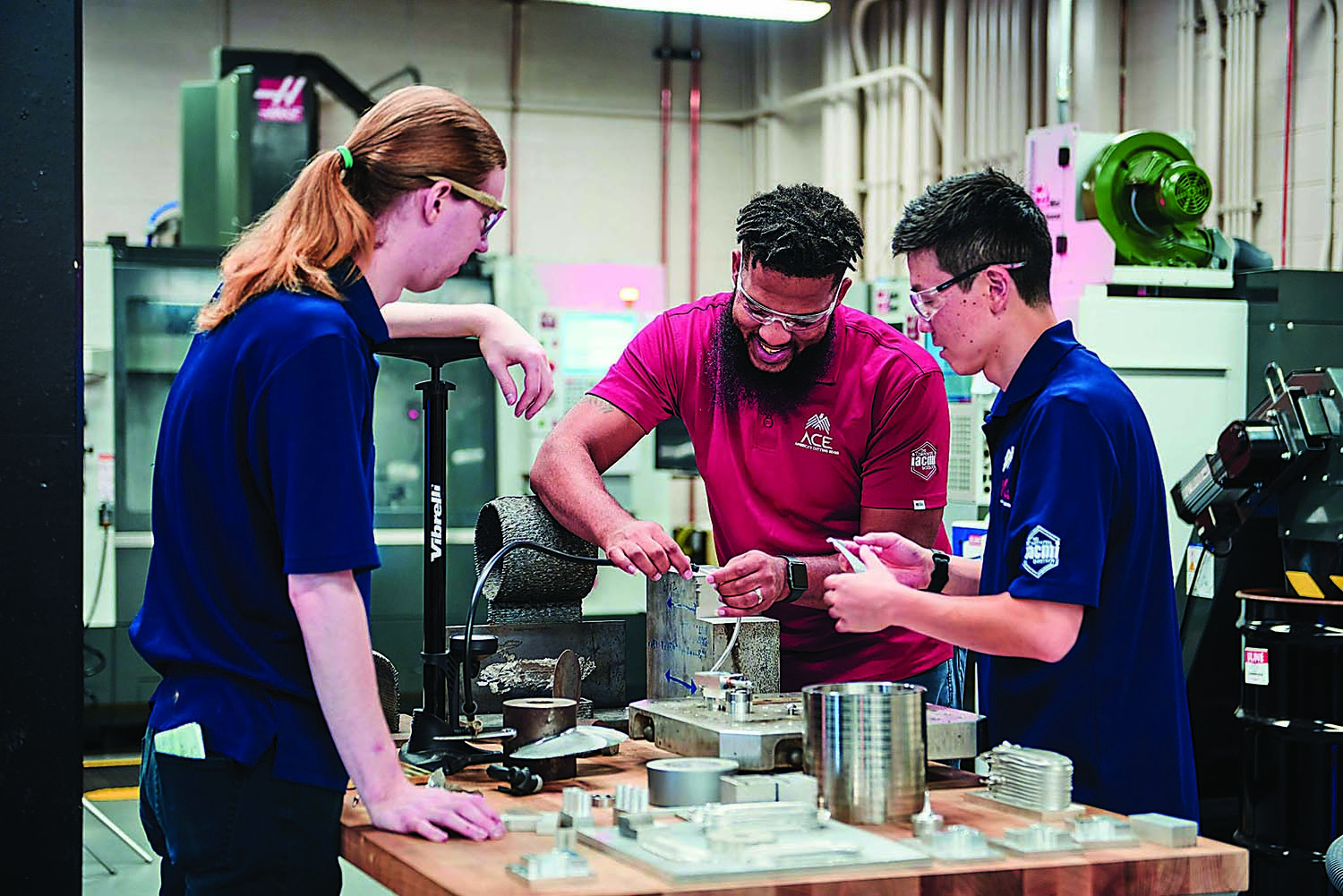
Two ACE trainers assist a student (middle). Image courtesy of IACMI
In addition to providing curriculum, ACE has given the TEES hub a boost by financing the purchase of three milling machines. These were sent to three different boot camps so they could increase the number of people being trained at their ACE sessions, Peterson reported.
On the downside, Peterson noted that the program currently falls short when it comes to matching up trained people with machining jobs. So TEES is trying to set up internship programs at manufacturing companies for some of those who complete ACE training. In addition, TEES is working with nonprofit organizations to create programs that will help transitioning veterans get the skills they need to qualify for manufacturing jobs.
“We’ve been having meetings with businesses that are highly interested in getting some folks in the door,” Peterson said, “but we need a little bit of help from local industry on what they want (workers) to know as a baseline.”
Reaching Youth
According to Schmitz, ACE also needs to expand its outreach efforts to young people. “If you’re in workforce development and training, what you often hear is that we’re not capturing our students early enough,” he said. “We need to get their attention in middle school or maybe even elementary school.” So ACE curriculum and activities have been developed for middle school students, and some pilot programs with these materials have been run “with good success,” Schmitz said.
In addition, some involved in the program are looking at what more can be done on the high school level. For example, Schmitz said, ACE might be able to provide teachers who are not experienced machining instructors with machining-related content that could be seamlessly integrated into their curriculum.
Already, though, ACE has done a good job of teaching Americans about machining. According to IACMI, over 9,000 people have registered for online courses since the program’s inception and more than 1,200 of them also have been trained in person.
While this can be considered a significant achievement, Schmitz doesn’t want to overstate its importance.
“We are not able to turn out a journeyman machinist” after one week of training, he said. “What we can do is provide exposure to and at least some experience on production-level CNC machining equipment. My goal is that when students depart from the online or in-person training, they have learned about CNC machining and are able to say, ‘I could do this. Maybe I’m not qualified to take a full-time position, but now I know the value of it and I’m ready to take the next step.'”
Related




Subscribers can use MFGAxis notes, saves and discussion tools with their innoNET account.


