A fluid choice: Drilling Performance
How water-miscible fluid and neat oil stack up when deep-hole drilling with high-pressure coolant.
When drilling a deep hole with high-pressure fluid, the correct pressure and volume for the cutting tool diameter is a key component, but more critical for successful holemaking in the process itself. That’s according to Tim Schneider, vice president of ATS Systems, with locations in Rancho Santa Margarita, California, and Sewickley, Pennsylvania. The company manufactures CoolJet high-pressure coolant delivery systems and distributes Masterall water-soluble, or water-miscible, metalworking fluids from Etna Products Inc. in Chagrin Falls, Ohio. “We know that brand works with high pressure.”
He recommends a two-step process, starting with the longest standard drill for the hole diameter being produced entering the workpiece at the highest feed rate as appropriate for the material and drill. That step is followed by using the deep-hole drill in which the high-pressure coolant is activated but rotation doesn’t begin until the drill tip enters the hole.
“What that does is it creates a hydrostatic bushing, so you don’t hit the margins on the drill and damage them,” Schneider said. “Then you can just go straight through that hole. There shouldn’t be any peck cycles required until you are at least 14, 15 times depth to diameter.”
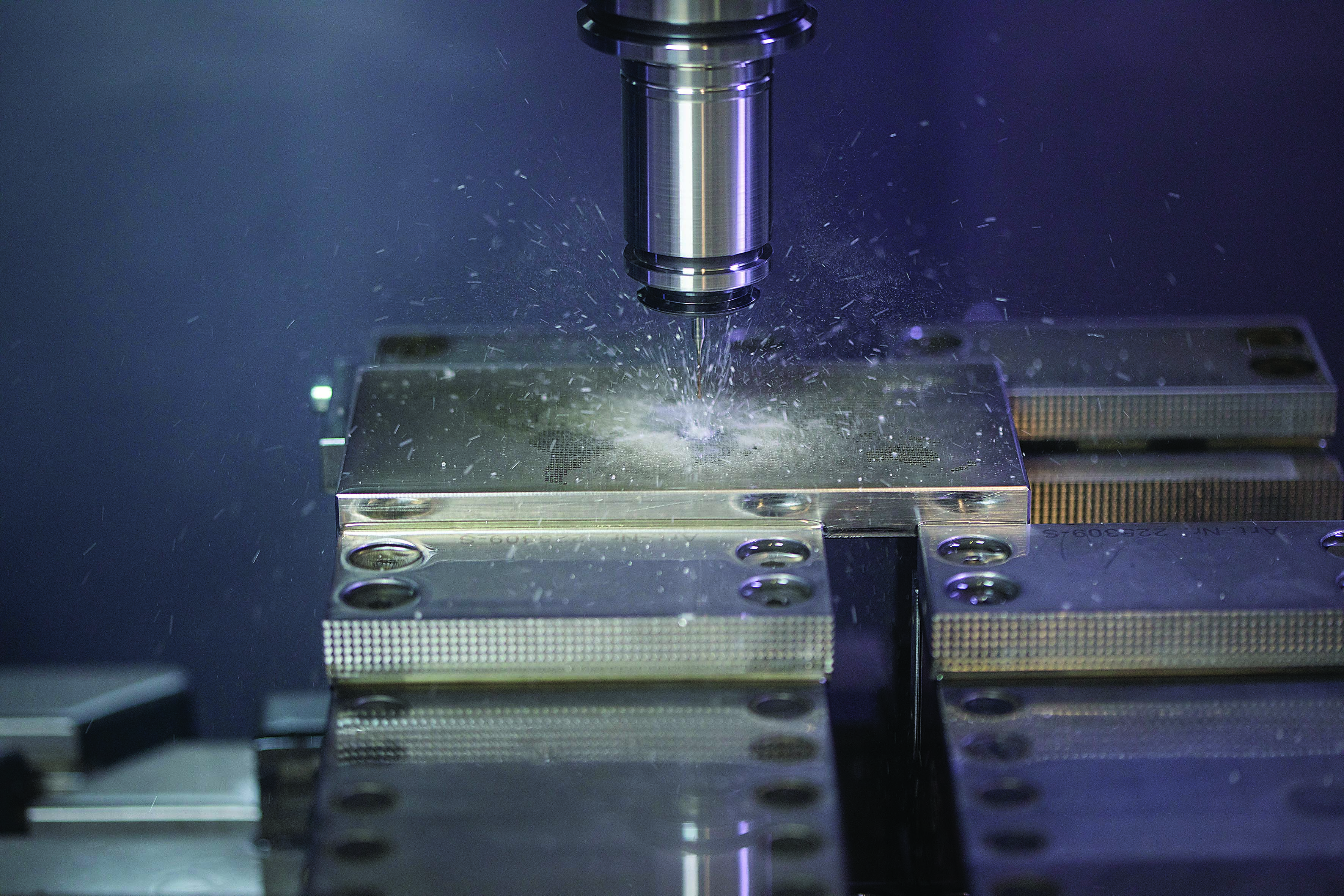
Blaser Swisslube reports that the low viscosity of 8 mm2/sec. (8 centistokes) at 40° C (104° F) of its Blasomill GT 8 X coolant optimally cools and lubricates at high pressures. In addition to drilling, the fluid is suitable for turning, milling and tapping. Image courtesy of Blaser Swisslube
The point geometry of both drills must be the same, he added.
If a cross-hole is encountered, Schneider noted that the feed rate needs to be reduced by half because there is no longer a hydrostatic bushing, or pressure built into that hole from the drill, once the tool breaks through. In addition, continuing at the higher feed rate will damage the drill and shorten tool life.
Decision Time
High pressure, however, covers a range, with 20.7 to 206.8 bar (300 to 3,000 psi) frequently referenced. “Most cases, 70 bar is your best pressure all around,” Schneider said, indicating a pressure that is approximately 1,015 psi.
Although he said he frequently receives requests for higher pressure systems, the only times an increased pressure is needed is for certain applications in which it is beneficial to have more volume, such as when applying small-
diameter drills for Swiss-style machining. Not only are higher pressure systems more expensive than one that provides 70 bar of pressure, but they can be more dangerous to operate.
Schneider noted that one Tier 1 manufacturer requested a 3,000-psi system, but ATS performed a test cut and determined that chip formation and overall performance was better at 1,000 psi. “Most machine tool spindles and turrets can’t go over 70 bar anyway.”
A more recent request, he said, was for a 300-bar (4,351-psi) system. “I’m like, ‘I don’t know what you need that for, but we’ll see.’ A lot of times people will get a number out there and think that’s their magic bullet. I’ve had a number of occasions where I proved that 1,000 psi rules in most cases.”
The use of neat oil when deep-hole drilling presents a slightly different scenario.
While 1,000 psi is ideal and typical for water-miscible coolant, pressures up to 138 bar (2,000 psi) are commonly used for neat oil, said Brett Reynolds, senior application engineer, and certified metalworking fluids specialist (CMFS) for Blaser Swisslube Inc. The Goshen, New York-based company’s metalworking fluids include a host of water-miscible coolants and neat oils, as well as fully synthetic coolants. For example, Blaser offers neat oils with fast air release to reportedly provide optimal lubrication and heat dispensation of the tool/workpiece interface. Entrained air does not allow optimal lubrication, which leads to poor cutting performance and decreased tool life.
“We have developed two brand new neat oils, Blasomill GT 8 X and Blasomill GT 16 X, that are dedicated gundrill oils, and they’re really formulated to meet the demands that are being placed on these oils in today’s machine tool market,” Reynolds said.
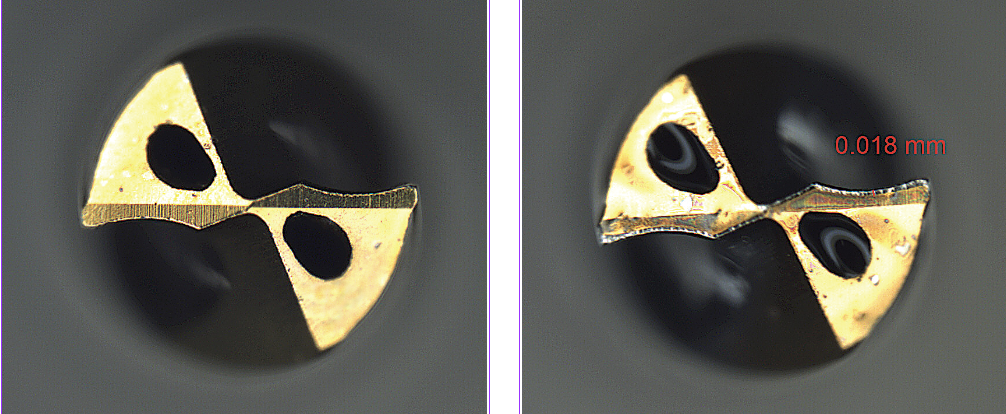
A new 1-mm drill (left) and tool wear of less than 20 µm after drilling 3,421 holes in stainless steel using Blasomill GT 8 X coolant. Image courtesy of Blaser Swisslube
In addition, the Blasomill GT 8 X is suitable for producing small holes with the addition of a high-pressure oil delivery system. Its fast air release properties and unique additivation package, provides effective heat dispensation and optimal lubricity at the cutting edge, Blaser Swisslube reports.
As with virtually every metalcutting decision, application is everything. There is a give and take with every fluid, he noted. Deep-hole drilling with oil requires additional effort to clean the parts after machining than when using water-miscible fluids, but the latter poses the risk of corrosion as well as poor cutting performance and decreased tool life if the coolant concentration is not maintained properly. Typical concentration ranges for water miscible coolants are usually from 10% to 15% to provide enhanced lubricity for deep-hole drilling.
“Straight oil is going to win every time from a lubricity standpoint and tool standpoint for the simple fact that it doesn’t rely on anybody to mix it,” Schneider said. “It has its viscosity, and it is what it is.”
Reynolds said: “Typically with water-miscible coolant, you can go quite a bit faster because of the cooling properties of water that they’re mixed with, versus a neat oil where you are limited. You can only go so fast until you start ‘smoking the oil’ and then you’ve pretty much reached the limit and should consider backing it off at least 5% at that point. If you continue to push the limits of the oil, you’re going to set the oil on fire, then you’ve really got a problem. This is why there is no ideal metalworking fluid for universal application developed yet. That’s always been the goal, but I don’t know if that will ever be achieved in my lifetime.”
In the Mix
A lot of the problems end users experience with water-miscible fluids is because they don’t mix them properly, according to Schneider. “There’s an acronym called OIL and what that means is oil in last. What a lot of people do is they’ll put the concentration in their mixing bucket, then they’ll put water in and that will create what’s called a reverse emulsion and cause foaming.”
Steven Lowery, executive vice president of oelheld U.S. Inc. in West Dundee, Illinois, offered the analogy of making chocolate milk with a syrup. If the syrup is poured before the milk, some of the syrup will likely remain on the bottom of the glass even after a thorough stirring. When milk is added first, it’s easier and quicker to evenly distribute the syrup throughout the drink. “That’s one of the downsides of water miscible is a lot of people don’t mix their products properly to create that tight water/oil bond of the molecules. We call it a loose, or sloppy, emulsion.”
In addition, many end users think they need an oil skimmer to remove way oil from the coolant. While this is true, much of the skimmed product is actually separated coolant concentration that’s floating to the top, he noted. “They mix it wrong and that’ll damage tool life and all the things in the facility and within the process.”
To tackle foaming, Lowery says oelheld formulates its oil and water-miscible products with ingredients to minimize or eliminate foam, with the option to treat tank side with defoamers. He added that a facility’s water hardness also impacts the amount of foam a fluid generates, where a very soft water has a higher propensity to foam compared to hard water. “We can induce artificial hardness to the water if it is too soft for the application.”
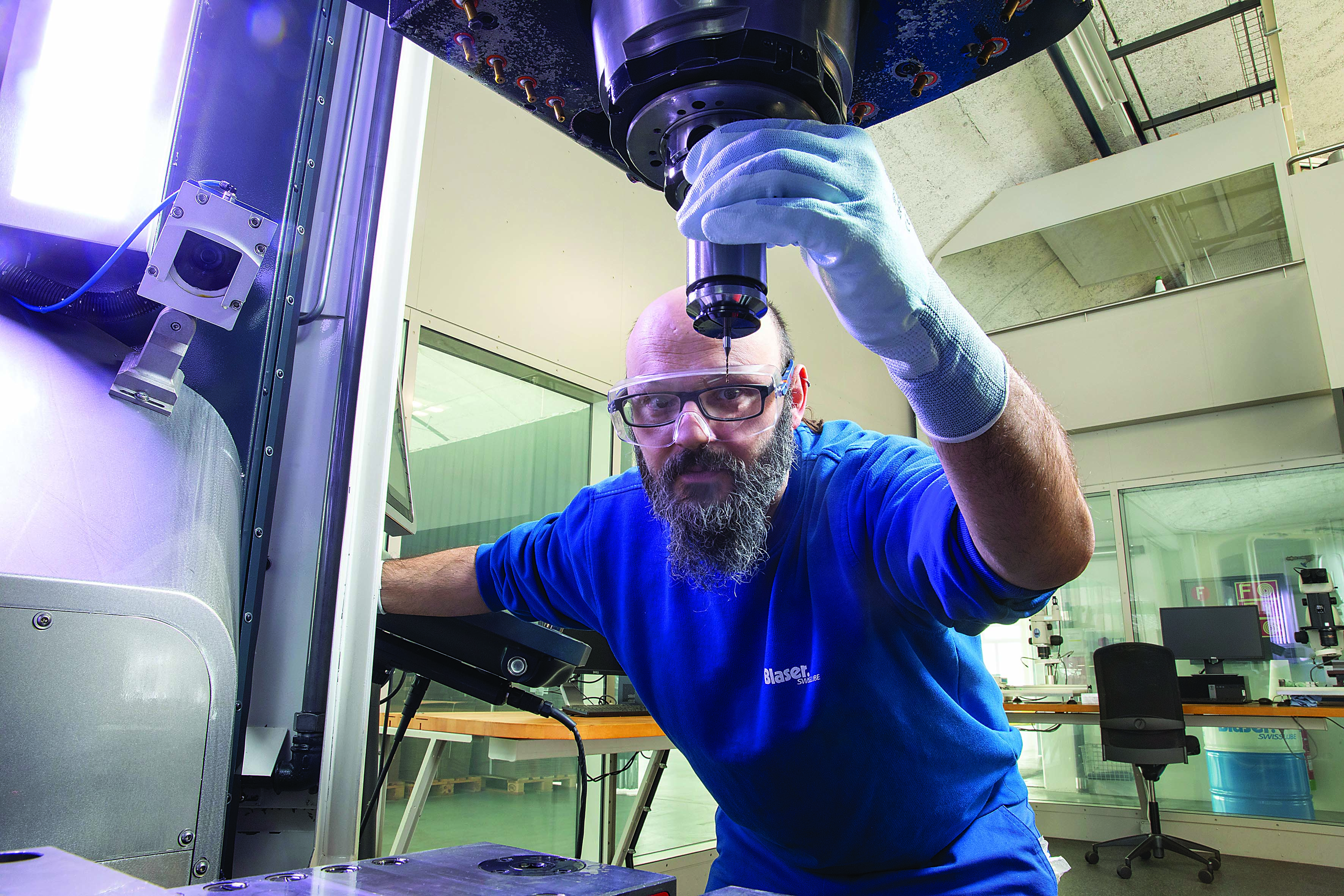
Philipp Marschall, a technician at Blaser Swisslube’s technical center, prepares a small drill for holemaking with the company’s Blasomill GT 8 X coolant. Image courtesy of Blaser Swisslube
Review the print ads from this magazine to continue
This quick advertiser review unlocks the rest of the article and keeps the full-screen reader focused on the ads instead of the page chrome.
Advertisers included in this article experience
Print placements connected to this article
Starcutter
OUR FAMILY
Star Cutter has acquired TRU TECH Grinding Systems. OF GRINDING Our expanded portfolio includes machines capable of handling a complete array of high precision TECHNOLOGIES grinding applications, starting with our NXT. This versatile tool and cutter grinder is packaged with industry-leading NUMROTO or ESPRIT CAM software. The.
OUR FAMILY Star Cutter has acquired TRU TECH Grinding Systems. OF GRINDING Our expanded portfolio includes machines capable of handling a complete array of high precision TECHNOLOGIES grinding applications, starting with our NXT. This versatile tool
Visit Starcutter View this placement in the issue recordPrint ads from this magazine
Star Cutter has acquired TRU TECH Grinding Systems. OF GRINDING Our expanded portfolio includes machines capable of handling a complete array of high precision TECHNOLOGIES grinding applications, starting with our NXT. This versatile tool and cutter grinder is packaged with industry-leading NUMROTO or ESPRIT CAM software. The.
OUR FAMILY Star Cutter has acquired TRU TECH Grinding Systems. OF GRINDING Our expanded portfolio includes machines capable of handling a complete array of high precision TECHNOLOGIES grinding applications, starting with our NXT. This versatile tool
Continue reading
February 2024
Additional additives for both types of products include extreme-pressure agents, Lowery noted, including sulfur, phosphorous, chlorine and boundary film additives, such as esters or fat. “Basically, they keep metal-to-metal contact from happening.”
The EP agents activate at different temperatures, he added.
In addition, chlorine-free, advanced-generation additives provide extreme-pressure lubricity, which are required for challenging holemaking applications, Lowery said.
Fine Filtration
Obviously, big chips must be removed from any recirculated metalworking fluid to prevent them from being re-cut, but finer particles also should not make their way to the tool/workpiece interface deep in a bore to properly maintain the fluid. A paper bed filter can get the job done, according to Lowery, and some use cyclone filters to centrifugally remove fines.
He recommends a filter that removes particles down to a single-digit micron level, particularly when the surface finish has a tight specification. However, even with a correctly mixed coolant, filtration that’s too fine can break the molecular bond and remove critical ingredients from the fluid.
Filtering finer than 5 µm (0.0002″) will start shearing critical molecules from the coolant, according to Schneider, with an upper limit of 10 µm being appropriate for through-spindle coolant.
“That’s one of the advantages of our cyclonic-style filtration because it’s rated to 5 µm. Since it doesn’t go through a bag, it can’t pull any properties out of the coolant,” Scheider said, adding that cyclonic filtration is better for “dirtier processes” such as when deep-hole drilling cast metal.
In addition to the risk of stripping the additives from a fluid by filtering finer than 5 µm, depending on the formulation, filtration becomes “rather expensive” once you go below that threshold, Reynolds said. When in doubt about the specific filtration level required, he recommends consulting with the fluid manufacturer.
With proper filtration and maintenance, part manufacturers can maximize the life of their liquid tools. When that’s the case, water-miscible coolants should last at least a year if not longer, Reynolds said.
However, the lifetime of water-miscible coolants can be cut in half or more when they are not properly mixed to maintain the recommended refractive index, Lowery noted, adding that a life of 18 months to two years is possible. If only water is added to compensate for evaporation, the EP additive package and anti-foam additives are reduced. “You’re constantly diluting all those key ingredients.”
That dilution process is not possible for straight oils, he added. “You’re constantly putting, let’s call it, the good stuff back into the oil.”
As a result, neat oil lasts longer, Lowery said. “We see some systems run five, seven years.”
Like perishable tooling, water-miscible fluids and neat oils have a finite life, Reynolds said. “Eventually, there’s going to come a day when it has to be disposed of.”
Here Come the Cool Jets
To meet a variety of customer metalworking fluid delivery requirements, the CoolJet high-pressure coolant system from ATS Systems provides “complete functionality,” said Tim Schneider, the company’s vice president.
One element is the modular design that enables a customer to add an aftermarket chiller or mist collector or both on the same footprint, he explained. “When you have an automated process, you have to have temperature control with your coolant, good filtration and mist collection all built into one platform.”
That capability enables a manufacturer that just purchased the high-pressure system to add a chiller, for example, if thermal issues occur, Schneider said. “It’s a plug-and-play option.”
ATS Systems reports that its CoolJet high-pressure coolant system enables end users to increase their speeds and feeds by at least 20% and tool life 3 to 10 times. Image courtesy of ATS Systems” data-entity-type=”file” data-entity-uuid=”675085e1-f18e-4c82-9412-abf61c2c3ee9″ height=”561″ src=”/wp-content/uploads/legacy/inline-images/Cooljet%20base%20model.jpg” width=”561″ />
In addition, the system is available with a fixed or variable coolant flow. A fixed flow is suitable when an end user is using the full volume, for example, of a 9 gpm system, he noted. However, if only 4 gpm are going through a cutting tool, 5 gpm travel through the bypass mechanism. “That creates 750 watts per minute of additional heat that goes back into your coolant. It can create thermal issues.”
In contrast, the variable-flow system automatically pumps the volume of coolant required to maintain the specified pressure, Scheider added. Although the variable-flow design costs $3,000 to $5,000 more, it reduces power consumption, making it less costly to operate than the fixed-flow design. “So, instead of, say, running at 60 Hertz all the time, it’s going to run at 15 or 20 Hertz.”
Having a variable-volume unit is beneficial when a machine tool uses a large number of cutting tools, he noted. “The simple rule of thumb is always use variable if you’re going to have wide variety of tool orifices and sizes. You can go with a fixed-flow system, and if you’re using all the volume, you’ll never have any issues with heat.”
One customer, however, had a fixed-flow system on a small gundrill but was experiencing thermal issues, Schneider said. The regional manager inquired whether he should sell him a variable-flow system to fix the problem, which would have fixed the situation but at a significant price. Instead, ATS calculated how much volume was going through the drill and then put a T-fitting in the high-pressure line with a correctly sized bleeder orifice.
“The drill was using two gallons a minute, and we put a bleeder orifice on for seven gallons a minute back to the machine tank and now he’s using all the volume, still drilling the hole but not creating heat,” Schneider said. “We solved this problem with a $5 Home Depot fix.”
—Alan Richter
Glossary terms in this article