

Planning for workforce growth: Workforce Development & Training
When William "Bill" Weier retired on Friday, December 4, 2020 after 41 years, he knew his retirement as a human resources (HR) veteran and well-seasoned machinist would be short-lived. In fact, he began his next chapter as the human resources director for Mazak Corporation the following Monday.
View print ads from this spread
Review the ads on this magazine spread to continue reading. Each ad takes two seconds; a two-page ad counts once.
Advertisers on this magazine spread
Print placements on this magazine spread
Mazakusa
INTEGREX j-Series
THE PARTS MULTIPLIER Mazak’s INTEGREX j-Series of Multi-Tasking machines performs turning, milling and drilling operations for the quick, accurate processing of simple and complex workpieces in fewer setups. Powered by the MAZATROL SmoothG CNC and known for its milling power and large tool magazine capacities, the INTEGREX j-Series delivers increased.
INTEGREX j-Series THE PARTS MULTIPLIER Mazak’s INTEGREX j-Series of Multi-Tasking machines performs turning, milling and drilling operations for the quick, accurate processing of simple and complex workpieces in fewer setups. Powered by the MAZATROL SmoothG CNC and known for its milling power and large tool magazine capacities, the INTEGREX j-Series delivers increased
Visit Mazakusa View this placement in the issue recordPrint ads from this magazine
THE PARTS MULTIPLIER Mazak’s INTEGREX j-Series of Multi-Tasking machines performs turning, milling and drilling operations for the quick, accurate processing of simple and complex workpieces in fewer setups. Powered by the MAZATROL SmoothG CNC and known for its milling power and large tool magazine capacities, the INTEGREX j-Series delivers increased.
INTEGREX j-Series THE PARTS MULTIPLIER Mazak’s INTEGREX j-Series of Multi-Tasking machines performs turning, milling and drilling operations for the quick, accurate processing of simple and complex workpieces in fewer setups. Powered by the MAZATROL SmoothG CNC and known for its milling power and large tool magazine capacities, the INTEGREX j-Series delivers increased
Continue reading
January 2024
When William “Bill” Weier retired on Friday, December 4, 2020 after 41 years, he knew his retirement as a human resources (HR) veteran and well-seasoned machinist would be short-lived. In fact, he began his next chapter as the human resources director for Mazak Corporation the following Monday.
In Weier, Mazak had found the production-minded HR director the machine builder had been seeking.
I sat down with Weier during Mazak’s recent DISCOVER 2023 event at its headquarters in Florence, Kentucky, to learn about his, and Mazak’s, workforce development strategies and plans. What follows is a stream of conscious blueprint for employee development that any company, large or small, may find helpful amid the workforce shortages of today.
“To me,” he began, “the most important tenet of human resource management is to treat everyone with dignity and respect. And to expect that from everyone from the top down, and all the way through the organization.”
Emphasizing that type of culture at Mazak not only improves workforce development, Weier explained, it leads to workforce retention.
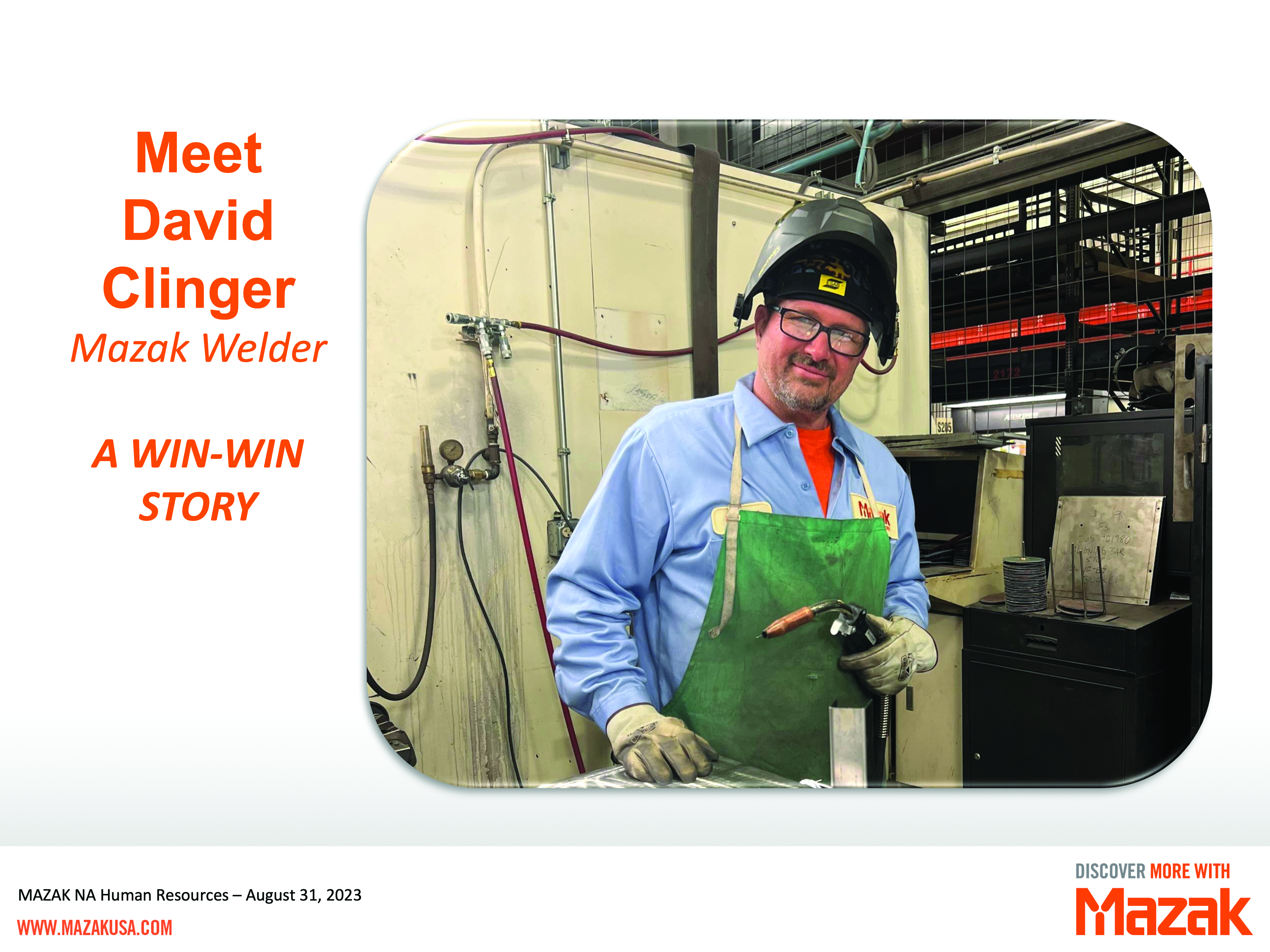
A slide from William Weier’s presentation at a Diverse, Equitable and Inclusive work environment training session held last year. Weier, who was invited to the event as a guest speaker, shared a story about recruiting David Clinger into the Mazak family.
“With retention,” he said, “it really comes down to the basics. It starts with great job descriptions. People need to understand their roles and the impact they have on the business. What’s more, they need to understand their potential progression and career path. Employees want to understand what it takes to level up in terms of skillset, pay and position.”
Mazak began by updating job descriptions across the organization. These include a skills matrix that provides a proficiency rating from 0 to 5 for each duty and task associated with each position. The proficiency scale is a tool used to place employees at the pay grades their skill sets demand. It’s not just a simple matter of how long someone has worked for the company.
“Years of service certainly affects proficiency in most cases, but it’s not everything,” Weier added.
Then there’s Mazak University (MU), which is comprised of more than 400 online classes that employees can take. If an employee wants to progress from a mechanical assembler to a runoff technician, they can use MU to find out what they need to learn in order to take on another role at the company. To complement that, Mazak also offers tuition assistance to those who seek further education outside of Mazak.
Showing existing employees the possibilities and future potential and that there is a tangible career trajectory for them at Mazak is key to the company’s workforce mission. So, when someone first secures a position at Mazak, Weier explained, that person isn’t limited to their initial role. For example, if someone joins the team to work with their hands, it doesn’t mean that the entirety of their path will involve manual work, though Weier emphasizes how important that type of skilled labor is to the organization’s success. He further noted that employees are encouraged to explore the possibilities and made aware that they can move up the ladder.
“Employees can work toward an associate or bachelor’s degree, and even for their master’s,” Weier continued. “We’re there to support you whatever journey they choose.”
Some of that support comes in the form of Mazak’s specialty recognition programs. One such program, called Hi-Potential Career Development, recently produced its first graduating class of five employees who all came off the shop floor, Weier said.
“One of the graduates was a top welder,” he noted. “His project was developing a process improvement team to improve the workflow out on the floor.”
The next Hi-Potential program will be twice as large with 10 employees, added Weier.
When it comes to recruiting new employees, Weier said there are many different avenues.
There’s a school down in Pikeville, Kentucky, which offers a two-year program for machinists and programmers. In the last two years or so, Mazak has hired eight of the school’s graduates.
Weier continues, “While these new graduates might not know everything there is to know about our MAZATROL CNCs on their first day out of school, for example, it’s easy enough to teach that part when somebody knows speeds, feeds, tools, types of cutters, and so on and so forth.”
There’s also Cincinnati State’s two-year program. Plus, there are Gateway Community and Technical Colleges with which Mazak maintains on-going relationships. In addition, Weier participates with the local chamber of commerce and a local Workforce Innovation Board.
Weier is currently working on an arrangement with the Samaritan Car Care Clinic, a non-profit organization providing car repair services for low-income families in Northern Kentucky. The program being developed would put a person to work at Samaritan for nine months, the first six months of which would be spent learning and training to work on cars. A trainee will get paid $18 an hour, with $10 an hour paid by Samaritan and the remainder covered by Mazak.
After the first six months, the person will begin working for Mazak two days a week, Weier said.
“At the end of nine months,” he concluded, “they graduate, and we hire them on full time. So that not only helps the employee, but it helps the people who are being supported by Samaritan Car Care. It also gives us an employee who we now know has the soft skills that are necessary to succeed.
“You have to invest in people,” he continued. “You have to take some chances, no doubt. But you also have to be sure people are able to see that there is a pathway to grow.”
That’s why he gives a great deal of credit to Mazak University for its role in helping establish a culture of learning and growth at the company.
“We don’t have to mandate that people take these classes, most of them are jumping online themselves,” Weier emphasized. “We are investing in people, and people, in turn, are investing in themselves.
“There are thousands of courses taken each month,” he said, noting that the company employs about 650 people at its U.S. headquarters in Kentucky. “And anyone in the organization can take the courses online.”
For that type of result, Weier added, “the company has to earn it from the culture that you have internally.”
At the same time, he acknowledged, “you have to be able to retain your employees—we don’t want to be a training ground for every other machine tool company out there.”
Still, that’s the chance Mazak is willing to take, Weier said as he recounted the story of David Clinger, a particularly meaningful successful recruit who found his way to Mazak in April 2023.
“David answered one of our recruitment ads and was interested in a welding position,” Weier recalled. Clinger had lost a previous welding job because he is hearing impaired and had been unemployed for some time. “We were more interested in what he could offer Mazak.” Clinger was brought into the company’s welding shop and given a hands-on welding test, and he did great.
After being told he had secured the job, Clinger confided with Mazak that he didn’t have a place to live at the time. He had no address.
“He was actually living in his truck underneath the interstate down in Covington, Kentucky,” said Weier. “So, we texted him and told him we’d found him a place to live until he got back on his feet.” Mazak also made sure Clinger had enough food, clothing and money for those first couple of weeks.
“it was important to us to support him not only as an employee, but as a person, which helped him dive into his work, training on the day shift, and then working on the night shift,” Weier continued, noting that he shared Clinger’s story during an outside training event for diverse, equitable and inclusive (DEI) work environments. Although Clinger has since left Mazak to take another welding job out West, Weier said that when he got to the slide with Clinger’s story during his presentation, he was too choked up to talk and asked the audience to read the story for themselves.
“I told him, ‘You always have a spot here, my friend.’ And he knows that.”