Hitting the mark: Turning Performance
After successfully navigating their way through all the difficulties of part making, machine shops must do the same with part marking, which presents its own set of challenges. These can be met by a number of different marking technologies, some of which have increased appeal these days thanks to developments that have made them more effective, productive and budget-friendly.
After successfully navigating their way through all the difficulties of part making, machine shops must do the same with part marking, which presents its own set of challenges. These can be met by a number of different marking technologies, some of which have increased appeal these days thanks to developments that have made them more effective, productive and budget-friendly.
Although parts are marked for a variety of reasons, probably the main one is so they can be identified and tracked in the field, said Preben Hansen, president of Platinum Tooling Technologies Inc. in Prospect Heights, Illinois, which sells imported marking systems.
“For accountability, serial numbers and part numbers need to be on parts for long-term reference,” he said. “You want to know where they’re going and if they have to be replaced.”
Other common part markings include logos and QR codes. The latter are becoming more popular because they can hold a lot of information, said Shawn Lawlor, CEO of Dapra Corp. in Bloomfield, Connecticut, a manufacturer and distributor of dot peen and laser marking systems.
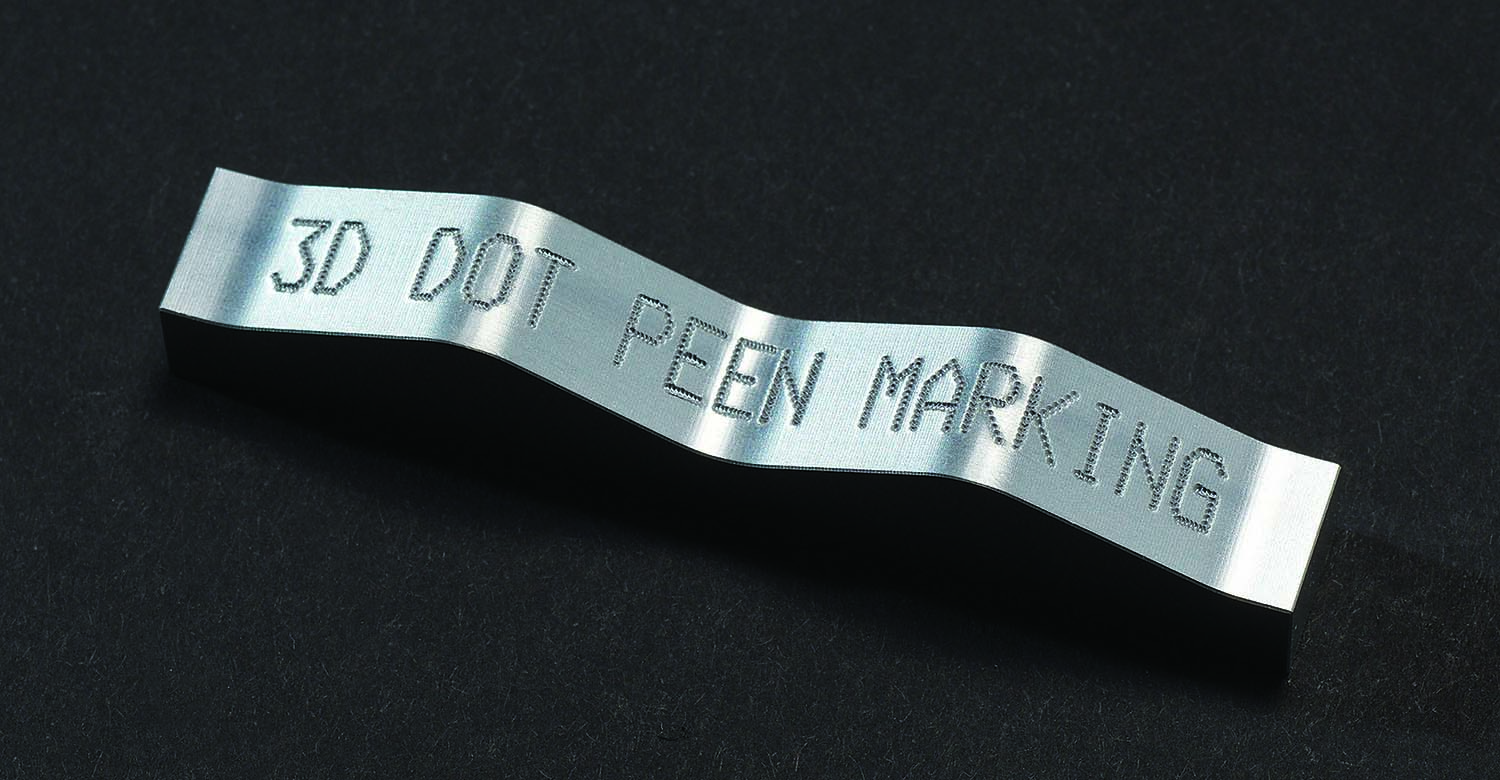
Equipped with Intelligent Driving Impact, the stylus of a dot peen marking system can follow the contour of a marking surface. Image courtesy of Technomark
Dot peen systems create marks using a stylus that displaces material on a part surface. As for laser marking, he sees wider adoption of the technology, with fiber lasers being the preferred option of their kind for marking metal parts. He said both dot peen and laser systems excel at putting QR codes on parts.
Laser marking, however, is “very fast” compared with the mechanical dot peen process, said Mustapha Boulkouane, export sales manager at Technomark, a France-based manufacturer of laser and dot peen marking systems. (Technomark North America is in Conroe, Texas.) He pointed out that dot peen systems, with all their moving parts, require more service than laser systems as well.
Marks also can be created by chemical etching and small endmills operated by CNC machines. Lawlor describes chemical etching as a little more complex than other common marking options but useful in medical applications and others requiring marks that are free of debris.
As for marking with endmills, Hansen pointed out that this can be done while parts are still in the machine tool, eliminating the extra handling needed for laser and dot peen marking, which tend to be offline secondary operations. On the downside, he said marking with endmills is slow and creates burrs, plus endmills don’t last long in the process.
Therefore, he said, shops looking for a marking system “might want to consider better options.”
Marking Challenges
Not surprisingly, all marking systems produce the best results when marking conditions are ideal.
“Marking on a flat, consistent surface definitely provides the best mark and leads to a more cost-effective solution for marking,” Lawlor said.
On the other hand, costs rise and the task becomes more difficult when application conditions are less than optimal. He said the most challenging applications are those that require marking across uneven surfaces. While chemical etching can effectively mark these surfaces, he said both laser and dot peen systems can struggle with wavy marking surfaces due to height differences across the wave profile. So he noted that some sellers of laser systems offer 3D marking heads that can adapt to variations in surface height relative to the laser lens.
Review the print ads from this magazine to continue
This quick advertiser review unlocks the rest of the article and keeps the full-screen reader focused on the ads instead of the page chrome.
Continue reading
October 2023