Accelerating assembly checks: CMM Inspection
The ultimate accuracy and reliability of a machine tool depends in no small degree on alignment checking during the building process. For machine tools produced in high volumes, the efficiency of the alignment checking process is paramount.
The ultimate accuracy and reliability of a machine tool depends in no small degree on alignment checking during the building process. For machine tools produced in high volumes, the efficiency of the alignment checking process is paramount.
Seeking an alternative to traditional error measurement techniques, Hurco Manufacturing Ltd. in Taichung City, Taiwan, chose Wotton-under-Edge, U.K.-based Renishaw PLC’s XK10 alignment laser system to increase precision and throughput. (Hurco Cos. Inc. is in Indianapolis, and Renishaw Inc. is in West Dundee, Illinois.)
Hurco builds a variety of machine tools, including five-axis CNC machines, multiple-axis CNC lathes, vertical machining centers and turning centers. Its worldwide customer base includes tool, mold and die makers; job shops; short-run production manufacturers; and original equipment manufacturers of metal fabrication tools. The product portfolio contains three brands: Hurco, Milltronics and Takumi.
To ensure that requirements for machine tool precision, safety and reliability are met, strict quality control is critical for each step in the building process.
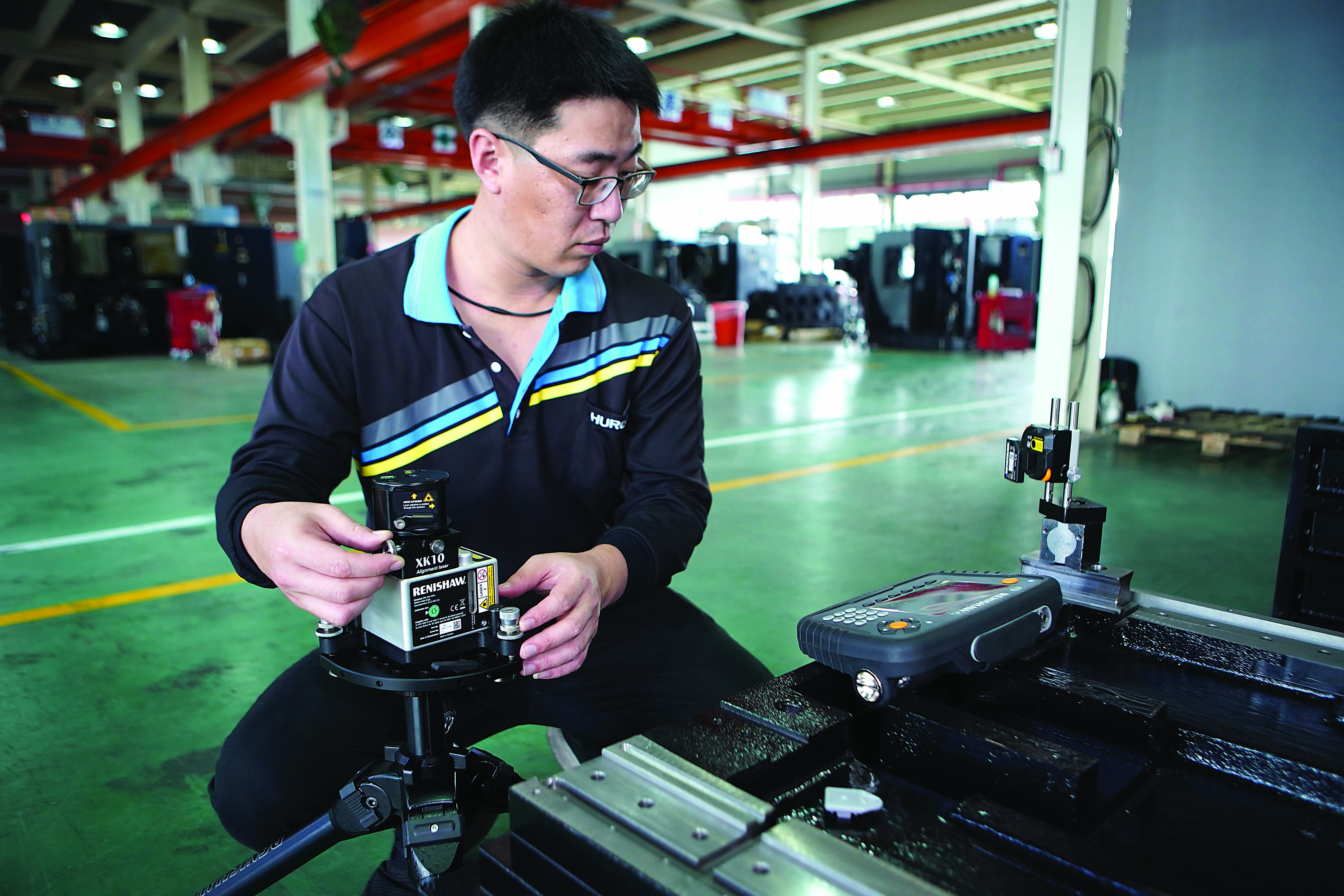
Hurco uses the XK10 alignment laser system for machine tool assembly, calibration and maintenance. Photo courtesy of Renishaw
With Hurco producing thousands of machine tools every year, increasing measurement efficiency was a vital driver for the company’s inspection and verification processes. Machine measurement and alignment needed to be highly accurate, as well as faster.
Hurco previously performed alignment inspections during the assembly process using a blend of traditional measurement tools, coordinate measuring machines and calibration equipment. The company had long employed a range of Renishaw products, including the XL-80 laser interferometer, QC20-W ball bar system and XR20-W rotary axis calibrator.
The sheer size of cast machine tool components presented significant restrictions for CMM solutions while the inherent weaknesses of traditional measurement techniques risked limiting operational performance.
“In the past, we have measured and aligned our cast products using coordinate measuring machinery, but the larger dimensions of cast parts were always a limiting factor and made it rather labor-intensive,” said Wang Shun-Chien, vice president of Hurco Manufacturing. “We would also use traditional error-checking tools like granite squares, dial gauges and autocollimators during the assembly process, but these were never efficient enough, and the measurement results were too inconsistent. When we needed to measure the parallelism of some large cast parts, if the granite square and guide rail are a distance away, then the dial gauge needed to be extended to reach the granite, which would then cause any deviation result to amplify.”
As a result, the company sought a more accurate machine tool alignment solution that would be less time-consuming and labor-intensive to set up and use and could replace the traditional measurement methods.
Following extensive research and testing, Hurco adopted the XK10 alignment laser system. The XK10 can be applied to linear rails to ensure they are straight, square, flat, parallel and level, as well as to spindles and chucks to assess direction and coaxiality of rotary machines.
Review the print ads from this magazine to continue
This quick advertiser review unlocks the rest of the article and keeps the full-screen reader focused on the ads instead of the page chrome.
Advertisers included in this article experience
Print placements connected to this article
Greenleafcorporation
The third-generation
DMU 50 is a universal milling machine with a swivel rotary table. i USA DMG Mor 10X HIGHER PRODUCTIVITY! XSYTIN®-360 CERAMIC END MILLS • Delivers tremendous cost savings! • High removal rates on a wide range of materials L • Capable of significantly increased chip loads versus other ceramic end mills • A combination of our strongest ceramic.
The third-generation DMU 50 is a universal milling machine with a swivel rotary table. i USA DMG Mor 10X HIGHER PRODUCTIVITY! XSYTIN®-360 CERAMIC END MILLS • Delivers tremendous cost savings! • High removal rates on
Visit Greenleafcorporation View this placement in the issue recordPrint ads from this magazine
DMU 50 is a universal milling machine with a swivel rotary table. i USA DMG Mor 10X HIGHER PRODUCTIVITY! XSYTIN®-360 CERAMIC END MILLS • Delivers tremendous cost savings! • High removal rates on a wide range of materials L • Capable of significantly increased chip loads versus other ceramic end mills • A combination of our strongest ceramic.
The third-generation DMU 50 is a universal milling machine with a swivel rotary table. i USA DMG Mor 10X HIGHER PRODUCTIVITY! XSYTIN®-360 CERAMIC END MILLS • Delivers tremendous cost savings! • High removal rates on
Continue reading
March 2022
An all-in-one digital measurement system suitable for a range of CNC machines, the XK10 comprises a launch unit for primary laser transmission, a portable display unit, a fixturing kit and wireless transmitter and receiver units. An XK parallelism kit carries out parallelism measurements.
The compact size, wireless connectivity and versatile fixturing of the system mean that it can be used in many configurations, enabling detection and measurement of both geometric and rotational errors across all types and sizes of machine tools, according to Renishaw. In addition, the display unit allows end users to collect, analyze and record measurement data.
Unlike an autocollimator, which depends on the principle of converting angular measurements into linear measurements, the alignment laser system takes linear measurements directly, thereby removing the inherent conversion error. And unlike a laser interferometer, breaking the system’s laser beam when capturing data does not require a complete restart.
The alignment laser system significantly reduced the amount of time that Hurco needed for accurate machine tool alignment. After repeatedly testing the XK10 system, the company found that it could replace traditional methods.
“As a conservative estimate, I’d say that Renishaw’s XK10 alignment laser system has at least doubled our overall measurement efficiency,” Wang said, “and our evaluation process has proven that the measurement results tally precisely with those from high-precision coordinate measuring machines.”
With a measurement range of 30 m (98.4′), the XK10 handles the requirements of many large machine tools. He said negotiating the span between guide rails for parallelism measurements has become easy, removing the need for large granite squares and avoiding the deviation risk of hyperextended dial gauges.
“The XK10 has particularly impressed us in terms of the parallelism measurement between two measurement rails,” Wang said. “Compared to autocollimators, setting up the XK10 for multiple rail measurements is much simpler. We align the laser unit and turn the laser beams through 90 degrees with the XK parallelism kit. The system then automatically analyzes the data collected and provides us with measurements of the parallelism between the two rails.”
By replacing various sizes of granite squares, he said the alignment laser system also has solved the problem of limited storage space and logistics.
“Thanks to its portability and flexibility, it is easy to take to (a) site, performing precision measurements in real time,” Wang said. “It is used for machine tool assembly, calibration and maintenance. And by enabling better understanding of the status of each CNC machine, resources can be allocated more effectively.”