Avoid machining malpractice
Cutting components for the medical industry is a lot like surgery: Success is rewarding, but the operation can be difficult. Complications stem from challenging part designs and specifications, as well as stringent requirements from regulatory bodies, such as the Food and Drug Administration.
Cutting components for the medical industry is a lot like surgery: Success is rewarding, but the operation can be difficult. Complications stem from challenging part designs and specifications, as well as stringent requirements from regulatory bodies, such as the Food and Drug Administration. So like surgeons, shops need special knowledge, tools, techniques and practices to bring medical operations to a satisfactory conclusion.
One of the main challenges facing shops that machine medical parts is how to deal with different materials. For example, spinal implants used to be made of common materials like titanium and stainless steel, said Mike MacArthur, vice president of engineering at RobbJack Corp., a maker of solid-carbide cutting tools in Lincoln, California. Now, however, the materials for these implants include polymers like polyether ether ketone and transparent options that allow doctors to see through them to check the progress of healing tissue.
“So we develop specialized geometries to cut these unique materials,” he said.
RobbJack also makes tools to machine intraocular lenses implanted in eyes. These lenses used to be made of hard, rigid plastics. But today, MacArthur said the materials of choice are soft, pliable polymers that enable the lenses to be folded, which makes them easier to place in the eyes of patients.
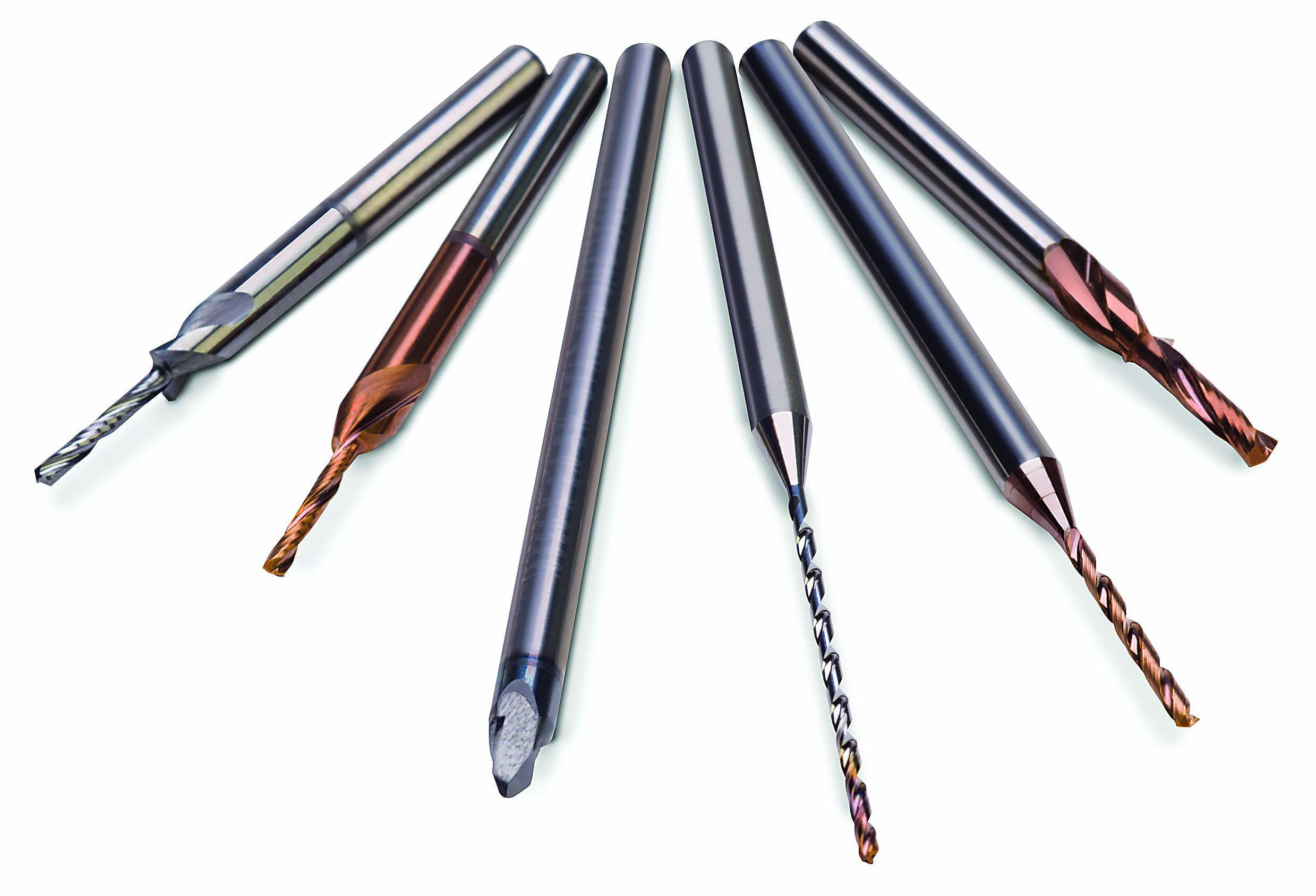
Custom-made, small-diameter, solid-carbide step and twist drills from Star Cutter are used to machine medical components. Image couresay of Star Cutter
“That’s beneficial for the patient,” he said. “But it’s very difficult to cut this soft, rubbery type of
material.”
To meet the requirements of this application, RobbJack makes tools in the 0.254 mm (0.01″) dia. range “with ultrapolished finishes and ultrasharp cutting edges,” MacArthur said.
As for metals, those gaining popularity in the medical industry in recent years include flexible nitinol and corrosion-resistant BioDur. While the properties of these materials are useful in medical instruments and implants, they are also more abrasive than conventional alternatives, said Steve Easterday, Swiss applications manager at NTK Cutting Tools USA in Wixom, Michigan.
Coating Considerations
NTK Cutting Tools focuses on multilayer physical vapor deposition tool coatings for hard-to-cut materials. Although a thick titanium nitride coating might do the job for titanium thread whirling, Easterday said it wouldn’t suffice for cutting abrasive BioDur or nitinol.
For tools that will be used to machine these materials, “we might do a TiN coating and then layer it with a titanium aluminum nitride coating to give it more wear resistance,” he said.
PVD coatings can be relatively thick, but Easterday pointed out that the PVD process still produces thinner layers than chemical vapor deposition coating. This makes PVD coatings more suitable for the sharp-edged inserts needed to cut small medical parts.
When turning tiny parts, insert “sharpness is everything because you want less tool pressure and freer cutting,” he said.
In addition to coatings, Easterday advises shops engaged in medical machining to pay close attention to feeds and speeds. When switching from cutting titanium bone screws to medical parts made of harder materials like nitinol and BioDur, for instance, he said the surface feet per minute and feed rate have to change to get the right amount of heat into chips. When turning nitinol, he recommends starting with an sfm and a feed rate significantly lower than those used for titanium. And in some cases, depending on the length and diameter of the material, as well as the depth of cut, the initial parameters might have to be adjusted as the process goes along.
“Nothing’s really written in stone with feeds and speeds on these exotic materials,” he said. “You have to get in there and tweak it in order to get it right.”
As the machining process proceeds, most materials used for medical parts tend to workharden, said Gary McCarel, application engineer at Star Cutter Co., a toolmaker in Farmington Hills, Michigan. Therefore, he said it’s important to have a stable process — that is, one in which there is a consistent feed rate. For example, there should be no dwells in the cut.
Keeping Your Cool
McCarel also recommends “a consistently clean coolant stream” for cutting medical parts.
In addition, he said shops should do research to make sure they’re using top-notch coolants and ones developed specifically for machining medical components.
In some cases, MacArthur pointed out, conventional coolants may have to be ruled out for medical machining because of stringent purity standards. Implants, for instance, might not be allowed to come into contact with potential contaminants. In these situations, he said one option is to make sure the programmed cutting
technique is not generating excessive amounts of heat. For example, he suggested that shops could make lighter cuts rather than heavy ones but at faster feed rates.
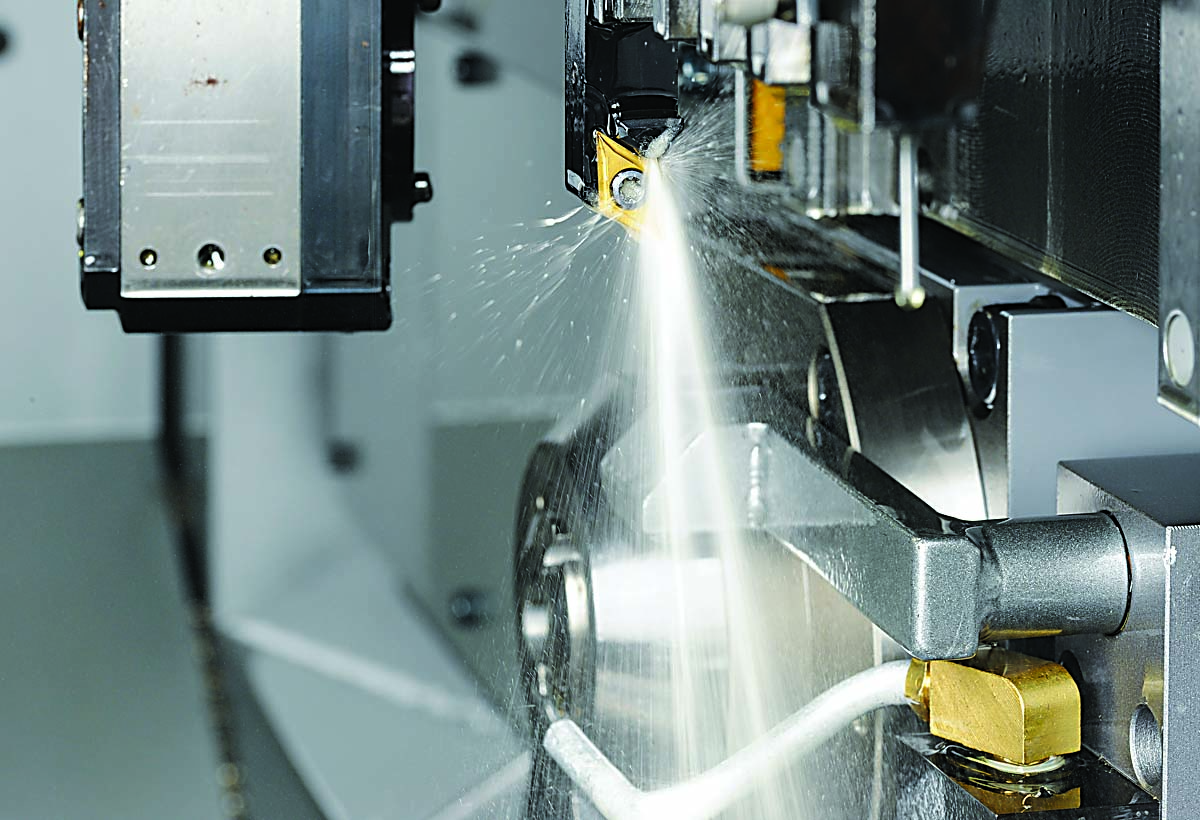
In medical and other applications, high-pressure coolant directed at the cutting edge helps evacuate chips and increase tool life. Image courtesy of NTK Cutting Tools
Another possibility is to use supercritical carbon dioxide for cooling and lubrication. A fluid state of CO2 held above its critical temperature and pressure, supercritical CO2 looks like a gas but is as dense as a liquid. When used as a coolant, supercritical CO2 leaves no residual contamination on medical parts, said MacArthur, whose company has partnered with firms that use supercritical CO2 to machine medical parts.
Review the print ads from this magazine to continue
This quick advertiser review unlocks the rest of the article and keeps the full-screen reader focused on the ads instead of the page chrome.
Advertisers included in this article experience
Print placements connected to this article
Tungaloy Accelerated Lines - Leading in Innovation
ADD more productivity to your 3D profiling with
the new VBO and VBN conical barrel milling heads Large radius cutting edge reduces the number of tool passes without degradation of surface quality, providing high machining efficiency.
ADD more productivity to your 3D profiling with the new VBO and VBN conical barrel milling heads Large radius cutting edge reduces the number of tool passes without degradation of surface quality, providing high machining efficiency Tungaloy Accelerated Lines - Leading in Innovation www.tungaloy.com/us I [email protected] I 888.554.8394
Visit Tungaloy Accelerated Lines - Leading in Innovation View this placement in the issue recordPrint ads from this magazine
the new VBO and VBN conical barrel milling heads Large radius cutting edge reduces the number of tool passes without degradation of surface quality, providing high machining efficiency.
ADD more productivity to your 3D profiling with the new VBO and VBN conical barrel milling heads Large radius cutting edge reduces the number of tool passes without degradation of surface quality, providing high machining efficiency Tungaloy Accelerated Lines - Leading in Innovation www.tungaloy.com/us I [email protected] I 888.554.8394
Continue reading
October 2021
Supercritical CO2 “is not the newest technology,” he said, “but it’s being tested and implemented more for the medical industry.”
Supplier Options
One of the biggest manufacturing challenges posed by the medical industry and others is shrinking part sizes. In response, RobbJack decided to stock its precision miniature tools used in medical machining in 0.0254 mm (0.001″) increments, from 0.127 mm (0.005″) to 1.5748 mm (0.062″) in cutting diameter.
Instead of having to settle for a common tool diameter, “we give customers the ability to choose a cutting diameter to the exact thousandth of an inch,” MacArthur said. “This allows them to optimize their processes a lot better.”
It also enables users to get precise tools very quickly. So a dentist, for instance, wouldn’t have to wait for a custom tool to be made to produce a crown for a waiting patient.
“We are facilitating rapid delivery of tools by having them all in stock,” MacArthur said.
Although standardized tools commonly are employed in medical machining, Star Cutter believes that there are important advantages to using custom tools like the ones it makes for medical applications.
“Our tools are designed specifically for the application,” said Jamie Dunneback, sales manager for round tools. “So you’re going to get better results and throughput when you come to a company like ours.”
He said small medical components often are machined with a number of different standardized tools. When Star Cutter evaluates parts like these, however, the firm frequently finds that a single combination tool can do the job.
“When you look at standard lines of off-the-shelf items, especially in microtools, (companies) don’t have these combination tools,” Dunneback said. “They’re all single-diameter tools.”
So, for example, a shop would need to purchase three standardized tools to cut two different hole diameters, plus a chamfer.
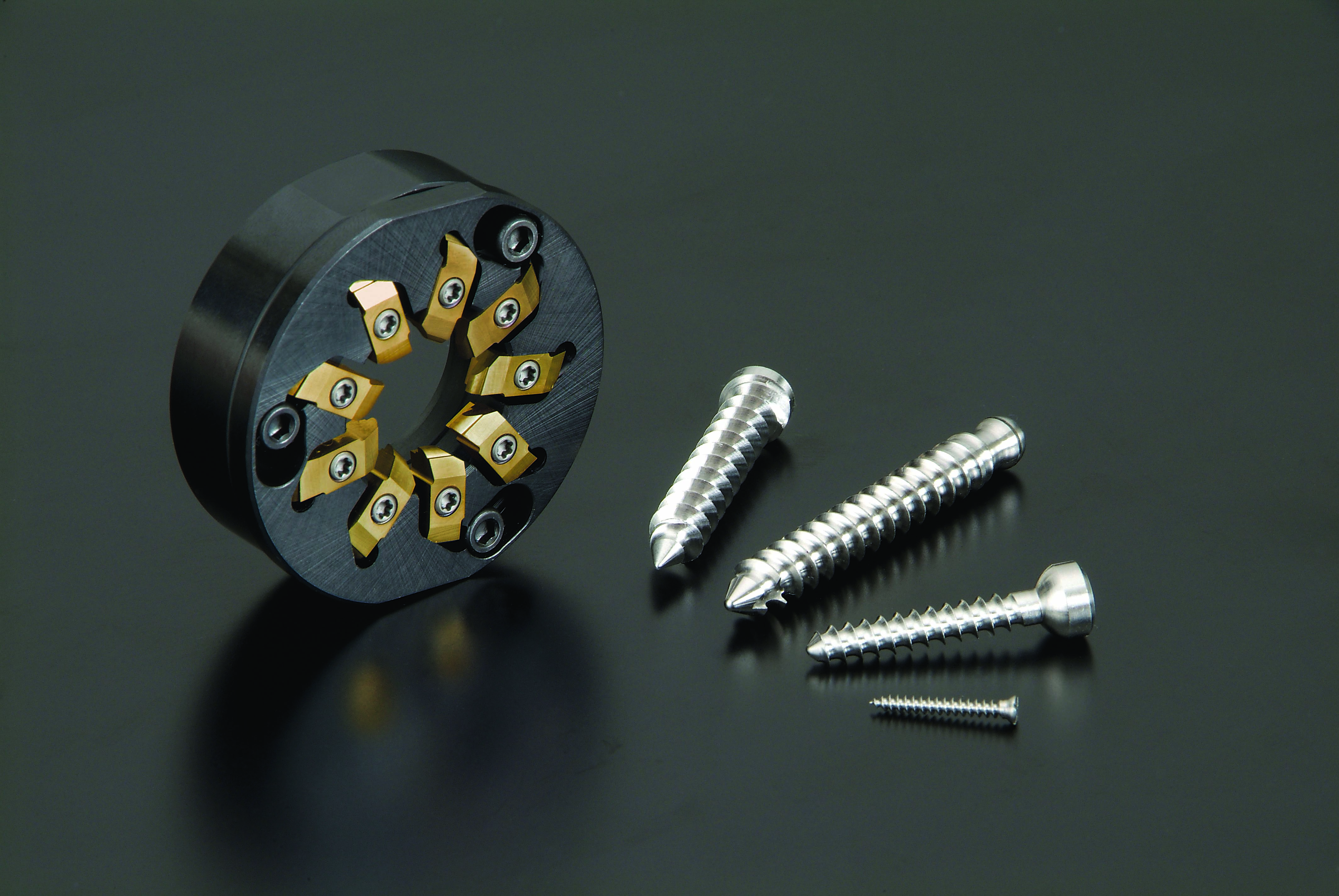
NTK Cutting Tools applies TiN coatings to thread whirling cutter systems. image coutesy of NTK Cutting Tools
Star Cutter, though, can create a small-diameter drill capable of cutting both hole diameters, as well as the chamfer. Besides helping a shop reduce its cycle time, Dunneback said this will improve part quality from a concentricity standpoint because a single tool is cutting both diameters rather than two separate tools.
In situations in which multiple parts are made with the same machine, another advantage of combining different tools into one is that it opens up spaces in the turret for tools that can be used for other jobs.
“If shops can load additional tools in there,” Dunneback said, “that gives them the option of
having a machine tooled up for multiple parts ready to go versus having to replace the tooling (for each job) because it all couldn’t fit into the turret originally.”
Best Practices
Shops cutting medical parts also can benefit from basic practices recommended by McCarel. These include making sure that workpiece and spindle fixtures are rigid and that spindles are aligned properly.
“When you’re dealing with solid-carbide drills, for the most part their depth-to-diameter ratio is extremely high, so they’re fragile,” he said. “So if you have any kind of alignment issue or any kind of movement in the bushing, you’re going to break these tools and you’re not going to get the hole quality that is necessary for the end user of the part.”
Another important practice is to make sure that preventive maintenance always is performed on machines at scheduled times.
“As field service engineers,” McCarel said, “many times we’ve seen that a part and a process will run great, but all of a sudden they go south because the machine hasn’t been maintained.”
In cases like this, a number of occurrences can adversely affect the machining process. Over time, for example, he said round bushings may become oval and clean coolant can be fouled by suspended particulates.
But “these are things that can be prevented if you have the proper (preventive maintenance) process in place,” McCarel said.
Glossary terms in this article