



Nanomaterials shape up: Sustainability & Environment
University of California engineers work to reassemble metal atoms into predictable shapes.
For metal nanomaterials to deliver on their promise to energy and electronics, they need to literally shape up.
To provide reliable mechanical and electrical properties, nanomaterials must have consistent, predictable shapes and surfaces, as well as scalable production techniques. Engineers at University of California, Riverside are solving this problem by vaporizing metals in a magnetic field to direct the reassembly of metal atoms into predictable shapes. The research is published in The Journal of Physical Chemistry Letters.
Nanomaterials are made of particles measuring 1 to 100 nanometers and typically are created in a liquid matrix, which is expensive for bulk production applications and in many cases cannot make pure metals, such as aluminum or magnesium. More economical production techniques usually involve vapor phase approaches to create a cloud of particles condensing from the vapor. These methods suffer from a lack of control.
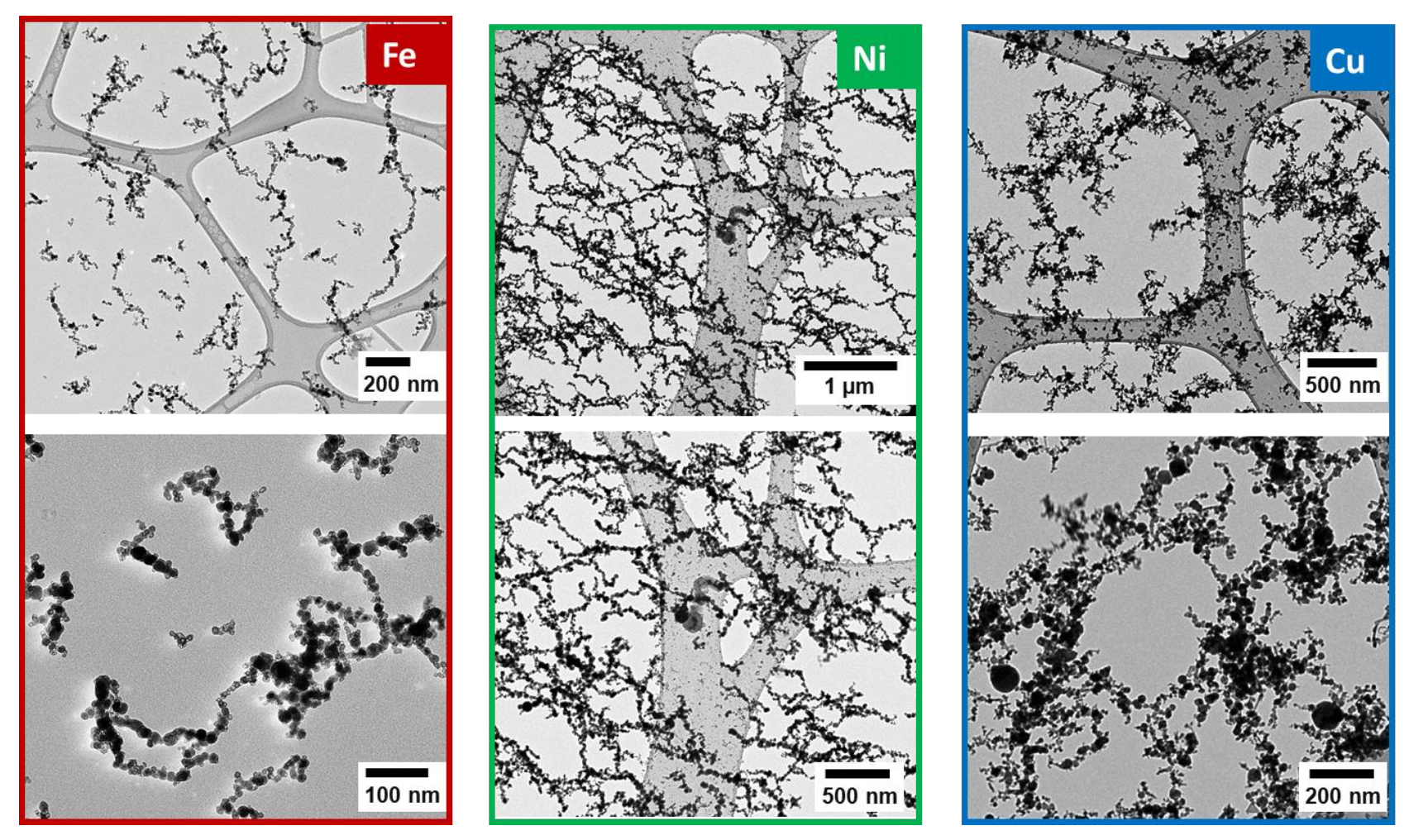
Shown are the stringlike particles formed by iron and nickel and the more globular clusters formed by copper. Image courtesy of Abbaschian, Zachariah, et al.
Reza Abbaschian, distinguished professor of mechanical engineering, and Michael Zachariah, distinguished professor of chemical and environmental engineering, at Riverside’s Marlan and Rosemary Bourns College of Engineering joined forces to create nanomaterials from iron, copper and nickel in a gas phase. The professors placed solid metal in a powerful electromagnetic levitation coil to heat the metal beyond its melting point, vaporizing it. The metal droplets levitated in the gas within the coil and moved in directions determined by their inherent reactions to magnetic forces. When the droplets bonded, they did so in an orderly fashion. The researchers learned they could predict this based on the type of metal and how and where they applied the magnetic fields.
Iron and nickel nanoparticles formed stringlike aggregates while copper nanoparticles formed globular clusters. When deposited on a carbon film, iron and nickel aggregates gave a porous surface to the film, and carbon aggregates resulted in a more compact, solid surface. The qualities of the materials on the carbon film mirrored at larger scale the properties of each type of nanoparticle.
Because the field can be thought of as an add-on, this method could be applied to any vapor phase nanoparticle generation source in which the structure is important, such as fillers used in polymer composites for magnetic shielding, or to improve electrical or mechanical properties.
“This field-directed approach enables one to manipulate the assembly process and change the architecture of the resulting particles from high-fractal-dimension objects to lower-dimension stringlike structures,” Zachariah said. “The field strength can be used to manipulate the extent of this arrangement.”
He and Abbaschian were joined in the research by Pankaj Ghildiyal, Prithwish Biswas, Steven Herrera, George W. Mulholland and Yong Yang.
— Holly Ober
Glossary terms in this article
Related



Subscribers can use MFGAxis notes, saves and discussion tools with their innoNET account.


