

Grooving can be bumpy: Turning Performance
Cutting grooves is one of the more challenging turning operations performed by machinists. Many scrapped parts and broken tools later, Christopher Tate shares important lessons about grooving.
Cutting grooves is one of the more challenging turning operations performed by machinists. Grooving tools are often thin and fragile. They have three sides in contact with a part, and chips can be difficult to extract.
After many scrapped parts and broken tools, I learned important lessons about grooving.
My first turning experiences were on a 1947 Monarch 10EE lathe, which was completely manual, as you probably would guess. After a little instruction and some practice, most people can make a turning tool that cuts. I learned to grind my own turning tools and became fairly good at offhand grinding. However, grinding usable grooving tools is tough. It takes lots of practice to achieve fine results. I could make a usable grooving tool in a pinch, but the process was slow and cumbersome.Lessons
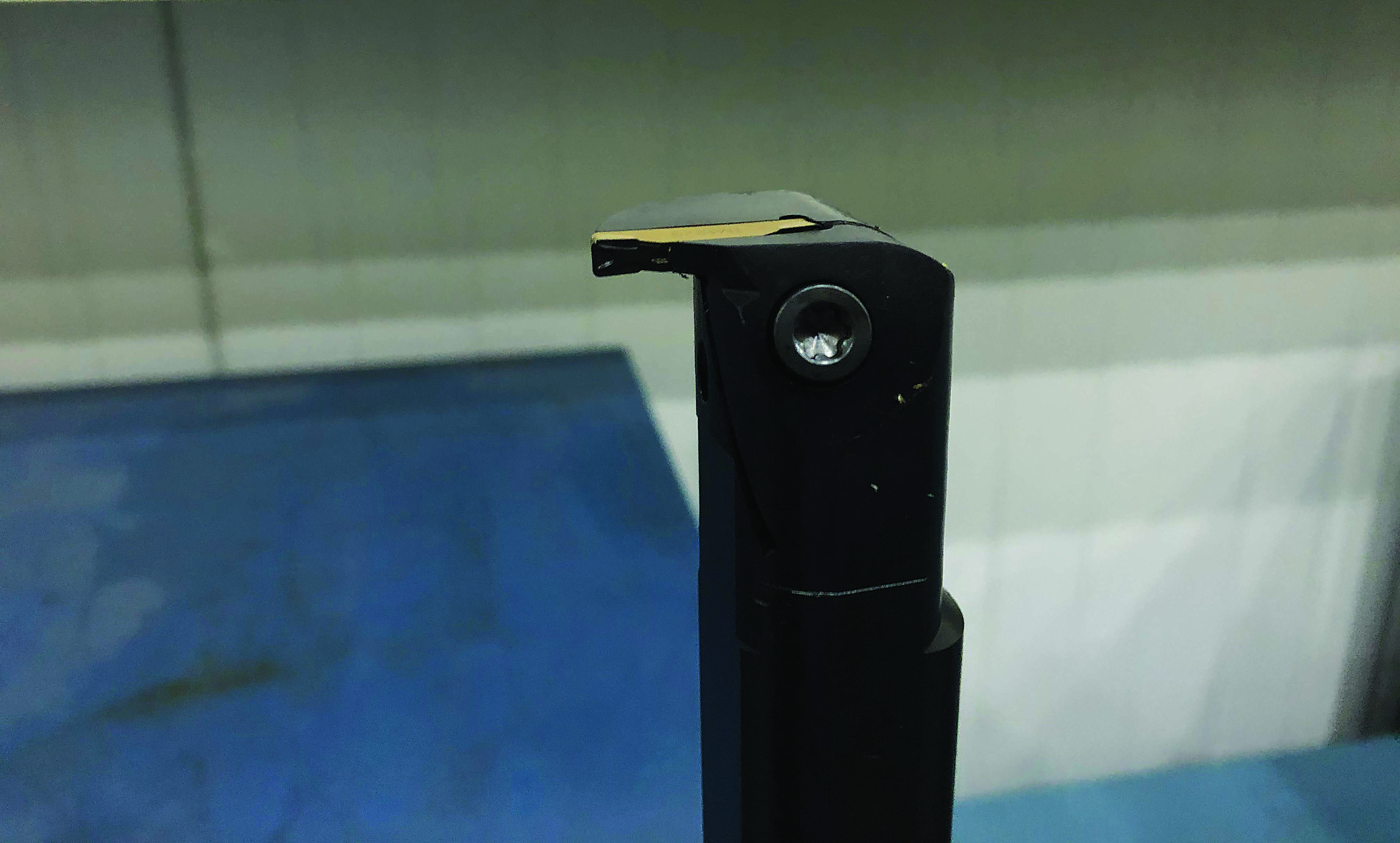
Used for internal grooves, this standard lathe grooving tool (right) is from a catalog. Mitsubishi Hitachi Power Systems Americas has used the tool in milling machines for hot jobs. Image courtesy of C. Tate
Lesson one. Buy a good grooving tool from a company that knows what it is doing. For manual machines, that frequently means purchasing a parting blade. Parting blades are made of high-speed steel and ground with proper clearances, so a tool does not rub the sides, which is the most common problem with hand-ground tools. Parting blades are available in many sizes and can be modified easily for special purposes.
Unfortunately, HSS tools do not always work well with hard or abrasive materials, which I discovered while machining cast-iron parts. Carbide grooving tools become a necessity with difficult-to-machine materials and bring their own challenges, especially on conventional machines. Carbide is significantly harder and more wear-resistant than HSS but very brittle and not as forgiving. Carbide tends to chip and break if not used properly. I learned this while feeding a carbide grooving tool by hand on cast-iron parts. That is lesson two.
Lesson two. Use a light feed rate, and let the machine feed the tool. Only hand-feed at the end if necessary.
Lesson three. When cutting grooves on a lathe, make sure that the grooving tool is on center or slightly below. Turning and facing tools can tolerate being above centerline, and small errors are often unnoticeable. But a grooving tool above centerline provides hours of aggravation as the part tries to climb up on the tool, the cutting edge continually is rubbed off or half a day is spent gingerly coaxing a piece of broken tool out of a shaft that is 99% complete.
Review the print ads from this magazine to continue
This quick advertiser review unlocks the rest of the article and keeps the full-screen reader focused on the ads instead of the page chrome.
Advertisers included in this article experience
Print placements connected to this article
Ctemedia
Launch your
product with Get MAXIMUM EXPOSURE and leads for your new product rollout by reaching our audience of MORE THAN 100,000 industry professionals across all CTE media. Let CTE help you launch your new product with the SPLASH IT DESERVES by using a combination of our print magazine, email list and social media followers. Contact your CTE sales team for details!
Launch your product with Get MAXIMUM EXPOSURE and leads for your new product rollout by reaching our audience of MORE THAN 100,000 industry professionals across all CTE media. Let CTE help you launch your new product with the SPLASH IT DESERVES by using a combination of our print magazine, email list and social media followers. Contact your CTE sales team for details!
Visit Ctemedia View this placement in the issue recordPrint ads from this magazine
product with Get MAXIMUM EXPOSURE and leads for your new product rollout by reaching our audience of MORE THAN 100,000 industry professionals across all CTE media. Let CTE help you launch your new product with the SPLASH IT DESERVES by using a combination of our print magazine, email list and social media followers. Contact your CTE sales team for details!
Launch your product with Get MAXIMUM EXPOSURE and leads for your new product rollout by reaching our audience of MORE THAN 100,000 industry professionals across all CTE media. Let CTE help you launch your new product with the SPLASH IT DESERVES by using a combination of our print magazine, email list and social media followers. Contact your CTE sales team for details!
Continue reading
October 2020
I thought that grooving would be simple after we purchased a shiny new CNC turning center with a control that had canned grooving cycles. That is lesson four.
Lesson four. A CNC does not eliminate grooving challenges. Computer-controlled machines offer limitless combinations of cutting speeds, feed rates and cutting paths, which make grooving easier. But CNC turning centers separate a machinist and his or her senses from a tool and the work. Tool turrets are usually behind the work, and tools frequently are run with inserts toward the bottom of a machine. So it can be difficult for a machinist to see what is happening. Being able to read the chips and view the way a tool behaves is important to get the best cutting parameters, and CNC machines might make this hard. Many people never imagine that a tool turret on an expensive turning center would be off-center, but it is extremely common. When a turret is not set on center, a machinist may have to shim tools, modify holders or, worst-case scenario, adjust the turret.
Lesson five. Face grooving can be difficult, and success requires having the proper tools. I learned this while machining very deep face grooves in pump impellers. My first attempts were made with tools we had ground at my shop. (I was still in the process of learning lesson one.) Progress came when we purchased an indexable tool with carbide inserts that was made specifically for face grooves. A face grooving tool is made with a curved shape, so the heel of the tool does not rub the curved groove. Each tool is limited to a range of diameters, which means that one tool cannot be used on all face grooves. If tools are used for diameters outside their design limits, they rub and damage a part. I also realized that face grooving tools with clamps held in place with a screw are much better than the other styles in which the insert is pressed into a slot.
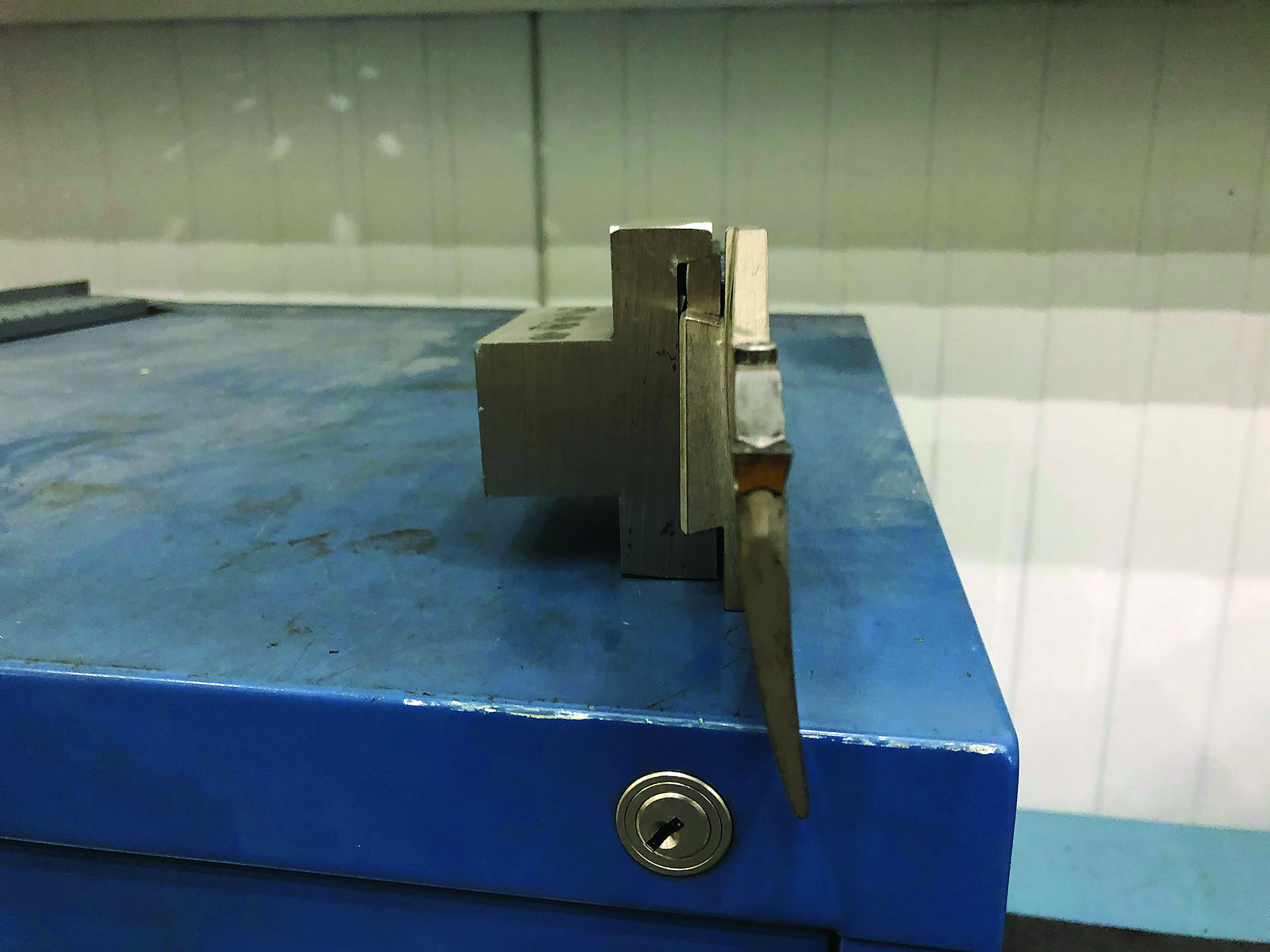
This face grooving tool is used for very large-diameter grooves. The curved blade creates clearance between a tool and part. Image courtesy of C. Tate
Lesson six. Not every cutting tool manufacturer can make special grooving tools. Grooves are common on power generation equipment like blade rings. These grooves are known as hook-fits, and they are used to hold smaller components in place. Hook-fit geometry is the same as a face groove, but hook-fits are made in areas where a normal face groove tool does not fit. Many grooving tool manufacturers are in the market. Most make excellent stock tools for grooving, but only a few are good at making special tools.
Machinists cannot see the tool tip when machining a hook-fit, so they do not know if there is a tool rub before the groove is done. Hook-fit tools must have perfect geometry so there is no question they will work properly. We tried several cutting tool manufacturers before finding a company that had the experience needed to make small quantities of special holders and inserts. We now use the supplier for all our special grooving tools.
Lesson seven. If it isn’t broken, don’t fix it. I learned to propagate results across different parts and avoid deviating from successful tools and techniques. In an era of continuous improvement, it can be difficult to watch a machining process that seems slow or uses expensive inserts without wanting to change it. After many failed attempts at enhancement, I recognized that a process making a satisfying part may not need improvement.
Grooving can be hard. For some of us, the lessons are painful. I found that the best outcomes came when I engaged cutting tool experts and explored options at trade shows. Being open to experimentation and making time to test are also important for developing good processes.
Glossary terms in this article
Related




 MFGAxis Discussion
Be part of the shop-floor conversation
Like, save, or comment on this CTE story.
MFGAxis Discussion
Be part of the shop-floor conversation
Like, save, or comment on this CTE story.


MFGAxis Discussion