


Tiny chip delivers large: Research & Innovation
A 1.5 mm × 1 mm chip that consumes just 28 microwatts and has a range of up to 21 m has potential for manufacturing applications.
View print ads from this spread
Review the ads on this magazine spread to continue reading. Each ad takes two seconds; a two-page ad counts once.
Advertisers on this magazine spread
Print placements on this magazine spread
800.833.2239 www.amamcotool.com
READY TO SHIP:
composite routers Some of our most popular designs are now THE RIGHT in stock, ready to ship when you need them. TOOL… We’ve just launched the new F108 KC Router, with a serrated concept to cut RIGHT NOW! Kevlar, fiberglass, or CFRP composites. We can optimize it for roughing or finishing. To request a quote call or visit us online
READY TO SHIP: composite routers Some of our most popular designs are now THE RIGHT in stock, ready to ship when you need them. TOOL… We’ve just launched the new F108 KC Router, with a serrated concept to cut RIGHT NOW! Kevlar, fiberglass, or CFRP composites. We can optimize it for roughing or finishing. To request a quote call or visit us online. 800.833.2239 www.amamcotool.com
Visit 800.833.2239 www.amamcotool.com View this placement in the issue recordPrint ads from this magazine
composite routers Some of our most popular designs are now THE RIGHT in stock, ready to ship when you need them. TOOL… We’ve just launched the new F108 KC Router, with a serrated concept to cut RIGHT NOW! Kevlar, fiberglass, or CFRP composites. We can optimize it for roughing or finishing. To request a quote call or visit us online
READY TO SHIP: composite routers Some of our most popular designs are now THE RIGHT in stock, ready to ship when you need them. TOOL… We’ve just launched the new F108 KC Router, with a serrated concept to cut RIGHT NOW! Kevlar, fiberglass, or CFRP composites. We can optimize it for roughing or finishing. To request a quote call or visit us online. 800.833.2239 www.amamcotool.com
Continue reading
October 2020
A 1.5 mm × 1 mm (0.06″×0.04″) chip that consumes just 28 microwatts and has a range of up to 21 m (69′) has potential for manufacturing applications. Developed by electrical engineers at the University of California San Diego, the chip uses 5,000 times less power than Wi-Fi radios.
“It definitely can be used in manufacturing environments,” said Dinesh Bharadia, assistant professor of electrical engineering at UCSD’s Jacobs School of Engineering. “The benefit is a very small form factor. The best part is, everything connects directly to your Wi-Fi.”
He said one possible use is to tag objects and utilize a cellphone to track them on a conveyor and find out the efficiency of a manufacturing unit. Robots could use the chip to locate items equipped with a very lightweight tag.
“You don’t need to buy any equipment or software,” Bharadia said. “It works with any type of phone, any type of tablet, any type of laptop.”
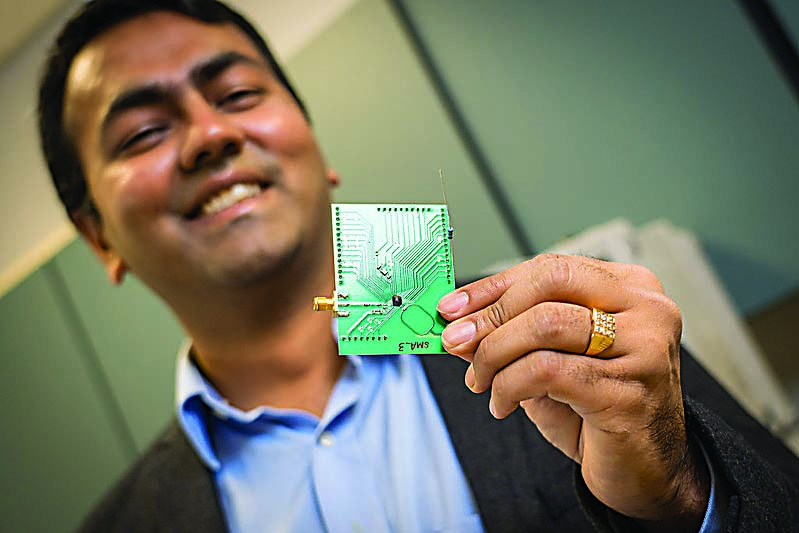
Dinesh Bharadia holds a printed circuit board that contains the Wi-Fi radio. Image courtesy of David Baillot/UCSD Jacobs School of Engineering
Another potential use is to help analyze vibration. He said a user could attach a tag to a vibration sensor whose readout would be sent to a smart device to determine if a piece of equipment vibrates too much.
“You can connect your phone, your smart devices, even small cameras or various sensors to this chip, and it can directly send data from these devices to a Wi-Fi access point near you,” Bharadia said. “And it could last for years on a single coin cell battery.”
Besides vibration, sensors could monitor such things as moisture or temperature. He said the chip even can be used with Raspberry Pi in a Wi-Fi card.
“Typically,” Bharadia said, “Wi-Fi signals take a lot of power to create them. What the chip does is take existing Wi-Fi signals — i.e., ambient Wi-Fi signals — (and) reflect these ambient signals in a specific way, thereby changing the data of the reflected signal. And these reflections are decodable by any Wi-Fi device that can receive the signal. A smartphone can read and figure out information sent by the tag device.”
For the project, he teamed up with Patrick Mercier, UCSD associate professor of electrical and computer engineering, to develop an integrated circuit, which combines the reflection-based communication with a lower-power Wi-Fi wake-up radio. The Wi-Fi radio awakens only when it needs to communicate with Wi-Fi signals, so it can stay in low-power sleep mode for the rest of the time, during which it consumes only 3 microwatts of power.
Bharadia said research is ongoing to increase the range of the chip and reduce its cost. Researchers are looking for partners to commercialize the chip. For more information about the work, visit www.ece.ucsd.edu.
Related



Subscribers can use MFGAxis notes, saves and discussion tools with their innoNET account.