Moving machines via hovercraft
AeroGo Inc.'s air caster system keeps expensive epoxy-coated floors looking good.
An epoxy-coated floor provides a modern, clean look, but it won’t stay that way if forklifts or other forms of wheeled transportation move heavy loads over it. Lincolnshire, Illinois-based GF Machining Solutions LLC reported that it realized that effect after the machine tool builder coated a concrete floor with epoxy at a demonstration showroom. The company previously used forklifts to move milling machines, EDMs and laser cutting machines from a warehouse to the showroom.
The machine builder researched air lift systems to avoid scratching the expensive epoxy while moving machines. Based on a recommendation, AeroGo Inc. of Seattle was asked to demonstrate its air caster rigging system, which also is referred to as air skates or air dollies. For the demo, GF Machining Solutions selected a difficult-to-move machine that’s larger than what the company typically moves. The system displayed its ease of use and ability to prevent equipment from contacting the floor.
Although forklifts have rubber tires, John Massenburg, president and CEO of AeroGo, explained that forklifts tend to damage epoxy when the tires turn in a fixed position, digging even a minimal amount of dirt and grit into the epoxy and scratching the surface.
“The scratches are in the epoxy itself, so there’s no real way to get them out,” he said. “Scratches start, and then you get dirt embedded in them, and it starts not to look so good.”
Massenburg said rollers are an even less appealing option. Their steel wheels cause epoxy to flake, eventually destroying it as they directly contact a floor while carrying heavy, concentrated loads.
Although a damaged area can be stripped and epoxy can be reapplied, “the odds of the match being good enough not to tell are pretty much zero,” he said.
In addition, Massenburg said cranes were not logistically practical because they have limited reach and therefore still require a machine to be moved across a floor.
“What they’re doing is more of a rigging move,” he said about GF Machining Solutions.
Air casters, on the other hand, fit under an object to be moved and use the same basic principles that power a game of air hockey or a hovercraft but scaled to move industrial-sized machines that weigh up to 6,350 kg (14,000 lbs.), Massenburg said. Operators use standard shop compressed air to fill a flexible doughnut-shaped air bag attached to each caster. As a bag inflates, it lifts a machine by about 51 mm (2″) and forms an airtight seal with a floor. Once a bag reaches capacity, excess air is squeezed between the air bag and floor, creating a nearly frictionless film of air. At that point, the load literally is floating on a cushion of air.
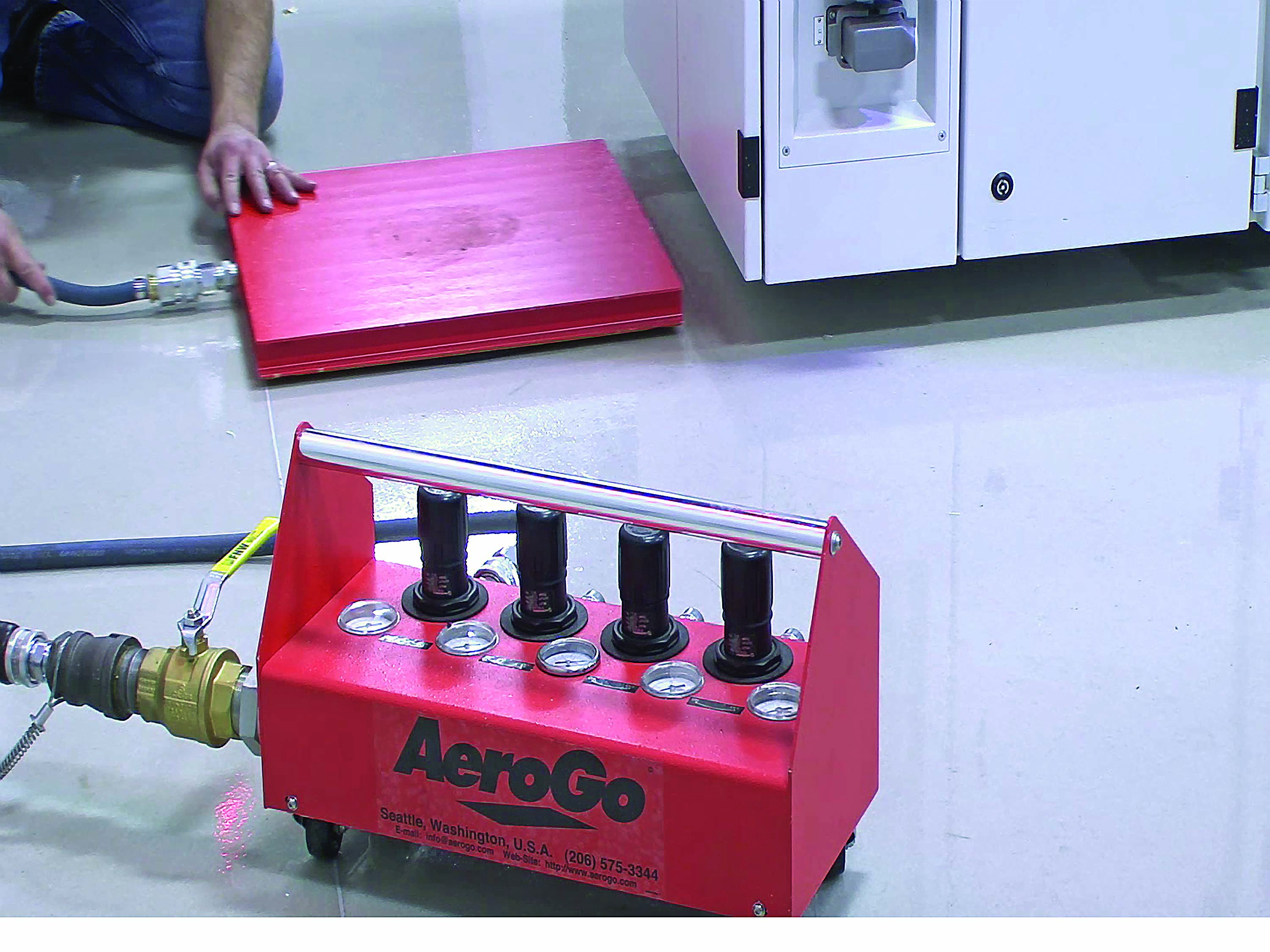
AeroGo says its air caster system is simple and fast to implement. Image courtesy of AeroGo
Review the print ads from this magazine to continue
This quick advertiser review unlocks the rest of the article and keeps the full-screen reader focused on the ads instead of the page chrome.
Advertisers included in this article experience
Print placements connected to this article
Nachiamerica
RE-Think Your
Carbide Oil Hole Drills with Nachi’s Aqua REVO Drill Unique patented design for coolant directed at the cutting edge Conventional Aqua REVO Keep your drill cooler while drilling ~ Allowing you to extend tool life. REVO lutionizing Drilling Area with low cooling effect Area with high cooling effect.
RE-Think Your Carbide Oil Hole Drills with Nachi’s Aqua REVO Drill Unique patented design for coolant directed at the cutting edge Conventional Aqua REVO Keep your drill cooler while drilling ~ Allowing you to extend tool life. REVO lutionizing
Visit Nachiamerica View this placement in the issue recordPrint ads from this magazine
Carbide Oil Hole Drills with Nachi’s Aqua REVO Drill Unique patented design for coolant directed at the cutting edge Conventional Aqua REVO Keep your drill cooler while drilling ~ Allowing you to extend tool life. REVO lutionizing Drilling Area with low cooling effect Area with high cooling effect.
RE-Think Your Carbide Oil Hole Drills with Nachi’s Aqua REVO Drill Unique patented design for coolant directed at the cutting edge Conventional Aqua REVO Keep your drill cooler while drilling ~ Allowing you to extend tool life. REVO lutionizing
Continue reading
July 2020
He said air casters also distribute the total weight of a load over a large surface area, producing low floor loading. The net floor load with air casters usually is identical to the load generated by a person walking across a floor.
With a friction coefficient of 1 or less, air caster systems typically require as little as 0.45 kg (1 lb.) of force for every 454 kg (1,000 lbs.) of weight to be moved, or only one-tenth of the force needed to move as wheeled casters, Massenburg said.
He said moving a machine necessitates as few as two people.
“None of these are fast moves,” Massenburg said, “so you just take your time and be careful.”
He said a machine can be prepared for moving in about 15 minutes. A machine generally sits on a set of legs, and areas are available underneath to insert the air casters, which are about 76 mm (3″) tall. If called for, users can place plywood cribbing on a caster to fill any gap between the caster and the machine.
Air casters also fit where forklifts cannot go. Large material-handling systems require a lot of space and open clearances for maneuvering. In a closely packed layout, this introduces the risk of damage to equipment or people if a forklift accidentally backs into anything, Massenburg said.
He said air casters are well suited for turning tightly and squeezing into snug areas.
“It’s not uncommon for these machines to barely fit inside the door,” Massenburg said.
Because air casters fit neatly within the footprint of a load to be moved, they can move omnidirectionally.
“I can rotate an object in its own envelope,” Massenburg said. “You can’t do that with a forklift or some other device that sticks out beyond where the load is. Even on regular concrete, the move is easier, faster and safer with air casters than it would be using rollers or any other method.”
Related Reading
- For more on moving, see this related guide.