

Broaching expertise key to shop’s success
When it comes to broaching, Ty Miles Inc. does it all: Build and rebuild broaching machines, produce broach tools and provide production broaching services.
When it comes to broaching, Ty Miles Inc. does it all: Build and rebuild broaching machines, produce broach tools and provide production broaching services.
With its humble beginnings, the family-owned Westchester, Illinois, company didn’t always provide such an array of capabilities. President Steven M. Mueller said his grandfather Tyrus H. Miles founded the company in 1958, designing broaching machines at his home and having them built elsewhere before he eventually leased manufacturing space and hired workers to produce the machines. One of the initial investors in the company was Leonard J. Smith, whose family owned a screw machine shop. Previously a Ty Miles customer, Smith ended up joining the company and served as president from 1972 to 1998, when he handed the reigns to Mueller.
Mueller said he started working at the company during his winter and summer breaks while attending the University of Illinois at Urbana-Champaign and came on board full time in 1978 after graduation.
Initially, Ty Miles outsourced broach manufacturing, Mueller said. “But as time went on, it was a natural for us to get into producing tools.” The tools are made of M4, T15 and powder metal HSS and are sold uncoated unless a customer specifies a coating, in which case Ty Miles sends the customer to a coating service.
Turn to Production
Ty Miles added production broaching services to its offerings in the 1990s when a customer with several of the company’s machines wanted to outsource a broaching program, Mueller explained. The customer approached the company that was producing its blanks, but the blank producer didn’t want to get involved with broaching and suggested that it purchase a broaching machine from Ty Miles and create a work cell. However, Ty Miles’ customer didn’t want to purchase additional equipment.
“So I raised our hand and said, ‘We can run broached parts for you,'” Mueller said. “That’s how we got into broaching parts.”
Because it was a high-volume automotive application that required broaching about 2 million parts annually, Ty Miles needed to extend its regular operating hours from 5 a.m. to 5 p.m. to 1 a.m. to 10 p.m., Mueller added. The company ran that program for about five years using two machines.
“On one machine, we were broaching four parts at a time, doing internal splines and other forms on an aluminum yoke part from the steering column,” he said. “We also broached an external slot on the clamp yoke.”
With that production broaching experience under its belt, the company took on additional automotive parts a few years later and continues to broach parts with the machines it builds — “the most efficient broaching machinery,” according to the company.
“When you are small,” Mueller said, “you can be flexible, and you just do what you have to do.”
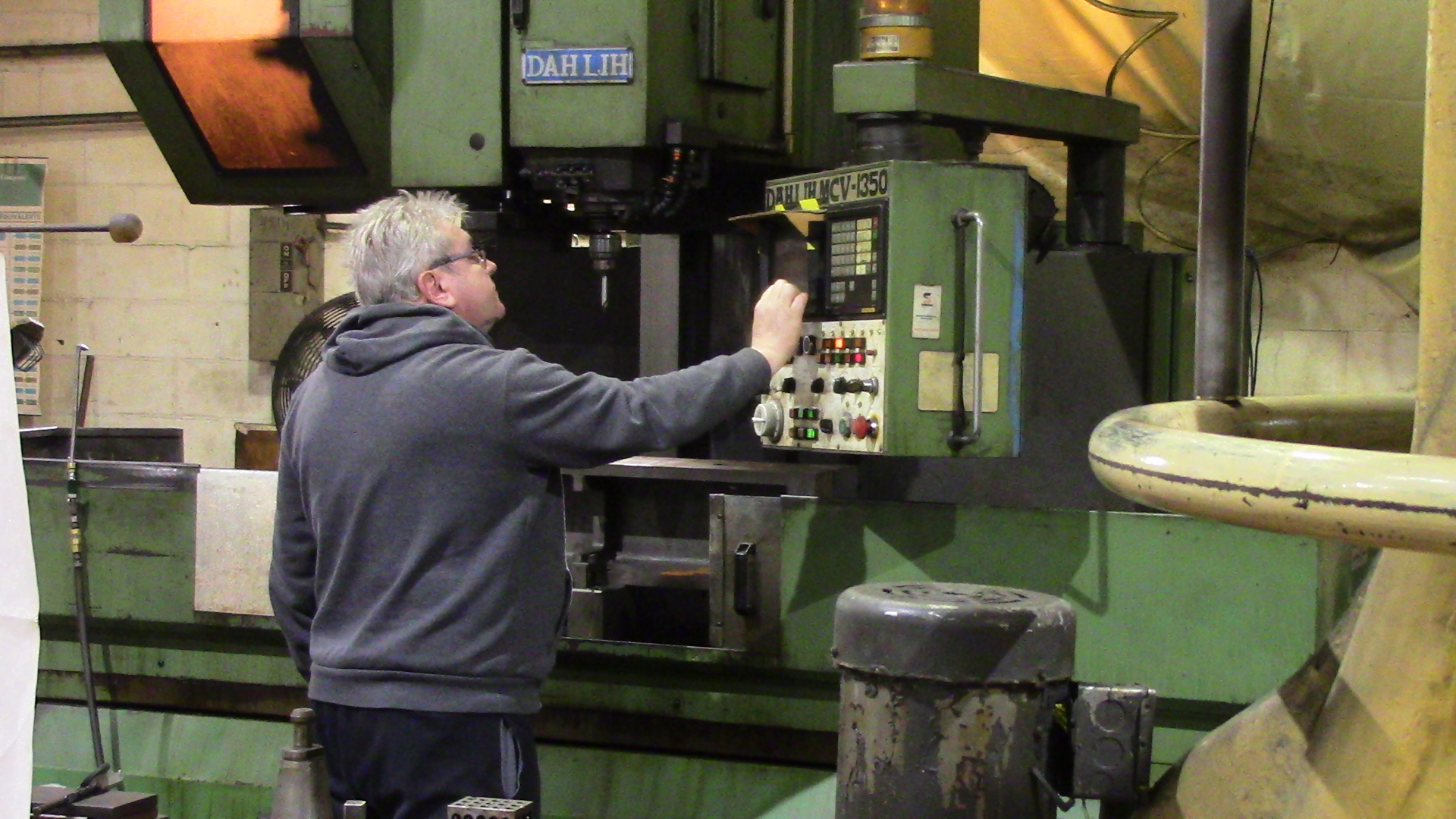
Production of a broaching tool is viewed at Ty Miles. Image courtesy of Alan Richter
Similar to other part manufacturers, Mueller said he is not seeing as many high-volume applications as in the past, yet Ty Miles has a number of steady jobs. “But the volumes are not where we need to extend our hours to meet those deliveries. If somebody had those types of volumes today, they would look to do it in-house with our equipment.”
He said Ty Miles performs the vast majority of its production work using vertical broaching machines, with rotary broaching reserved for generating the twist on pistol barrels, for example. In addition to automotive, the company frequently serves the firearms, medical and hardware industries. Workpiece materials include stainless steel, steel, brass and aluminum, and typical broached features are keyways, splines, flats and forms. Common part tolerances are ±0.0254 mm (±0.001″), with some as tight as ±0.0127 mm (±0.0005″).
Adding Automation
Ty Miles reports that having robotics interfaced with one of its broaching machines makes things more economical by reducing operating costs while increasing production rates. Robotic part loading and unloading can be integrated with any Ty Miles broaching machine, and Mueller said the company has incorporated a small selective compliance articulated robot arm into numerous broaching systems. This arrangement is becoming more popular as smaller robots are being manufactured that cost less than earlier models, he added.
“The robot doesn’t take a break,” Mueller said. “In the right application, you are going to see more
robotics utilized.”
Nonetheless, although a broaching machine can run for an extended period of time without operator intervention, Mueller said he doesn’t feel that a broaching machine can run unattended during a night shift.
To enhance the versatility of a broaching machine by enabling it to perform secondary operations, Mueller said Ty Miles can add a rotary table to it. Indexing a part, for example, would enable a manufacturer to not only broach a feature but drill or tap a hole.
Review the print ads from this magazine to continue
This quick advertiser review unlocks the rest of the article and keeps the full-screen reader focused on the ads instead of the page chrome.
Advertisers included in this article experience
Print placements connected to this article
To request a quote visit amamcotool.com
READY TO SHIP:
slow spiral router THE RIGHT One of the most popular and effective tools in the industry—the AMAMCO F101 Slow TOOL… Spiral Router—is ready to ship, when you’re ready to order! RIGHT NOW!
READY TO SHIP: slow spiral router THE RIGHT One of the most popular and effective tools in the industry—the AMAMCO F101 Slow TOOL… Spiral Router—is ready to ship, when you’re ready to order! RIGHT NOW! To request a quote visit amamcotool.com or call 800.833.2239. 800.833.2239 www.amamcotool.com
Visit To request a quote visit amamcotool.com View this placement in the issue recordPrint ads from this magazine
slow spiral router THE RIGHT One of the most popular and effective tools in the industry—the AMAMCO F101 Slow TOOL… Spiral Router—is ready to ship, when you’re ready to order! RIGHT NOW!
READY TO SHIP: slow spiral router THE RIGHT One of the most popular and effective tools in the industry—the AMAMCO F101 Slow TOOL… Spiral Router—is ready to ship, when you’re ready to order! RIGHT NOW! To request a quote visit amamcotool.com or call 800.833.2239. 800.833.2239 www.amamcotool.com
Continue reading
June 2020
“We have been fairly innovative over the years by combining other secondary operations with broaching,” he added, “so that with one part handling, you can get a completed part.”
Quicken the Pace
Traditionally, broaching machines were built to run at cutting speeds of 9.1 to 18.3 m/min. (30 to 60 sfm). Mueller said Ty Miles specializes in high-speed broaching systems. “Our standard machine is typically 120 feet per minute (36.6 m/min.),” he added, noting that internal applications usually go up to only 60 sfm.
Those speeds, however, are for HSS broaches. When applying a broach with indexable carbide inserts from another cutting tool manufacturer, the company was able to run as high as 87.8 m/min. (288 sfm) during a demonstration at a trade show, Mueller said.
Because Ty Miles’ broaching machines are built to last, Mueller said it can be a challenge to sell a new machine to existing customers when an older machine still cranks out parts, even if at a reduced rate.
“We still have machines from the 1960s that are working,” he said. “Once a company has maybe two, three, four machines, you can always retool them for a different application, so they are really not in the market for a new piece of equipment. Unfortunately, there is no planned obsolescence, and that is a problem.”
To enhance machine productivity and bring it up to date, Ty Miles frequently rebuilds its machines. “Over the last several years, we are doing more remanufactured machines than new ones,” Mueller said.
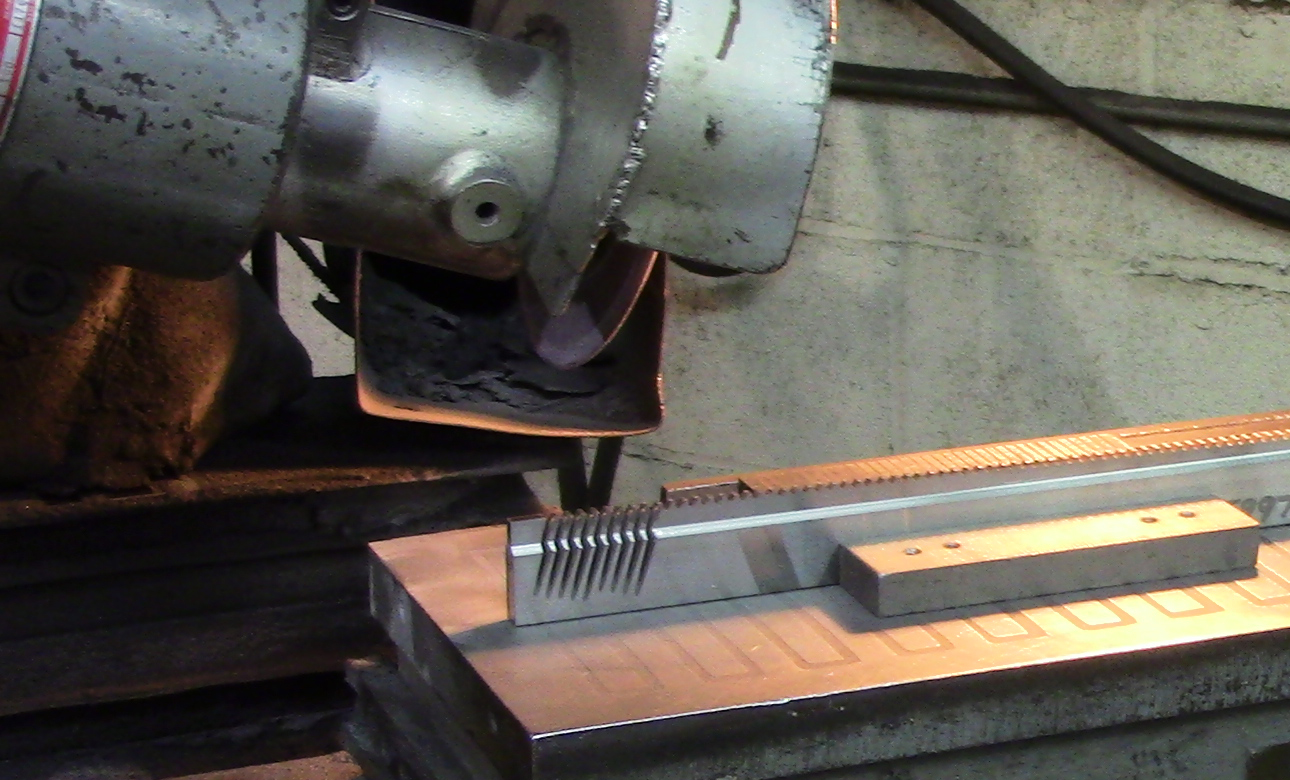
Production of a broaching tool is viewed at Ty Miles. Image courtesy of Alan Richter
The rebuilding process potentially involves stripping down a machine to its base; reconditioning the ram column; replacing needed electrical, pneumatic and hydraulic components; updating the control; and building it back up, Mueller explained.
“Basically, what they get looks like a new machine when it gets done,” he said, adding that the cost of a rebuild is about 70% to 75% of the cost of a new machine, which costs from about $75,000 to $200,000 or more.
Not all rebuilt machines go back to the same end users. Mueller said Ty Miles sometimes purchases its used machines at auctions or other venues and takes old equipment as trade-ins when customers want new machines. If needed to close a deal, the company even takes a competitor’s machine and rebuilds it.
“We prefer not to because we are more familiar with our equipment,” he said.
On occasion, however, a customer just wants to sell a machine without replacing it. “I’ve had customers come back to us that aren’t utilizing the machine because maybe a product has gone away for them,” Mueller said. “They contacted me and said, ‘Your company was good to work with, and this machine was a great machine, and we would like you to have it.’ Basically, they prefer that they sell it to us and know we will rebuild it, sell it to somebody else and the machine will have a new home.”
Workforce Matters
Ty Miles employs 15 workers at its 1,700-sq.-m (18,300-sq.-ft.) facility, including toolroom machinists and design, mechanical, broach tooling, electrical and control engineers. “Most of our people have been here over 25, 30, 40 years,” Mueller said.
Because worker longevity is high, turnover is low, he noted. In addition, business has been relatively stable for the company over the past several years. As a result, Ty Miles hasn’t needed to hire anyone. However, the company occasionally may hire a temporary worker when it sees an uptick in production broaching.
This scenario helps Ty Miles avoid the challenges of finding workers with appropriate skills or training promising applicants. Although broaching is a highly consistent, precise machining operation and typically faster than milling required part features, many people consider broaching “black magic” and are sometimes hesitant to get into it, according to Mueller. “At times, there is a hand-holding process that has to take place.”
For more information about Ty Miles, call 708-344-5480 or visit www.tymiles.com.






