

Making the grade: General Industry Coverage
Selecting a tungsten-carbide grade for an application is similar to putting together a jigsaw puzzle. "You can't just look at one attribute and determine the quality is going to be good based on that," said Rich Deptola, quality and continuous improvement director for TechMet Carbides Inc.
Selecting a tungsten-carbide grade for an application is similar to putting together a jigsaw puzzle. “You can’t just look at one attribute and determine the quality is going to be good based on that,” said Rich Deptola, quality and continuous improvement director for TechMet Carbides Inc. “There are quite a few things that fit together that give you a full picture of the grade.”
Founded more than 20 years ago, the Hickory, North Carolina-based company provides tungsten-carbide technology and products to fabricators and OEMs.
Those puzzle pieces include the size of the tungsten-carbide grains, the percentage of binder content, the quantity of lesser alloying elements — or refractory carbides — in the mix and the level of wear resistance.
Against the Grain
The classifications for grain size at TechMet include nanograin, ultrafine, submicron, fine, medium, coarse and extra coarse, Deptola noted. A nanograin measures around 0.2 µm (0.000008″) while an extra-coarse grain is larger than 6 µm (0.000236″). Between those two are ultrafine at 0.2 µm to 0.5 µm (0.00002″), submicron at 0.5 µm to 0.8 µm (0.000031″), fine at 0.8 µm to 1.3 µm (0.000051″), medium at 1.3 µm to 2.5 µm (0.000098″) and coarse at 2.5 µm to 6 µm.
“The technologies that have been developed have been pushing the boundaries of smaller and smaller grain sizes over the years,” Deptola said. As a result, nanograin carbide, which provides a higher level of hardness compared with grades with larger grains, is easier to manufacture than in the past. To minimize grain growth during the sintering process, he added that refractory carbides, such as vanadium carbide and chromium carbide, are added.
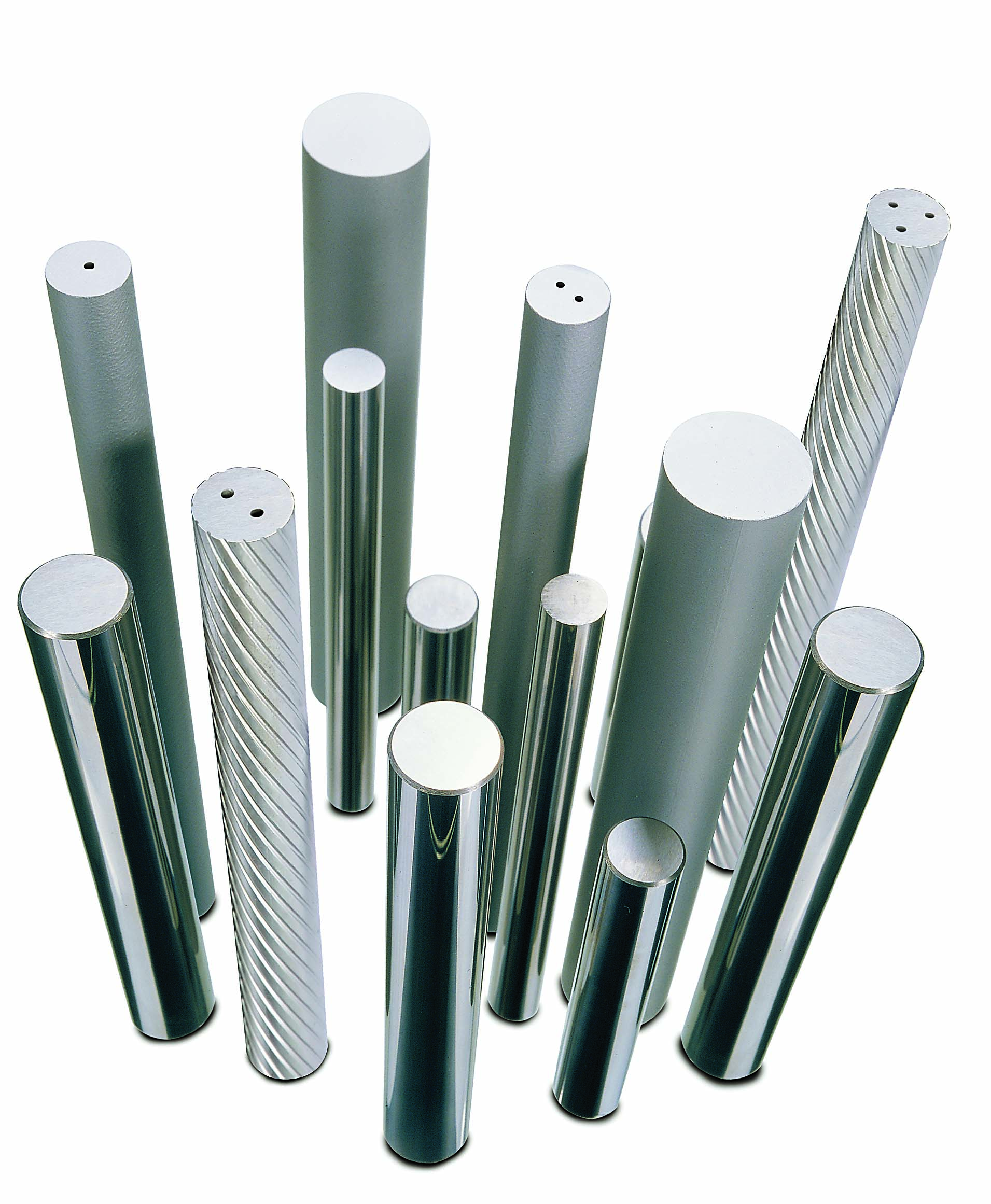
Displayed is an assortment of rotary cutting tool blanks. Image courtesy of TechMet Carbides
Carbide hardness is measured in the HRA scale. At TechMet, the hardness of grades ranges from 81.5 to 94 HRA. At the high end is a grade made with ultrafine grain. Although some grades have a variety of grain sizes, such as ones for producing mining bits, Deptola said grain size is typically uniform in cutting tools. “The goal is to have a nice, homogenous microstructure.”
Held Tight
Review the print ads from this magazine to continue
This quick advertiser review unlocks the rest of the article and keeps the full-screen reader focused on the ads instead of the page chrome.
Advertisers included in this article experience
Print placements connected to this article
Toolflo
The Threading & Grooving Specialist!
Solution for Chip Control in Grooving! FLOCUT MULTI-FUNCTIONAL GROOVING TOOLS Stable Locking System for your grooving application! Excellent stability allows for increased depth of cut! Superior breaker designs for better chip control! √ grooving √ face grooving √ deep grooving √ side turning √ cut off √ internal & external.
The Threading & Grooving Specialist! Solution for Chip Control in Grooving! FLOCUT MULTI-FUNCTIONAL GROOVING TOOLS Stable Locking System for your grooving application! Excellent stability allows for increased depth of cut! Superior breaker designs for better chip control! √ grooving √ face grooving
Visit Toolflo View this placement in the issue recordNachiamerica
RE-Think Your
Carbide Oil Hole Drills with Nachi’s Aqua REVO Drill Unique patented design for coolant directed at the cutting edge Conventional Aqua REVO Keep your drill cooler while drilling ~ Allowing you to extend tool life. REVO lutionizing Drilling Area with low cooling effect Area with high cooling effect.
RE-Think Your Carbide Oil Hole Drills with Nachi’s Aqua REVO Drill Unique patented design for coolant directed at the cutting edge Conventional Aqua REVO Keep your drill cooler while drilling ~ Allowing you to extend tool life. REVO lutionizing
Visit Nachiamerica View this placement in the issue recordPrint ads from this magazine
Solution for Chip Control in Grooving! FLOCUT MULTI-FUNCTIONAL GROOVING TOOLS Stable Locking System for your grooving application! Excellent stability allows for increased depth of cut! Superior breaker designs for better chip control! √ grooving √ face grooving √ deep grooving √ side turning √ cut off √ internal & external.
The Threading & Grooving Specialist! Solution for Chip Control in Grooving! FLOCUT MULTI-FUNCTIONAL GROOVING TOOLS Stable Locking System for your grooving application! Excellent stability allows for increased depth of cut! Superior breaker designs for better chip control! √ grooving √ face grooving
Continue reading
May 2020
A binder is also added to the mix to hold the grains together. For cutting tools, cobalt is essentially always used as the binding material, but nickel is one option for suitable applications, such as a wear part in an aggressive environment, Deptola said. “That might see a lot of chemical attack on the part itself, so it would have a nickel binder instead of cobalt.”
The amount of cobalt in TechMet’s grades ranges from 3% to 25%. According to Deptola, the low end of that range is found in tools for cutting wood and composite materials while grades for parts that experience a lot of impact, such as cold heading dies, have the highest amount.
“As you increase the cobalt, you increase the toughness,” he said. “In other words, it’s more resistant to breaking.”
When selecting a grade for cutting tools, Deptola said TechMet’s most popular grade is TMK-320, which has submicron grains, 10% cobalt and a hardness of 91.9 HRA. “That’s the industry workhorse, and that’s typically what people will try first unless they are doing something application-specific.”
For example, TMK-3012 is an effective grade when machining heat-resistant superalloys, he added. That ultrafine-grain grade has 12% cobalt and a hardness of 92.6 HRA. “We’ve had good success in titanium and in Inconel with that,” Deptola said.
Another of the company’s many grades is TMK-22D, which is specifically formulated for being coated with diamond, Deptola noted. The fine-grain grade has 6% cobalt and a hardness of 92.5 HRA.
He emphasized that TechMet continues to focus on customer service, developing high-quality grades and delivering value to customers. “Part of this value comes in the form of lab analysis both dimensionally and metallurgically. We offer this service free to our customers.”
For more information about TechMet, call 877-872-0044 or visit www.techmet-carbide.com.






