

Tools to bridge the skills gap
While the evolution of 3D CAD partly caused the skills gap, proper utilization of the software can be the key to bridging the gap.
There is no denying that a manufacturing skills gap has existed for years in the U.S. A skills gap is caused by not having people trained to perform a task when and where they are needed. London-headquartered consultancy Deloitte predicts that this gap will grow to an estimated 2.4 million unfilled manufacturing jobs by 2025. It is going to take technology that drives both efficiency and workforce development to ensure that the gap does not hurt U.S. manufacturing, which made up over 11% of gross domestic product in 2018.
In custom parts manufacturing, one cause of the gap is the moving target of skills required to support the ever-increasing complexity of produced components. The complexity is due to the rapid evolution of product design software, specifically 3D CAD. This software has given flexibility to designers to quickly create, collaborate and iterate on highly complicated components and assemblies.
This capability has increased the burden on manufacturers to efficiently make items with more intricacy and requirements for accuracy. Manufacturers simultaneously have been limited often to working with antiquated software, which has formed an imbalance.
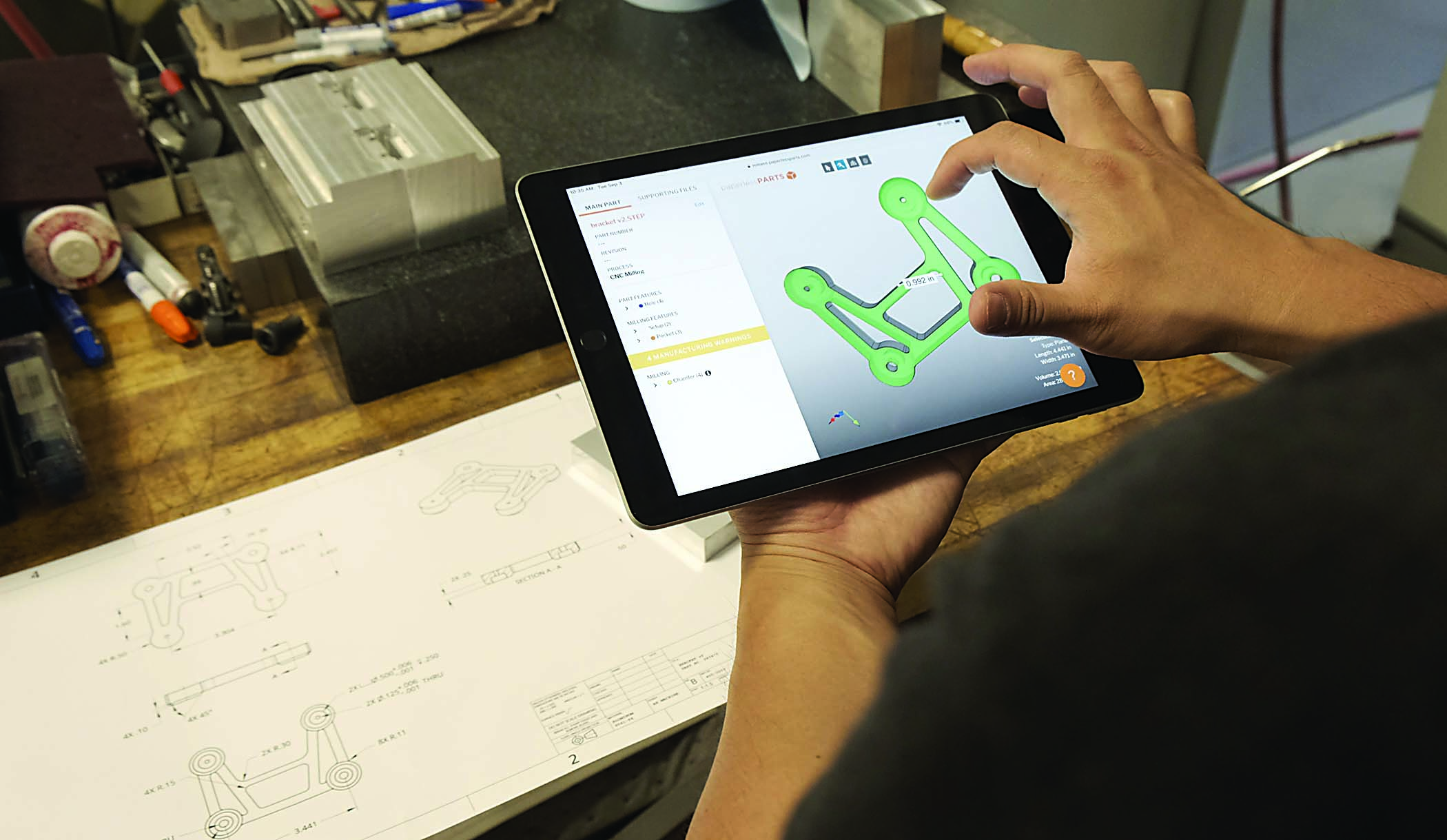
Whether in an office or on a shop floor, workers should be able to securely access 3D models and supporting files anytime for any job. Image courtesy of Paperless Parts
While the evolution of 3D CAD partly caused the skills gap, proper utilization of this software across the manufacturing value chain can be the key to bridging the gap. Models produced with 3D CAD represent one of the most powerful communication tools ever created in manufacturing. Leveraging these models allows an engineer to more effectively communicate design intent and more clearly convey an enormous amount of geometric metadata. The challenge facing manufacturers is that these files frequently are translated into 2D drawings with geometric dimensioning and tolerancing before being sent to job shops for quoting and production. The first step in bridging the gap is for all parties involved with part production to have access to the same level of communication tools.
Review the print ads from this magazine to continue
This quick advertiser review unlocks the rest of the article and keeps the full-screen reader focused on the ads instead of the page chrome.
Advertisers included in this article experience
Print placements connected to this article
Check it out at kyoceraprecisiontools.com/JCT
PRECISE CooLING
Where it Counts JET COOLANT-THROUGH SERIES Gain the upper hand in chip control and wear prevention with Kyocera’s newly developed JCT-Series jet coolant-through holders for turning, grooving, cut-off, threading, and small parts machining applications. TURNING SHALLOW GROOVING GROOVING / CUT-OFF THREADING Double-Clamp JCT KGBA-JCT KGD-JCT KTN-JCT.
PRECISE CooLING Where it Counts JET COOLANT-THROUGH SERIES Gain the upper hand in chip control and wear prevention with Kyocera’s newly developed JCT-Series jet coolant-through holders for turning, grooving, cut-off, threading, and small parts machining applications. Check it out at kyoceraprecisiontools.com/JCT NOW ON PROMO! kyoceraprecisiontools.com/promo-pack TURNING SHALLOW GROOVING GROOVING / CUT-OFF THREADING
Visit Check it out at kyoceraprecisiontools.com/JCT View this placement in the issue recordPrint ads from this magazine
Where it Counts JET COOLANT-THROUGH SERIES Gain the upper hand in chip control and wear prevention with Kyocera’s newly developed JCT-Series jet coolant-through holders for turning, grooving, cut-off, threading, and small parts machining applications. TURNING SHALLOW GROOVING GROOVING / CUT-OFF THREADING Double-Clamp JCT KGBA-JCT KGD-JCT KTN-JCT.
PRECISE CooLING Where it Counts JET COOLANT-THROUGH SERIES Gain the upper hand in chip control and wear prevention with Kyocera’s newly developed JCT-Series jet coolant-through holders for turning, grooving, cut-off, threading, and small parts machining applications. Check it out at kyoceraprecisiontools.com/JCT NOW ON PROMO! kyoceraprecisiontools.com/promo-pack TURNING SHALLOW GROOVING GROOVING / CUT-OFF THREADING
Continue reading
April 2020
3D CAD is protected by expensive licenses and proprietary formats that make the technology inaccessible to most employees at an average U.S. job shop. Many companies have developed viewers with limited functionality to aid accessibility, but the functionality often is geared toward designers, not manufacturers. This reduces the value of viewers in a manufacturing environment and regularly causes them to go unused. These tools also were not designed with collaboration in mind, which keeps them from being particularly useful at a job shop, where communication is crucial.
Paperless Parts Inc. was launched to help bridge the skills gap. Our platform enables manufacturers to share tribal knowledge, communicate with their teams and refer to historical conversations through a 3D CAD viewer specifically designed to meet the needs of job shops.
Our platform gives everyone at a company a powerful tool to view and communicate about 2D and 3D CAD files. This capability replaces the call for additional CAD licenses or stand-alone viewers that lack the functionality needed to be useful. All job-related files can be uploaded to one secure place, capturing the full technical data package of each job and ensuring that everyone at a shop has what they require.
The platform is cloud-based, complies with International Traffic in Arms Regulations and supports all proprietary file formats. Built to support the effective job shop communication needed to bridge the skills gap, the 3D CAD viewer has chat features that enable team members to internally collaborate on quotes and jobs, along with supplying secure communications with customers and vendors. Examples include:
- Communication between estimators and programmers to verify cycle time estimates.
- Feedback to customers on design-for-manufacturability issues.
- Discussion between experienced machinists about how best to approach production of a part.
- Identification of especially tight tolerances, undercuts and other challenging features.
Many industry experts talk about Industry 4.0 and what new technology means for the future gap. They say connecting machines to gather data for better decision-making is a way to use technology to improve productivity and reduce the need for skilled people. We believe that the first step toward implementing Industry 4.0 and bridging the gap is to connect a shop’s most valuable asset: its people.






