

Cut waste at the machine tool
Palletization and other lean methods reduce the time spent not making chips.
Lean manufacturing principles are based on the concept of eliminating waste. Lean experts have categorized waste in various ways, such as over-processing and inventory. Waste is generally anything that does not add value to a product.
Many shops do not practice lean manufacturing but still work to eliminate waste. It is easy for machinists, programmers and engineers to understand why reducing cycle times, increasing tool life and boosting spindle utilization are important to improve the bottom lines of organizations.
Cutting faster is often the default method for eliminating waste at a machine shop. Machinists and programmers are usually keen to try the latest high-performance cutting tools or programming techniques aimed at reducing cycle times. Evidence of this can be seen in the popularity of tools and approaches like trochoidal milling, variable-helix endmills and high-feed inserts.
Machine tool builders and cutting tool manufacturers will continue to bring technological innovations aimed at improving machining processes and eliminating waste. However, demand for improvement always will outpace advances in technology, so machine shops need to find other ways to eliminate waste.
Keep Chips Flying
One of the most effective ways to reduce costs and improve bottom lines is by eliminating noncutting time. It is amazing how much time is wasted at a machine tool with activities that do not add value to the part being produced.
While at a previous employer, our team worked to eliminate noncutting time by addressing everything that kept a machine from making chips. In the end, we improved productivity so much that we were able to reduce cutting speeds and feed rates to save additional costs by extending tool life. To accomplish this gain, we improved our inspection processes, enhanced tool life management involving redundant tools and added part probing to eliminate manual setup. The result was a first-year savings of $300,000.
Single-minute exchange of die is a Toyota Production System concept that many shops have adopted. The idea is to change fixtures and tools as fast as possible because the time spent changing does not add value to a part. For small shops, implementing this concept can require a cultural shift away from traditional methods like indicating parts or “dialing in fixtures” and toward developing more proactive fixture designs that utilize subplates and similar quick-change devices, thereby reducing setup times and returning machines to production sooner.
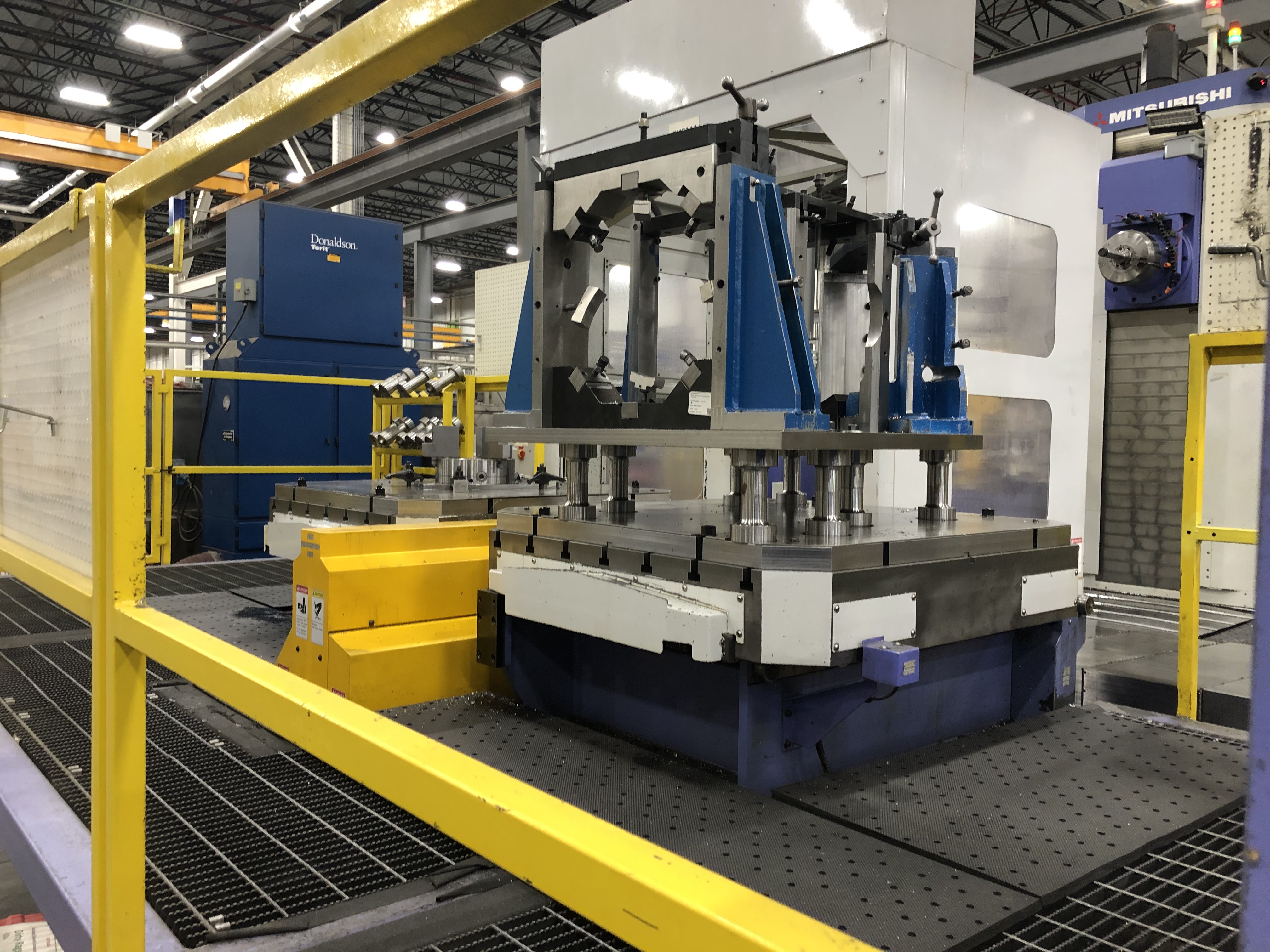
Mitsubishi Hitachi Power Systems Americas specified pallet changers for its horizontal boring mills and recovered the added expense during the first year that the machines were in operation. Image courtesy of C. Tate
Review the print ads from this magazine to continue
This quick advertiser review unlocks the rest of the article and keeps the full-screen reader focused on the ads instead of the page chrome.
Advertisers included in this article experience
Print placements connected to this article
Toolflo
The Threading & Grooving Specialist!
Solution for Chip Control in Grooving! FLOCUT MULTI-FUNCTIONAL GROOVING TOOLS Stable Locking System for your grooving application! Excellent stability allows for increased depth of cut! Superior breaker designs for better chip control! √ grooving √ face grooving √ deep grooving √ side turning √ cut off √ internal & external.
The Threading & Grooving Specialist! Solution for Chip Control in Grooving! FLOCUT MULTI-FUNCTIONAL GROOVING TOOLS Stable Locking System for your grooving application! Excellent stability allows for increased depth of cut! Superior breaker designs for better chip control! √ grooving √ face grooving
Visit Toolflo View this placement in the issue recordPrint ads from this magazine
Solution for Chip Control in Grooving! FLOCUT MULTI-FUNCTIONAL GROOVING TOOLS Stable Locking System for your grooving application! Excellent stability allows for increased depth of cut! Superior breaker designs for better chip control! √ grooving √ face grooving √ deep grooving √ side turning √ cut off √ internal & external.
The Threading & Grooving Specialist! Solution for Chip Control in Grooving! FLOCUT MULTI-FUNCTIONAL GROOVING TOOLS Stable Locking System for your grooving application! Excellent stability allows for increased depth of cut! Superior breaker designs for better chip control! √ grooving √ face grooving
Continue reading
March 2020
Adding pallets to a machine also can reduce noncutting time by allowing setup and changeover to occur while the machine operates. At Mitsubishi Hitachi Power Systems Americas Inc., we machine our combustion hardware after fabrication. These parts are difficult to hold; sometimes it can take over an hour to clamp and align a part. Machining cycles are lengthy, and completing one part can take longer than a shift. By purchasing machines with dual pallets, we are able to take advantage of long run times and complete setup activities on one pallet while the other pallet of workpieces is in the machine being cut. While we have not eliminated setup — yet — we have eliminated its cost.
Eliminating noncutting can be as easy as increasing part density or the number of parts in a machine. Improvements are achieved by lessening the time it takes to load and unload parts. Consider a part that has a five-minute cycle time. If it takes one minute to unload the part, load another workpiece and restart the machine, that is a six-minute part. If the number of parts increases to four and the load/unload time remains the same, that is now a five-minute, 15-second part. Although 45 seconds is not a big deal when there are only a few parts, savings are significant when there are hundreds or thousands of parts to produce.
Develop Repeatable Processes
It is common to see a machinist open the doors of a machine tool, measure a feature and then restart the machine so it can continue. Stopping a machine to inspect a feature is sometimes a necessary activity that can result in significant noncutting time. We most often stop and measure a part when we feel that we risk creating a defect.
Eliminating the risk of defects by developing repeatable, reliable processes allows machinists to reduce the number of inspections and thereby decrease noncutting time during the machining process. Duplicating robust processes for similar features creates standard methods, which build confidence and further reduce the need to stop and measure.
Large shops frequently install flexible manufacturing systems to reduce noncutting time. These cells integrate machine tools, pallet systems and advanced tool storage units into a cell that runs almost autonomously. Multiple pallets in the system can hold many different parts and be used by any of the machines in the cell, so setup times essentially are eliminated.
Advanced tool storage also allows machines to share tools and, most importantly, enables a machinist to maintain a supply of cutting tools without stopping a machine or cell. A flexible manufacturing system integrates all the concepts mentioned earlier.
For small manufacturers, some of these concepts may seem unnecessary or daunting. However, simply eliminating the top two or three noncutting activities can pay significant dividends, and finding these opportunities is easy. Developing a culture that is aggressive in reducing noncutting time — along with other forms of waste — is important to achieving success in a competitive market.
Glossary terms in this article
Related




Subscribers can use MFGAxis notes, saves and discussion tools with their innoNET account.


