

How to avoid embedded particles
Dear Doc: When grinding nickel alloys, I occasionally get tiny aluminum-oxide particles embedded in the workpiece. It's infrequent but unacceptable. What can I do?
Dear Doc: When grinding nickel alloys, I occasionally get tiny aluminum-oxide particles embedded in the workpiece. It’s infrequent but unacceptable. What can I do?
The Doc replies: You’re venturing into uncharted territory. This is a problem I hear about occasionally, but I’ve never seen a good solution or good study that explains it — just a lot of half-baked theories. Since it’s infrequent, determining whether process changes had an effect can take months. Having said that, here’s what I tell my customers.
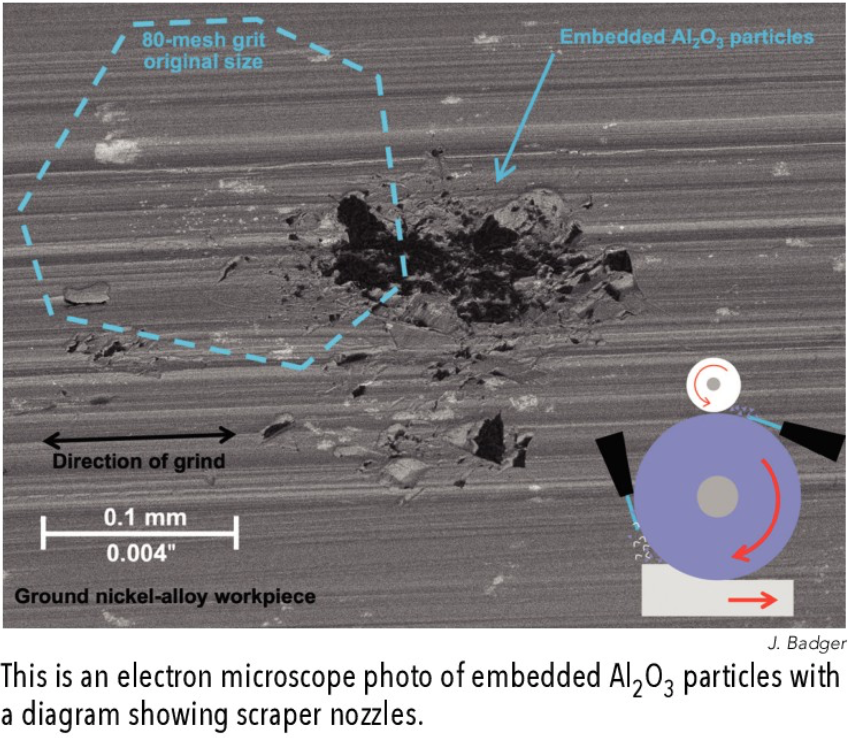
First, look at the possible causes. After diamond dressing, the tips of the Al2O3 grits are somewhat fragile and “crumbly.” Immediately upon first contact with the workpiece, the wheel loses 3 to 10 µm (0.0001″ to 0.0004″) off the radius as the tips of the grits break off. This loss matters because you don’t want to finish or spark out with a freshly dressed wheel. Otherwise, you run the risk of these crumbling grit tips embedding in the workpiece. You want to leave at least 10 mm2 (0.016 in.2), which is the depth of grind times the length of grind, of material for finish grinding.
This crumbly clean-up period is especially relevant if you’re performing continuous dress. Here, you don’t want to use CD during finishing or sparking out as the wheel will be crumbling off tiny pieces at the end of grind — a bad idea.
Second, examine the type of Al2O3. Theoretically, a tougher, or less friable, grit is less prone to break into small pieces and embed itself in the workpiece.
Review the print ads from this magazine to continue
This quick advertiser review unlocks the rest of the article and keeps the full-screen reader focused on the ads instead of the page chrome.
Advertisers included in this article experience
Print placements connected to this article
Check it out at kyoceraprecisiontools.com/JCT
PRECISE CooLING
Where it Counts JET COOLANT-THROUGH SERIES Gain the upper hand in chip control and wear prevention with Kyocera’s newly developed JCT-Series jet coolant-through holders for turning, grooving, cut-off, threading, and small parts machining applications. TURNING SHALLOW GROOVING GROOVING / CUT-OFF THREADING Double-Clamp JCT KGBA-JCT KGD-JCT KTN-JCT.
PRECISE CooLING Where it Counts JET COOLANT-THROUGH SERIES Gain the upper hand in chip control and wear prevention with Kyocera’s newly developed JCT-Series jet coolant-through holders for turning, grooving, cut-off, threading, and small parts machining applications. Check it out at kyoceraprecisiontools.com/JCT NOW ON PROMO! kyoceraprecisiontools.com/promo-pack TURNING SHALLOW GROOVING GROOVING / CUT-OFF THREADING
Visit Check it out at kyoceraprecisiontools.com/JCT View this placement in the issue recordPrint ads from this magazine
Where it Counts JET COOLANT-THROUGH SERIES Gain the upper hand in chip control and wear prevention with Kyocera’s newly developed JCT-Series jet coolant-through holders for turning, grooving, cut-off, threading, and small parts machining applications. TURNING SHALLOW GROOVING GROOVING / CUT-OFF THREADING Double-Clamp JCT KGBA-JCT KGD-JCT KTN-JCT.
PRECISE CooLING Where it Counts JET COOLANT-THROUGH SERIES Gain the upper hand in chip control and wear prevention with Kyocera’s newly developed JCT-Series jet coolant-through holders for turning, grooving, cut-off, threading, and small parts machining applications. Check it out at kyoceraprecisiontools.com/JCT NOW ON PROMO! kyoceraprecisiontools.com/promo-pack TURNING SHALLOW GROOVING GROOVING / CUT-OFF THREADING
Continue reading
March 2020
Third, consider putting a flushing nozzle at the exit point when grinding — and at the exit point of the dresser if you’re performing CD — to prevent swarf and busted-out grit particles from traveling with the wheel and returning to the grinding zone, as shown in the image. Unlike a cleaning nozzle, which needs to be over 50 bar (725 psi), the flushing nozzle doesn’t have to be superhigh pressure. Just match the wheel speed, with the direction of the nozzle “scraping” away the swarf as it comes off the wheel.
Fourth, some people — usually the guys who sell filtration systems — swear that poor coolant filtration is the source of the problem. I’m not convinced that’s the cause, but the theory holds water. If Al2O3 particles come out of a nozzle and enter the grinding zone, they can embed themselves into the workpiece.
Fifth, one could argue that simply having better cooling in the main arc of cut would help flush away particles. Aim coolant at the wheel/workpiece interface, and have the wheel velocity equal to the coolant velocity.
Sixth, a gentler grind, especially during finishing, will decrease the risk of fracturing the grit or busting it out of the bond and getting crushed in the arc of cut.
Finally, a harder-grade wheel could help by keeping entire grits from breaking out of the bond material and getting crushed in the arc of cut. On the other hand, a softer-grade wheel could help by allowing the entire grit to break out instead of fracturing into small pieces and becoming embedded. I lean toward a harder grade — and a tougher grit.
Imperfect as it is, that’s my expert opinion. Let me know what happens.
Related



Subscribers can use MFGAxis notes, saves and discussion tools with their innoNET account.


