

A look inside Wisconsin Engraving Co.
Need to have your newest bowling trophy engraved? If so, don't call Wisconsin Engraving Co./Unitex. Although Vice President Pete Kambouris said the New Berlin-based company receives plenty of requests for retail-type engraving, "That's not what we do." Instead, the job shop's craftsmen are dedicated to detailed engraving for molds and dies.
Need to have your newest bowling trophy engraved? If so, don’t call Wisconsin Engraving Co./Unitex. Although Vice President Pete Kambouris said the New Berlin-based company receives plenty of requests for retail-type engraving, “That’s not what we do.” Instead, the job shop’s craftsmen are dedicated to detailed engraving for molds and dies.
Founded in 1922 as Badger Engraving Co. by German immigrants, Wisconsin Engraving employs 28 workers at its 1,951-sq.-m (21,000-sq.-ft.) facility.
For engraving, the company developed the CAD-Grave process, which satisfies the requirements for the most complex shapes and contours and is suitable for mold surfaces that are not easily accessible by conventional methods, such as engraving close to a vertical wall.
Turn to the Burn
The company’s EDM department, which includes nine sinker EDMs, serves as an extension of the engraving department, Kambouris said, adding that he considers “engraving department” an overly broad term. “We’ve started calling it our micromachining department because of the level of detail we cut.”
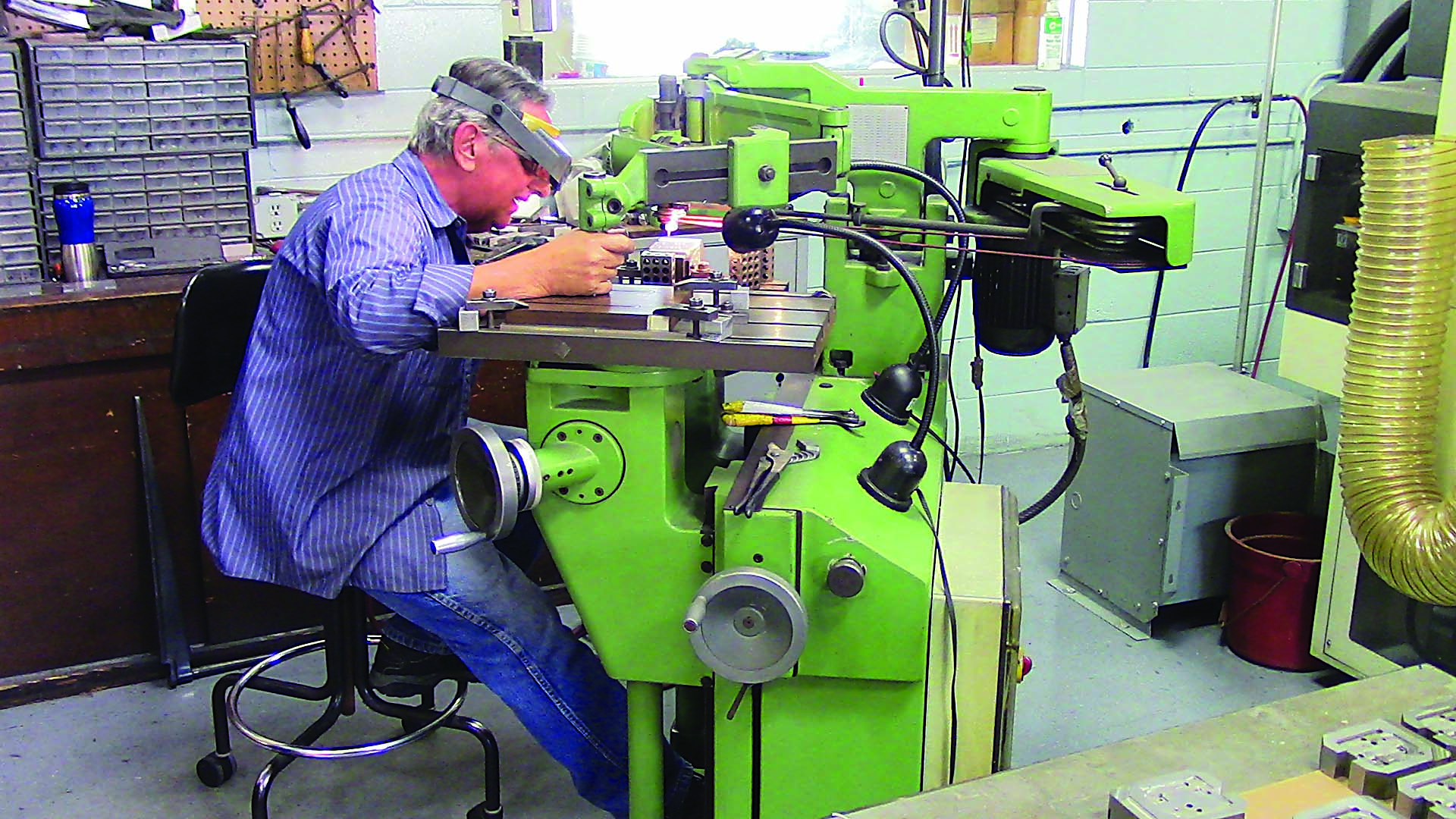
A pantograph being operated.
The sinker EDMs perform a variety of functions, such as burning cavity IDs, logos and ribs for customers that perform plastic injection molding, he added. Other tasks include threadmaking when a customer forgets to tap a hole in a block of hardened steel and assisting tool, mold and die shops by burning cores and cavities.
Because its projects have little need for wire EDMing, Kambouris said Wisconsin Engraving outsources that work to local shops when the occasion arises.
In addition, Wisconsin Engraving receives overflow work from moldmakers. “They don’t have time to push it through their shops,” Kambouris said. “Not being dedicated moldmakers, we don’t compete with our customers. This enables us to take in a project, and there is no worry from our customer that we’re going to go after their customer, because we are only doing a small portion.”
Offering a variety of services, such as engraving, texturing, polishing and sinker EDMing, enables Wisconsin Engraving to be a one-stop shop for customers — a good selling point, according to Kambouris. “Timelines have become condensed. Before, toolmakers would quote a project for 16 weeks, and there was time. I’ll quote a project to my customers now and say, ‘Two weeks,’ and they’ll call back and say, ‘Three days.’ I’ll say, ‘How about four days?’ It’s very tight.”
When acquiring a sinker EDM, Kambouris said Wisconsin Engraving always looks for good-quality used equipment to save money while still satisfying the shop’s requirements. The average age of an EDM in the shop is 10 years.
“We have to look at the value of the equipment versus the product that we are putting in there,” he said. “If I had my way, everything would be brand new, but that’s not the case. We find that even an EDM that’s 10, 12, 13 years old does the same thing for us that a new one would do.”
Electrode Production
On the other hand, the company always buys new CNC metalcutting machine tools, Kambouris noted, with its latest purchases being Haas machines, including a five-axis one with 3+2 machining capability. Previously, Wisconsin Engraving favored Sharnoa machines. The shop still has three, but “two are having some surgery done on them. The problem is that after they closed shop in the U.S., there were no parts or service. If we are down a few weeks, in a few weeks I can cut a lot of electrodes.”
The five-axis machine helps reduce the number of electrodes needed when a mold detail requires a lot of undercuts, for example, he said. “If we can do the majority of the work on the five-axis, it will become more efficient for our workflow internally and help us with deliveries and pricing.”
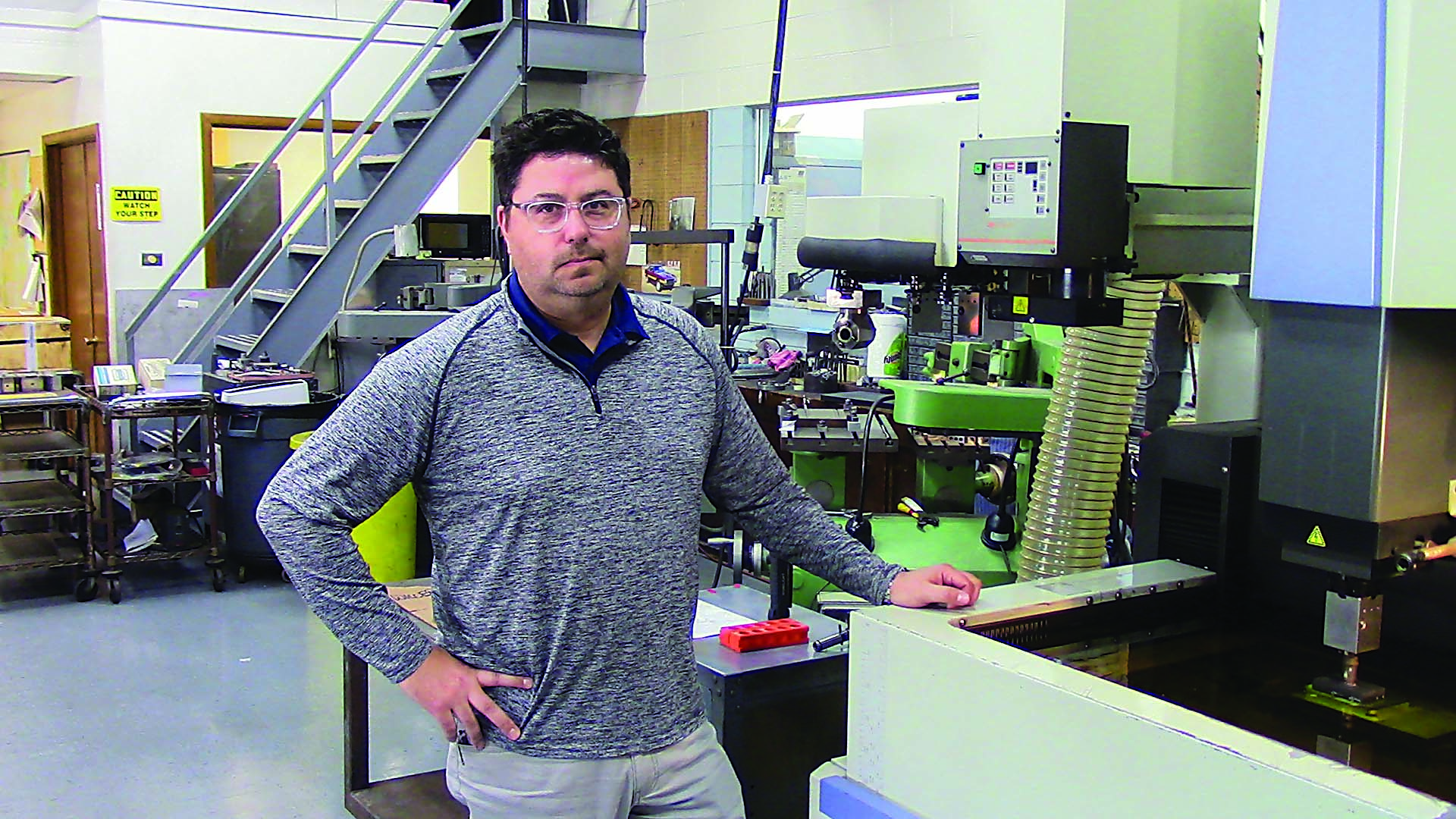
Pete Kambouris, vice president of Wisconsin Engraving, started working at the company as a summer job while in high school.
The process for machining an electrode starts with a customer providing artwork or a CAD file, Kambouris explained. Wisconsin Engraving reviews the CAD file and “cleans it up” if needed. From there, the shop determines the depth of features and sends the file to a machine. The electrode is mounted on a fixture using the System 3R Macro holder system, which Kambouris said enhances stability, and then the tool steel or aluminum workpiece is burned. The company avoids EDM-ing carbide, he noted, because its hardness causes electrodes to wear quickly, requiring numerous electrodes to complete the job.
In addition, carbide jobs are challenging to quote or at least challenging for a customer to stomach the quote. “If I have it sitting in the EDM tank for 10 hours, and I have to use 100 electrodes to burn that detail, it’s expensive,” Kambouris said. “Sometimes they don’t pick that up, but most of our customers are highly educated about this stuff and understand.”
The vast majority of the electrodes are made of graphite. Wisconsin Engraving occasionally machines and burns using copper electrodes but tries to avoid it, Kambouris said. The graphite grade is an important consideration, with higher-quality grades being denser, easier to machine and able to produce finer workpiece details without chipping than lower-quality ones.
“Where it is applicable, we will always go with the highest grade we can,” he said. “We go mid to high on almost everything.”
Sometimes a customer supplies the graphite material and Wisconsin Engraving recommends a grade based on a project’s requirements, Kambouris said. However, that doesn’t guarantee that a customer will follow the recommendation and avoid sending a lower-quality grade to try to save money.
“But now I’m struggling to cut it,” Kambouris will tell the customer when that’s the case. “My price is going to change, so you are going to lose money. We try to educate the customer.”
Review the print ads from this magazine to continue
This quick advertiser review unlocks the rest of the article and keeps the full-screen reader focused on the ads instead of the page chrome.
Advertisers included in this article experience
Print placements connected to this article
Nachiamerica
RE-Think Your
Carbide Oil Hole Drills with Nachi’s Aqua REVO Drill Unique patented design for coolant directed at the cutting edge Conventional Aqua REVO Keep your drill cooler while drilling ~ Allowing you to extend tool life. REVO lutionizing Drilling Area with low cooling effect Area with high cooling effect.
RE-Think Your Carbide Oil Hole Drills with Nachi’s Aqua REVO Drill Unique patented design for coolant directed at the cutting edge Conventional Aqua REVO Keep your drill cooler while drilling ~ Allowing you to extend tool life. REVO lutionizing
Visit Nachiamerica View this placement in the issue recordPrint ads from this magazine
Carbide Oil Hole Drills with Nachi’s Aqua REVO Drill Unique patented design for coolant directed at the cutting edge Conventional Aqua REVO Keep your drill cooler while drilling ~ Allowing you to extend tool life. REVO lutionizing Drilling Area with low cooling effect Area with high cooling effect.
RE-Think Your Carbide Oil Hole Drills with Nachi’s Aqua REVO Drill Unique patented design for coolant directed at the cutting edge Conventional Aqua REVO Keep your drill cooler while drilling ~ Allowing you to extend tool life. REVO lutionizing
Continue reading
February 2020
In addition to producing electrodes, including ones for other shops, Wisconsin Engraving uses its CNC machines for contract manufacturing on a limited basis, with volumes ranging from one-offs to double digits. “There is a lot of competition in that,” he said. “We got into it just to help fill some of the lulls.”
An Alternative Approach
Kambouris said hard milling continues to be an alternative to sinker EDMing, and Wisconsin Engraving has milled hardened workpieces as well. If the surface that’s being hard-milled does not require a texture, hard milling is suitable and the shop can polish the surface to the specified finish. But because hard milling workhardens a workpiece, workhardening can cause problems when texturing, such as when acid etching the surface, he added.
However, sinker EDMing creates a thin white layer, about 0.127 mm (0.005″), on the surface that was vaporized, Kambouris said. Because acid can’t penetrate the white layer during etching, it must be removed via bench work.
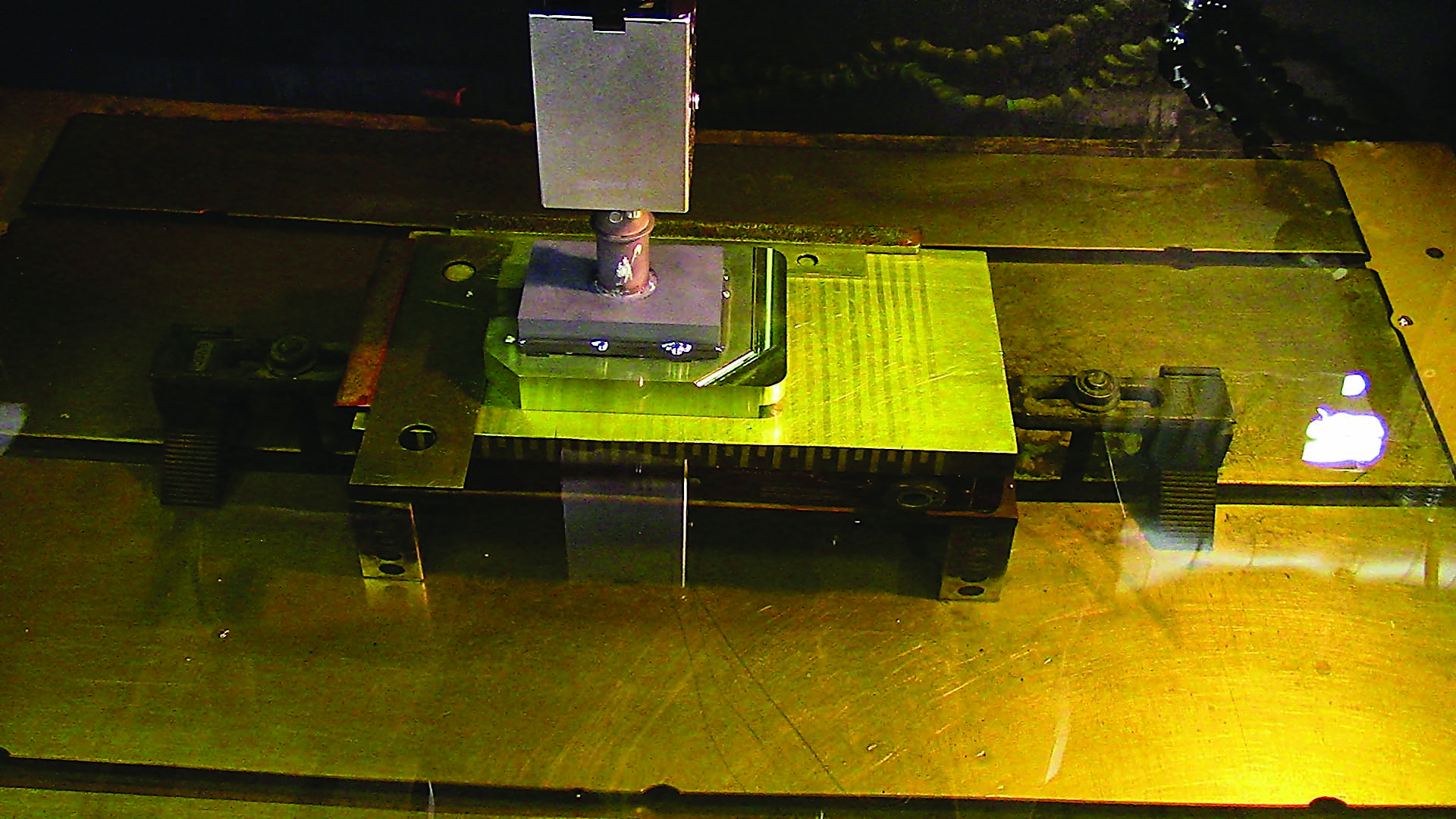
A part is EDMed at Wisconsin Engraving.
Due to electrode wear during EDMing, roughing and finishing electrodes are needed. Kambouris explained that the shop might begin roughing with a slightly oversized electrode to perform most of the burning and then switch to a more detailed electrode to sharpen the corners and “iron everything out.”
The required number of roughers and finishers depends on the application. If a customer requests a large number of roughers and finishers, say 20 of each, Kambouris said he will ask to see the CAD data and inquire about the workpiece material. With that information, he’ll discuss it with others at the shop. If they suggest that fewer roughers and finishers will do, Kambouris will tell the customer that if Wisconsin Engraving does the job in-house, the desired results may be achieved with as few as two of each.
“We can take the money and run, but we hope for repeat business,” he said. “You build a relationship, and they trust you.”
On the Move
The company’s current location is its third. It has expanded the building three times, and no more land is available for additional expansion, Kambouris said. However, to add equipment and better serve customers, he feels that Wisconsin Engraving needs nearly twice the square footage it has. As a result, for about a year the company has been looking to move to another facility, either an existing building or a site to build one. That would enable the shop to add machine tools and possibly an automated work cell while replacing a couple of EDMs.
In the event of a move, Wisconsin Engraving probably wouldn’t dispose of too much equipment regardless of its vintage, according to Kambouris. “We have been one not to throw out any of the old technology. We are all over the board in technology because by having all that available to us, we can do almost any project our customer brings us.”
He added that if the shop hits a roadblock when using technology, it can circle back and achieve the desired task with old technology. “And that gives us a competitive edge.”
That old technology includes pantographs that are used every day and older than he is, Kambouris said. A pantograph is for copying a drawing or plan on a different scale by a system of hinged, jointed rods.
The array of machines, tools and other equipment enables Wisconsin Engraving to continue creating specialized, highly detailed work that often skews toward the artistic side of industrial production, according to Kambouris. “We are a tool and die shop, and I like to joke and say, ‘With an art degree.'”
For more information about Wisconsin Engraving, call 262-786-4521 or visit www.wi-engraving.com.
Quality Wire EDM launches tooling-on-demand program
To enable its customers, many of which are spring manufacturers and stamping houses, to keep production tooling up and running, Quality Wire EDM Inc. developed QW Elite, a tooling-on-demand program. According to Jeffrey Andrade, plant manager and technical sales – quality for the Bristol, Connecticut, job shop and contract manufacturer, the program is unique to the manufacturing industry.
In addition to wire EDMing, the company provides other machining services, such as sinker EDMing, CNC milling, grinding, waterjetting, stamping and laser marking and engraving.
A manufacturer begins by enrolling in the program and selecting a set of details that will be put under contract with Quality Wire EDM. The company recommends starting with the most important and mission-critical wear items. Next, Quality Wire EDM procures the materials specified and begins production. A customer’s one-off web store will be located at Quality Wire EDM’s website. The store includes part photos and all corresponding information about every detail under contract, as well as a “buy now” button.
QW Elite orders receive next-day shipping at no additional charge. To assist in supply chain continuity and maintain traceability, customers can have individual login accounts for every buyer, along with the ability to attach purchase order numbers and notes. Orders also ship with mill, heat-treat and conformance certificates at no extra expense.
The program enables participants to leverage their supply chains by no longer forcing their experienced employees to work on tooling maintenance and repair and reduces unscheduled overtime when a machine unexpectedly goes offline, according to the company.
Program participants pay an annual subscription fee based on the quantity of parts stored at Quality Wire EDM, Andrade said.
For more information, call 860-583-9867 or visit www.qwmfg.com/elite.
Glossary terms in this article
Related



Subscribers can use MFGAxis notes, saves and discussion tools with their innoNET account.


